 书单
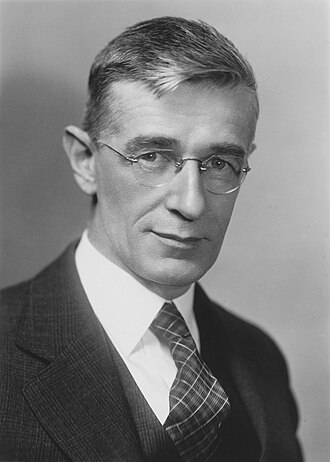
万尼瓦尔·布什
- 生卒
- 1890 – 1974
- 国籍
- 美国
- 外文名
- Vannevar Bush
照片:Harris & Ewing,公有领域,来自维基共享资源「Vannevar Bush, 1938, Harris & Ewing (cropped).jpg」(经缩小)。
生平与创作
万尼瓦尔·布什(英语:Vannevar Bush,1890年3月11日—1974年6月28日),美国工程师,发明家和科学行政人员,在第二次世界大战期间担任美国科学研究与开发办公室主任,几乎所有的战时军事研发都是通过该办公室进行的,包括雷达的重要发展以及曼哈顿计划的启动和早期管理。他强调了科学研究对国家安全和经济福祉的重要性,并敦促建立国家科学基金会。
布什于1919年加入麻省理工学院电气工程系,并于1922年创立了后来的雷神公司。布什于1932年成为麻省理工学院副校长和麻省理工学院工程学院院长,并于1938年成为华盛顿卡内基研究所所长。
在他的职业生涯中,布什为自己的一系列发明申请了专利。他尤其以模拟计算机和Memex而闻名。
布什于1938年被任命为国家航空咨询委员会(NACA)成员,并很快成为其主席。作为美国国防部科研委员会主席,以及后来的美国科学研究与开发办公室主任,布什协调了大约六千名美国主要科学家在科学应用于战争中的活动。布什在第二次世界大战期间是一位著名的政策制定者和公共知识分子。作为美国国防部科研委员会及美国科学研究与开发办公室负责人,他发起了曼哈顿计划,并确保该计划得到政府最高层的最高重视。
生平
他于二战期间为曼哈顿计划发挥了巨大的作用。后来布什写了《科学,无尽的边疆》(Science, the Endless Frontier)一文给小罗斯福总统,建议美国政府大力支持科学研究,而且政府不需自己设立研究机构,只需提供研究经费,让大学和私人企业依照研究表现来竞争政府的研究经费。此后美国政府提供的科学研究经费大幅增加,研究成果也很杰出成为全球科技第一的国家。在《诚如所思》中,他提出Memex这一概念,可以被看成为是现代万维网的先锋。
以上文字摘自维基百科「万尼瓦尔·布什」(去掉了参考文献等尾部小节),按 CC BY-SA 4.0 使用,作者为维基百科的各位编者。
中文维基百科的条目比较短,下面附上英文维基百科的内容(英文原文):
Vannevar Bush ( van-NEE-var; March 11, 1890 – June 28, 1974) was an American engineer, inventor and science administrator, who during World War II headed the U.S. Office of Scientific Research and Development (OSRD), through which almost all wartime military R&D was carried out, including important developments in radar and the initiation and early administration of the Manhattan Project. He emphasized the importance of scientific research to national security and economic well-being, and was chiefly responsible for the movement that led to the creation of the National Science Foundation.
Bush joined the Department of Electrical Engineering at the Massachusetts Institute of Technology (MIT) in 1919, and founded the company that became Raytheon in 1922. Bush became vice president of MIT and dean of the MIT School of Engineering in 1932, and president of the Carnegie Institution of Washington in 1938.
During his career, Bush patented a string of his own inventions. He is known particularly for his engineering work on analog computers, and for the memex. Starting in 1927, Bush constructed a differential analyzer, a mechanical analog computer with some digital components that could solve differential equations with as many as 18 independent variables. An offshoot of the work at MIT by Bush and others was the beginning of digital circuit design theory. The memex, which he began developing in the 1930s (heavily influenced by Emanuel Goldberg's "Statistical Machine" from 1928) was a hypothetical adjustable microfilm viewer with a structure analogous to that of hypertext. The memex and Bush's 1945 essay "As We May Think" influenced generations of computer scientists, who drew inspiration from his vision of the future.
Bush was appointed to the National Advisory Committee for Aeronautics (NACA) in 1938, and soon became its chairman. As chairman of the National Defense Research Committee (NDRC), and later director of OSRD, Bush coordinated the activities of some six thousand leading American scientists in the application of science to warfare. Bush was a well-known policymaker and public intellectual during World War II, when he was in effect the first presidential science advisor. As head of NDRC and OSRD, he initiated the Manhattan Project, and ensured that it received top priority from the highest levels of government. In Science, The Endless Frontier, his 1945 report to the president of the United States, Bush called for an expansion of government support for science, and he pressed for the creation of the National Science Foundation.
Early life and education
Vannevar Bush was born in Everett, Massachusetts, on March 11, 1890. He was the third child and only son of Richard Perry Bush, the local Universalist pastor, and his wife Emma Linwood (née Paine), the daughter of a prominent Provincetown family. He had two older sisters, Edith and Reba. He was named after John Vannevar, an old friend of the family who had attended Tufts College with Perry. The family moved to Chelsea, Massachusetts, in 1892, and Bush graduated from Chelsea High School in 1909.
Bush graduated from Tufts College, like his father before him. A popular student, he was vice president of his sophomore class, and president of his junior class. During his senior year, he managed the football team. He became a member of the Alpha Tau Omega fraternity, and dated Phoebe Clara Davis, who also came from Chelsea. Tufts allowed students to gain a master's degree in four years simultaneously with a bachelor's degree. For his master's thesis, Bush invented and patented a "profile tracer". This was a mapping device for assisting surveyors that looked like a lawn mower. It had two bicycle wheels, and a pen that plotted the terrain over which it traveled. It was the first of a string of inventions. On graduation in 1913 he received both Bachelor of Science and Master of Science degrees.
以上文字摘自英文维基百科「Vannevar Bush」(有删节,去掉了参考文献等尾部小节),按 CC BY-SA 4.0 使用,作者为维基百科的各位编者。
资料卡
- 母语名
- Vannevar Bush
- 出生
- 1890 年 3 月 11 日
- 出生地
- 埃弗里特
- 逝世
- 1974 年 6 月 28 日
- 逝世地
- 贝尔蒙特镇
- 职业
- 计算机科学家、发明家、政治人物、大学教师、工程师、电气工程师
- 使用语言
- 英语
- 就读学校
- 麻省理工学院、塔夫茨大学、哈佛大学、Chelsea High School、Tufts University School of Engineering
- 领域
- 未来学
- 所属团体
- 美国文理科学院、美国哲学会(1937)、美国科学进步协会、美国物理学会、美国国家科学院(1934);另有 2 项只有外文名
- 代表作
- 记忆延伸
- 获奖
- 美国国家科学奖章(1963)、大英帝国爵级司令勋章、IEEE爱迪生奖章(1943)、法国荣誉军团勋章、约翰·弗里茨奖章(1951)、威廉·普罗克特科技成果奖(1954)、约西亚·威拉德·吉布斯讲座(1935)、美国发明家名人堂(2004)、约翰·J·卡蒂科学进步奖(1953)、胡佛奖章(1946)、约翰·斯科特奖(1943)、华盛顿奖(1946)、美国物理学会会士(1923)、公益奖章(1945) 等 16 项,另有 3 项只有外文名
资料卡来自 Wikidata Q299595(CC0),众包数据,个别字段可能不全。
作品年表(1 本)
本站书库里署名万尼瓦尔·布什的书(Open Library 上至少 10 人加过书架的才收),按首版年份排(有本站书页的用 Wikidata 记的首版年,其余用 Open Library 的);年份偶尔记成后来的版本或译本,以原书为准。全部作品见 Open Library。
- 1970Pieces of the action书架 21