 书单
约翰·菲利普斯·马昆德
- 生卒
- 1893 – 1960
- 国籍
- 美国
- 外文名
- John P. Marquand
生平与创作
这个词条暂时没有中文维基百科条目,下面是英文维基百科的内容(英文原文):
John Phillips Marquand (November 10, 1893 – July 16, 1960) was an American writer. Originally best known for his Mr. Moto spy stories (starting with Your Turn, Mr. Moto in 1935), he achieved popular success and critical respect for his satirical novels, winning a Pulitzer Prize for The Late George Apley in 1938. One of his abiding themes was the confining nature of life in America's upper class and among those who aspired to join it. Marquand treated those whose lives were bound by these unwritten codes with a characteristic mix of respect and satire.
Early life and education
Marquand was born on November 10, 1893, in Wilmington, Delaware, the son of Philip Marquand and his wife Margaret née Fuller. His mother was a great-niece of 19th-century transcendentalist and feminist Margaret Fuller. Marquand was also a cousin of Buckminster Fuller. He grew up in Newburyport, Massachusetts, where his forebears had lived, raised by his three maiden aunts, while his parents lived in a number of other cities as his father pursued his career.
Marquand attended Newburyport High School, where he won a scholarship that enabled him to attend Harvard College, where his family had a long tradition of attendance. As an impecunious public school graduate in the heyday of Harvard's Gold Coast, however, he was seen as an unclubbable outsider.
After being turned down by the Harvard Crimson, Harvard's student newspaper, Marquand succeeded in being elected to the editorial board of the humor magazine, the Harvard Lampoon.
Career
Boston Evening Transcript
After graduating from Harvard in 1915, Marquand was hired by The Boston Evening Transcript, working initially as a reporter and later on the Transcript's bi-weekly magazine section.
World War I
While he was a student at Harvard, Marquand joined Battery A of the Massachusetts National Guard, which, in 1916, was activated. In July 1916, Marquand was sent to the Mexican border. Later, like many of his classmates, he served in World War I, where he was engaged in combat in France.
Writing career
Marquand's life and work reflected his ambivalence about American society and especially the power of its old-line elites. Being rebuffed by fashionable Harvard did not discourage his social aspirations. In 1922, he married Christina Sedgwick, niece of Atlantic Monthly editor Ellery Sedgwick. In 1925, Marquand published his first book, Lord Timothy Dexter, an exploration of the life and legend of 18th-century Newburyport eccentric Timothy Dexter (1763–1806).
By the mid-1930s, he was a prolific and successful writer of fiction for slick magazines like the Saturday Evening Post. Some of these short stories were of an historical nature as had been Marquand's first two novels, The Unspeakable Gentleman and The Black Cargo, which were later characterized by Marquand as "costume fiction", to which he stated that an author "can only approximate provided he has been steeped in the tradition". By the mid-1930s, Marquand abandoned "costume fiction".
In the late 1930s, Marquand began producing a series of novels on the dilemmas of class, most of which centered on New England, and some of which were partially set in Clyde, Massachusetts, a fictional seaside community based strongly on Marquand's home town of Newburyport.
The first of these novels, The Late George Apley (1937), a satire of Boston's upper class, won the Pulitzer Prize for the Novel in 1938. Other Marquand novels exploring New England and class themes include Wickford Point (1939), H.M. Pulham, Esquire (1941), and Point of No Return (1949). The last is especially notable for its satirical portrayal of Harvard anthropologist W. Lloyd Warner, whose Yankee City study attempted (and in Marquand's view, dismally failed) to describe and analyze the manners and mores of Newburyport.
Marquand was a part-time war correspondent during World War II. The war's huge impact on American citizens and families is an element in his later novels. Several characters in these novels are motivated by a sense of duty to aid the war effort, though they are past draft age and unsure of the value of their contribution.
For all of his ambivalence about America's elite, Marquand ultimately succeeded in joining it and in embodying its characteristics. He forgave the upper crust classmates who snubbed him as a Harvard student, relationships he satirized in H.M. Pulham, Esq and The Late George Apley. He was invited to join all the prestigious social clubs in Boston, including Tavern and Somerset, and those in New York City, including the Century Association.
Through his second marriage to Adelaide Ferry Hooker, he became linked to the Rockefeller family. Her sister, Blanchette, was married to John D. Rockefeller III. He maintained luxury homes in Newburyport and in the Caribbean.
Personal life
Marquand was married twice and had five children. He married Christina Sedgwick in 1922, and they had two children: son John Jr and daughter Christina Jr. Marquand and Sedgwick divorced in 1935. The following year, Marquand married Adelaide Ferry Hooker, a descendant of Connecticut Colony founder Thomas Hooker. They had three children together, two sons and a daughter, before divorcing in 1958.
Death
On July 16, 1960, Marquand died in Newburyport, Massachusetts, of a heart attack in his sleep at the age of 66. He is buried in Sawyer Hill Burying Ground in Newburyport.
Novels
Mr Moto novels
No Hero. Boston, Little Brown, 1935; as Mr. Moto Takes a Hand, London, Hale, 1940; as Your Turn, Mr. Moto, New York, Berkley, 1963
Thank You, Mr. Moto. Boston, Little Brown, 1936; London, Jenkins, 1937
Think Fast, Mr. Moto. Boston, Little Brown, 1937; London, Hale, 1938
Mr. Moto Is So Sorry. Boston, Little Brown, 1938; London, Hale, 1939
Last Laugh, Mr. Moto. Boston, Little Brown, 1942; London, Hale, 1943
Stopover Tokyo. Boston, Little Brown, and London, Collins, 1957; as The Last of Mr. Moto, New York, Berkley, 1963; as Right You Are, Mr. Moto, New York, Popular Library, 1977
Other crime novels
Ming Yellow. Boston, Little Brown, and London, Lovat Dickson, 1935
Don't Ask Questions. London, Hale, 1941
It's Loaded, Mr. Bauer. London, Hale, 1949
以上文字摘自英文维基百科「John P. Marquand」(有删节,去掉了参考文献等尾部小节),按 CC BY-SA 4.0 使用,作者为维基百科的各位编者。
资料卡
- 笔名
- J.P. Marquand
- 出生
- 1893 年 11 月 10 日
- 出生地
- 威尔明顿
- 逝世
- 1960 年 7 月 16 日
- 逝世地
- 纽伯里波特
- 职业
- 新闻工作者、小说家、作家、编剧
- 使用语言
- 英语
- 写作语言
- 英语
- 就读学校
- 哈佛大学、哈佛学院、Newburyport High School
- 所属团体
- 美国艺术暨文学学会
- 配偶
- Adelaide Ferry Hooker
资料卡来自 Wikidata Q1190579(CC0),众包数据,个别字段可能不全。
本站收录的作品(1)
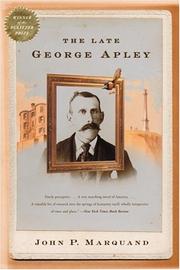
作品年表(1 本)
本站书库里署名约翰·菲利普斯·马昆德的书(Open Library 上至少 10 人加过书架的才收),按首版年份排(有本站书页的用 Wikidata 记的首版年,其余用 Open Library 的);年份偶尔记成后来的版本或译本,以原书为准。全部作品见 Open Library。
- 1937The late George Apley书架 18