 书单
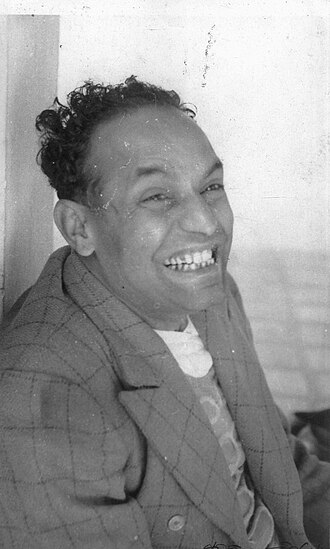
罗齐尔·普拉萨得·德库塔,
- 生卒
- 1909 – 1959
- 国籍
- 尼泊尔
- 外文名
- Laxmi Prasad Devkota
照片:Madan Puraskar Pustakalaya,公有领域,来自维基共享资源「Laxmi Prasad Devkota 3.jpg」(经缩小)。
生平与创作
这个词条暂时没有中文维基百科条目,下面是英文维基百科的内容(英文原文):
Laxmi Prasad Devkota (12 November 1909 – 14 September 1959), was a Nepalese poet, novelist, playwright, scholar, lawyer, lecturer, and politician. Honored with the title of Mahakavi in Nepalese literature. He is regarded as one of the greatest literary figures in Nepal, and often described as a poet with a golden heart. Devkota is best known for works such as Muna Madan, Sulochana, Kunjini, Bhikhari, and Shakuntala.
Early life and education
Laxmi Prasad Devkota was born on the night of Lakshmi Puja on 12 November 1909 (27 Kartik 1966 BS) to Til Madhav Devkota and Amar Rajya Lakshmi Devi in Dhobidhara, Kathmandu. His father was a Sanskrit scholar, who taught him in his childhood. He started his formal education at Durbar High college, where he studied both Sanskrit grammar and English. After finishing his matriculation exams from Patna at the age of 17, he pursued a Bachelor of Arts along with a Bachelor of Laws at Tri-Chandra College and graduated from Patna University as a private examinee. His desire to complete his master's degree was left incomplete due to his family's financial conditions.
A decade after his graduation as a lawyer, he started working in the Nepal Bhasaanuwad Parishad (Publication Censor Board), where he met famous playwright Balkrishna Sama. At the same time, he also worked as a lecturer at Tri-Chandra College and Padma Kanya College.
Literary career
Devkota contributed to Nepali literature by starting a modern Nepali language romantic movement in the country. He was the second writer born in Nepal to begin writing epic poems in Nepali literature. Nepali poetry soared to new heights with Devkota's innovative use of the language.
Departing from the Sanskrit tradition that dominated the Nepali literary scene at the time, and being inspired by the Newar language ballad song Ji Waya La Lachhi Maduni, he wrote Muna Madan (Nepali: मुनामदन) (1930), a long narrative poem in a popular Jhyaure bhaka (Nepali: झ्याउरे भाका) folk tune. Muna Madan is undoubtedly the best-selling book in the history of Nepali literature. The 2003 film Muna Madan, which was Nepal's official entry for the Best Foreign Language Film at the 76th Academy Awards, was based on this poem. The work received immediate recognition from the Ranas—the country's ministers at the time. Muna Madan tells the story of Madan, a traveling merchant, who departs for Tibet in a bid to earn some money leaving behind his wife, Muna. The poem describes the thematic hardships of the journey: the grief of separation, the itching of longing, and the torment of death.
The ballad Ji Waya La Lachhi Maduni is a tragic song based on a Newa merchant, his mother, and his wife. The merchant is about to leave Kathmandu for Tibet on a work. The song starts with the wife pleading with her mother-in-law to stop him, saying that it's not even been a month since she came to their home and he wants to go away. Being raised in Kathmandu, Devkota had heard this song from locals singing it at a local Pati (Nepali: पाटी or फ़ल्चा). He was highly fascinated by the song and decided to re-write it in Nepali. Since the Rana rulers had put a ban on the Newa trade, language and literature, he changed the main character from a Newa merchant as in the original song to a Kshatriya (warrior class) character. Although Kshatriya people did not practice trade for their living during those days, he had to depict it as such in order to lure the Rana rulers.
The following couplet, which is among the most famous and frequently quoted lines from the epic, celebrates the triumph of humanity and compassion over the hierarchies created by caste in Nepalese culture.
Considered his magnum opus, Muna Madan has remained widely popular among the lay readers of Nepali literature; it remains the most popular Nepali book since 1936; the book was also translated into Mandarin; it was well received by China and considered successful.
Devkota, inspired by his five-month stay in a mental asylum in 1939, wrote a free-verse poem, Pagal (Nepali: पागल, lit. 'The Lunatic'). The poem deals with his usual mental ability and is considered one of the best Nepali language poems.
Devkota had the ability to compose long epics and poems with literary complexity and philosophical density in very short periods of time. He wrote Shakuntala, his first epic poem, and also the first Mahakavya (Nepali: महाकाव्य) written in the Nepali language, in a mere three months. Published in 1945, Shakuntala is a voluminous work in 24 cantos based on Kālidāsa's famous Sanskrit play Abhijñānaśākuntalam. Shakuntala demonstrates Devkota's mastery of Sanskrit meter and diction, which he incorporated heavily while working primarily in Nepali. According to the late scholar and translator of Devkota, David Rubin, Shakuntala is among his greatest accomplishments. "It is, without doubt, a remarkable work, a masterpiece of a particular kind, harmonizing various elements of a classical tradition with a modern point of view, a pastoral with a cosmic allegory, Kālidāsa's romantic comedy of earthly love with a symbolic structure that points to redemption through the coinciding of sensual and sacred love."
Devkota also published several collections of short lyric poems set in various traditional and non-traditional forms and meters. Most of his poetry shows the influence of English Romantic poets like Wordsworth and Coleridge. The title poem in the collection Bhikhari (Nepali: भिखारी, lit. 'Beggar') is reminiscent of Wordsworth's "The Old Cumberland Beggar". In this poem, Devkota describes the beggar going about his ways in dire poverty and desolation, deprived of human love and material comforts. On the other hand, the beggar is also seen as the source of compassion placed at the core of suffering and destitution. Devkota connects the beggar with the divine as the ultimate fount of kindness and empathy:
以上文字摘自英文维基百科「Laxmi Prasad Devkota」(有删节,去掉了参考文献等尾部小节),按 CC BY-SA 4.0 使用,作者为维基百科的各位编者。
资料卡
- 母语名
- लक्ष्मीप्रसाद देवकोटा
- 出生
- 1909 年 11 月 12 日
- 出生地
- 加德满都
- 逝世
- 1959 年 9 月 14 日
- 逝世地
- 加德满都
- 职业
- 诗人、散文家、剧作家、小说家、填词人、短篇故事作家、译者、作家
- 使用语言
- 尼泊尔语、梵语、英语、印地语
- 写作语言
- 尼泊尔语、英语
- 就读学校
- 巴特那大学
- 配偶
- Manadevi Chalise
- 代表作
- Muna Madan、Pagal、Sakuntal、Sulochana、Prithviraj Chauhan、Champa、Savitri Satrawan、Bhikhari、Putali、Sunko Bihan 等 17 项
资料卡来自 Wikidata Q3629422(CC0),众包数据,个别字段可能不全。
本站收录的作品(1)
作品年表(2 本)
本站书库里署名罗齐尔·普拉萨得·德库塔,的书(Open Library 上至少 10 人加过书架的才收),按首版年份排(有本站书页的用 Wikidata 记的首版年,其余用 Open Library 的);年份偶尔记成后来的版本或译本,以原书为准。全部作品见 Open Library。
- 1979Munā-Madana书架 15
- 1996Muna Madan书架 16