 书单
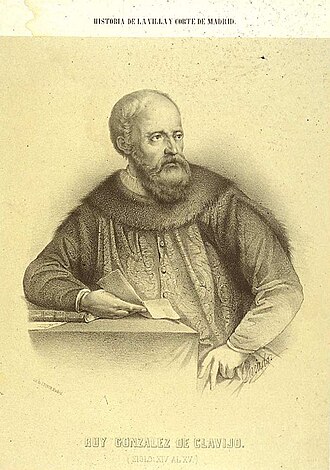
克拉维约
- 生卒
- 14 世纪 – 1412
- 国籍
- 卡斯提尔王冠领地
- 外文名
- Ruy González de Clavijo
照片:Rufino Casado,公有领域,来自维基共享资源「Retrato de Ruy González de Clavijo.jpg」(经缩小)。
生平与创作
罗·哥泽来滋·克拉维约(西班牙语:Ruy González de Clavijo;14世纪—1412年4月2日),卡斯提亚宫廷大臣、使节、旅行家及作家。曾于15世纪初出使帖木儿帝国,并到撒马尔罕向帖木儿朝觐。
出使帖木儿帝国
克拉维约之出使,与当时的国际形势有着密切关系。在14世纪末、15世纪初,奥斯曼帝国扩张迅速,正威胁着基督教欧洲,卡斯提亚亦不例外。不过,到1402年,奥斯曼帝国苏丹巴耶塞特一世在安卡拉之战中,惨败于帖木儿,并沦为俘虏。对卡斯提亚而言,帖木儿的崛起,可说是解除奥斯曼帝国威胁的转机。另外,在此之前,1402年,卡斯提亚国王亨利三世已曾派使赴帖木儿帝国,并颇获优待。于是,亨利三世便决定再派遣以克拉维约为首的使节团,出使帖木儿帝国。
1403年5月,克拉维约出发,先后经过君士坦丁堡、黑海南岸,跨越现今的土耳其、亚美尼亚、阿塞拜疆、伊朗、土库曼、乌兹别克等国,到1404年9月,才抵达撒马尔罕觐见帖木儿。克拉维约使团受到帖木儿的隆重款待,屡次获邀参加盛宴,参加各种庆典。克拉维约又饱览撒马尔罕的宫殿、花园及各项建筑。但因帖木儿突然病重,汗国内部亦出现权力斗争,克拉维约使团便只好仓猝离去。
撰写游记
克拉维约回卡斯提亚后,写成《克拉维约东使记》(据学者杨兆钧所说,若依原名直译,应为《帖木儿时代之自卡提斯至撒马尔罕游记》)。将他在旅程中的见闻,记述下来。
《克拉维约东使记》一书的汉译版本,由杨兆钧据土耳其学者奥玛·理查(Omer Riza)的土耳其文译本译出。
以上文字摘自维基百科「克拉維約」(去掉了参考文献等尾部小节),按 CC BY-SA 4.0 使用,作者为维基百科的各位编者。
中文维基百科的条目比较短,下面附上英文维基百科的内容(英文原文):
Ruy González de Clavijo (died 2 April 1412) was a Castilian traveler and writer. In 1403–1405, Clavijo was the ambassador of Henry III of Castile to the court of Timur, founder and ruler of the Timurid Empire. A diary of the journey, perhaps based on detailed notes kept while traveling, was later published in Spanish in 1582 (Embajada a Tamorlán) and in English in 1859 (Narrative of the Embassy of Ruy Gonzalez de Clavijo to the Court of Timour at Samarcand AD 1403–6).
Biography
Clavijo was a member of a prominent noble family, but little is known about his life; his date of birth is unknown. He was a native of Madrid and a renowned orator who served as chamberlain to Henry III of Castile and later to Henry's successor John II. He built a grand estate in the parish of San Andrés, Madrid, and was a witnesses to the king's will in 1406. Some time after Henry's death in December 1406 Clavijo constructed an ornate sepulcher for himself and his descendants in the convent of San Francisco in Madrid, the chapel of which he rebuilt at a great cost. He was buried there after his death. His sepulcher was later replaced by that of Queen Joan, wife of Henry IV; the chapel was destroyed in 1784.
Henry III had already sent an embassy to the Central Asian conqueror Timur in 1402, which caused Timur to send his own ambassador, named Muhammad Qazi (or perhaps Haji Muhammad), to the Castilian court. At the time, Timur was contacting various European rulers, seeking to form an alliance against the Ottoman sultan Bayezid I (his embassy to Castile came with gifts including two women captured from Bayezid's harem). Henry's second embassy to Timur consisted of Clavijo; Friar Alonso Páez de Santa María, a theologian; Gómez de Salazar, a royal guard; Alfonso Fernández de Mesa; and others. The party set sail from Cádiz on 22 May 1403, making stops in the Balearic Islands, Gaeta and Rhodes before reaching Constantinople, where the Byzantine emperor Manuel II received them. They remained there until 20 March 1404, then set out again on the Black Sea and arrived in Trebizond on 11 April. The original intention was to meet with Timur in Georgia, but the conqueror had already left for his capital, Samarkand. Following Timur, the ambassadors passed through Erzincan, Erzurum, Khoy, Tabriz, Soltaniyeh, Tehran, Bastam, Nishapur, Mashhad, Andkhoy, Balkh, Termez, and Kesh, usually stopping only for one or two nights and everywhere being provided for and guided by Timurid officials. They reached the outskirts of Samarkand on 4 September 1404. Clavijo provides the most detailed contemporary description of Timur's court by a westerner. He found the city in a constant cycle of construction and rebuilding, in search of perfection:The Mosque which Timur had caused to be built to the memory of the mother of his wife... seemed to us to be the noblest of all we visited in the city of Samarkand, but no sooner had it been completed than he began to find fault with its entrance gateway, which he now said was much too low and must be pulled down.At the time, Timur was holding a great gathering or kurultai in anticipation of his invasion of China (which was aborted after his death). Clavijo's long-sought first audience with Timur was in "a great orchard with a palace therein", the paradise garden of Iranian tradition, where Clavijo gave detailed descriptions of the trained and painted elephants he saw, and the tent-pavilions of jewel- and pearl-encrusted silks with tassels and banners that fluttered in the wind. The embassy spent several months in Samarkand, during which time the Castilians attended celebrations for Timur's recent victory at Ankara in July 1402 over the Turkish sultan, Bayezid I, whom he captured, relieving Western fears of Ottoman expansion in Hungary and spurring the desire for diplomatic connections on the part of Charles VI of France as well as Henry of Castile.
以上文字摘自英文维基百科「Ruy González de Clavijo」(有删节,去掉了参考文献等尾部小节),按 CC BY-SA 4.0 使用,作者为维基百科的各位编者。
资料卡
- 出生
- 14 世纪
- 出生地
- 马德里
- 逝世
- 1412 年 4 月 2 日
- 逝世地
- 马德里
- 职业
- 探险家、外交官、作家、历史学家、编年史家、发现者
- 使用语言
- 西班牙语
- 写作语言
- 西班牙语
- 配偶
- Mayor Arias
- 代表作
- 克拉维约东使记
资料卡来自 Wikidata Q725872(CC0),众包数据,个别字段可能不全。
本站收录的作品(1)
作品年表(1 本)
本站书库里署名克拉维约的书(Open Library 上至少 10 人加过书架的才收),按首版年份排(有本站书页的用 Wikidata 记的首版年,其余用 Open Library 的);年份偶尔记成后来的版本或译本,以原书为准。全部作品见 Open Library。
- 1406Embajada a Tamorlán书架 11