 书单
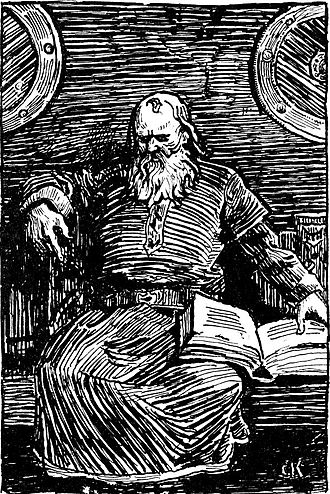
斯诺里·斯蒂德吕松
- 生卒
- 1179 – 1241
- 国籍
- 冰岛自由邦
- 外文名
- Snorri Sturluson
照片:Christian Krohg,公有领域,来自维基共享资源「Snorre Sturluson-Christian Krohg.jpg」(经缩小)。
生平与创作
斯诺里·斯蒂德吕松(冰岛文:Snorri Sturluson,或译斯诺里·斯图鲁松,1178或1179年—1241年9月23日)是冰岛历史学家、政治家、诗人。他三度获选为冰岛国会的法律顾问。他有著作《埃达》。后人将他的著作称为《散文埃达》或称《新埃达》,以便与古代冰岛的同名歌谣集《诗体埃达》或称《旧埃达》相区别。另外有重要的作品《挪威王列传》。
内容
《埃达》以散文体记录古代北欧神话与史诗。
以上文字摘自维基百科「斯諾里·斯蒂德呂松」(去掉了参考文献等尾部小节),按 CC BY-SA 4.0 使用,作者为维基百科的各位编者。
中文维基百科的条目比较短,下面附上英文维基百科的内容(英文原文):
Snorri Sturluson (Old Norse: [ˈsnorːe ˈsturloˌson]; Icelandic: [ˈstnɔrːɪ ˈstʏ(r)tlʏˌsɔːn]; 1179 – 23 September 1241) was an Icelandic historian, poet, knight, and politician. He was elected twice as lawspeaker of the Icelandic parliament, the Althing. He is commonly thought to have authored or compiled portions of the Prose Edda, which is a major source for what is today known about Norse mythology and alliterative verse, and Heimskringla, a history of the Norse kings that begins with legendary material in Ynglinga saga and moves through to early medieval Scandinavian history. For stylistic and methodological reasons, Snorri is often taken to be the author of Egil's Saga. He was assassinated in 1241 by men claiming to be agents of the King of Norway.
Biography
Early life
Snorri Sturluson was born in Hvammur í Dölum (commonly transliterated as Hvamm or Hvammr) as a member of the wealthy and powerful Sturlungar clan of the Icelandic Commonwealth, in AD 1179. His parents were Sturla Þórðarson the Elder of Hvammur (also known as Hvamm-Sturla) and his second wife, Guðný Böðvarsdóttir. He had two older brothers, Þórðr (b. 1165) and Sighvatr Sturluson (b. 1170), two sisters, Helga and Vigdís, and nine half-siblings. Snorri was raised from the age of three or four by Jón Loftsson, a relative of the Norwegian royal family, in Oddi, Iceland.
Key to his political and cultural education was his fosterage at Oddi, which resulted from a settlement regarding his father's legal dealings. As Hvamm-Sturla was trying to settle a lawsuit with the priest and chieftain (Goðorðsmaðr) Páll Sölvason, Páll's wife Þorbjörg Bjarnardóttir lunged suddenly at him with a knife – intending, she said, to make him like his one-eyed hero Odin. Before the knife could strike its target, though, bystanders deflected the blow so it hit his cheek instead. The resulting settlement would have beggared Páll, but Jón Loftsson intervened in the Althing to mitigate the judgment and, to compensate Sturla, offered to raise and educate Snorri. Thus Snorri received an excellent education and forged connections he might not otherwise have been able to. He was educated by Sæmundr fróði, grandfather of Jón Loftsson, at Oddi, and never returned to his parents' home. His father died in 1183 and his mother, as his guardian, soon squandered Snorri's share of the inheritance. Jón Loftsson died in 1197. The two families then arranged a marriage in 1199 between Snorri and Herdís, the daughter of Bersi Vermundarson. From her father, Snorri inherited an estate at Borg, as well as a chieftainship, and soon acquired more property and additional chieftainships.
Snorri and Herdís were together for four years at Borg. They had at least two children, Hallbera and Jón. The marriage succumbed to Snorri's philandering, and in 1206, he settled without Herdís in Reykholt as the manager of an estate. He also made significant improvements to the estate, including an outdoor bath fed by hot springs. The bath was known as Snorralaug, and the buildings have been preserved to some extent. During his initial years at Reykholt he fathered another five children, with three different women: Guðrún Hreinsdóttir, Oddný, and Þuríður Hallsdóttir.
National life
Snorri quickly became known as a poet, and also functioned as a lawyer. In 1215, he became lawspeaker of the Althing, the only public office of the Icelandic commonwealth and a position of high respect. In the summer of 1218, he left the lawspeaker position and sailed to Norway, by royal invitation. There he became well acquainted with the teenage King Hákon Hákonarson and his co-regent, Jarl Skúli. He spent the winter as house guest of the jarl. They showered gifts upon him, including the ship in which he sailed, and he in return wrote poetry about them. In the summer of 1219, he met his Swedish colleague, the lawspeaker Eskil Magnusson, and his wife, Kristina Nilsdotter Blake, in Skara. They were both related to royalty and probably gave Snorri an insight into the history of Sweden.
以上文字摘自英文维基百科「Snorri Sturluson」(有删节,去掉了参考文献等尾部小节),按 CC BY-SA 4.0 使用,作者为维基百科的各位编者。
资料卡
- 母语名
- Snorri Sturluson
- 出生
- 1179 年
- 出生地
- Hvammur
- 逝世
- 1241 年 9 月 23 日
- 逝世地
- 雷克霍特
- 职业
- 作家、吟唱诗人、历史学家、政治人物、外交官、诗人
- 使用语言
- 古诺尔斯语、冰岛语
- 写作语言
- 古诺尔斯语
- 文学运动 / 流派
- 欧赫迈罗斯主义
- 配偶
- Hallveig Ormsdóttir
- 代表作
- 散文埃达、挪威王列传、埃吉尔传
资料卡来自 Wikidata Q102323(CC0),众包数据,个别字段可能不全。
本站收录的作品(1)
作品年表(3 本)
本站书库里署名斯诺里·斯蒂德吕松的书(Open Library 上至少 10 人加过书架的才收),其中 3 本记的年份比作者去世晚 50 年以上或者早于他出生(多半是后世的版本、译本或占位年份),不列年份,按首版年份排(有本站书页的用 Wikidata 记的首版年,其余用 Open Library 的);年份偶尔记成后来的版本或译本,以原书为准。全部作品见 Open Library。
- 年份不详散文埃达Edda书架 81
- 年份不详Heimskringla; Lives/Saga of the Norse Kings书架 55
- 年份不详The Prose Edda书架 15