 书单
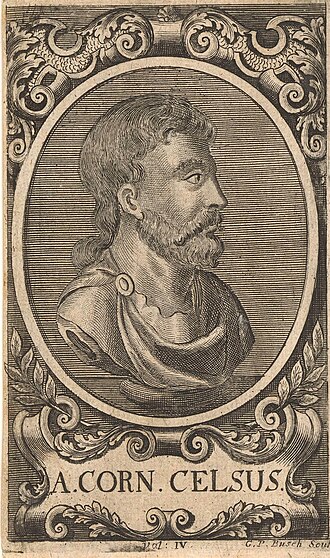
凯尔苏斯
- 生卒
- 公元前 25 – 25
- 国籍
- 古罗马
- 外文名
- Aulus Cornelius Celsus
照片:Georg Paul Busch,CC0,来自维基共享资源「Portret van Aulus Cornelius Celsus, RP-P-1908-2809.jpg」(经缩小)。
生平与创作
凯尔苏斯(英语:Aulus Cornelius Celsus,前25年—50年),生于提比略统治时期(公元14年至公元37年),古罗马医学家。著有一部涵盖多种主题的百科全书,前5卷与农业相关,但现仅存关于医学的八卷,被称为《医术》。其不仅提出“清洁主张”,更提出“包括发烧、肠炎、肝痛、小脓包、眼疾等疾病都可通过洗浴来减轻或治疗。”许多医学词汇包含他的名字,如脓癣(Kerion Celsi)。
以上文字摘自维基百科「凯尔苏斯」(去掉了参考文献等尾部小节),按 CC BY-SA 4.0 使用,作者为维基百科的各位编者。
中文维基百科的条目比较短,下面附上英文维基百科的内容(英文原文):
Aulus Cornelius Celsus (c. 25 BC – c. 50 AD) was a Roman encyclopedist, known for his extant medical work, De Medicina (On Medicine), which is believed to be the only surviving section of a much larger encyclopedia. The De Medicina is a primary source on diet, pharmacy, surgery and related fields, and it is one of the best sources concerning medical knowledge in the Roman world. The lost portions of his encyclopedia likely included volumes on agriculture, law, rhetoric, and military arts. He made contributions to the classification of human skin disorders in dermatology, such as myrmecia, and his name is often found in medical terminology regarding the skin, e.g., kerion celsi and area celsi. His name is said to be referenced in the name Paracelsus.
Life
Nothing is known about the life of Celsus. Even his praenomen is uncertain; he has been called both Aurelius and Aulus, with the latter being more plausible. Some incidental expressions in his De Medicina suggest that he lived under the reigns of Augustus and Tiberius; which is confirmed by his reference to the Greek physician Themison as being recently in his old age.
It is not known with any certainty where he lived. He has been identified as the possible dedicator of a gravestone in Rome, but it has also been supposed that he lived in Narbonese Gaul, because he refers to a species of vine (marcum) which, according to Pliny, was native to that region.
It is doubtful whether he practised medicine himself, and although Celsus seems to describe and recommend his own medical observations sanctioned by experience, Quintilian says that his volumes included all sorts of literary matters, and even agriculture and military tactics.
Works
De Medicina
Of the numerous volumes of his encyclopedia published before 47 CE, only one remains intact, his celebrated treatise On Medicine (De Medicina). "The work's encyclopedic arrangement follows the tripartite division of medicine at the time as established by Hippocrates and Asclepiades — diet, pharmacology, and surgery." It is divided into eight books.
Book 1 – The History of Medicine (includes references to eighty medical authors, some of whom are known only through this book)
Book 2 – General Pathology
Book 3 – Specific Diseases
Book 4 – Parts of the Body
Book 5 and 6 – Pharmacology
Book 7 – Surgery
Book 8 – Orthopedics
In the "Prooemium" or introduction to De Medicina there is an early discussion of the relevance of theory to medical practice and the pros and cons of both animal experimentation and human experimentation. Celsus discusses, for example, the case of Herophilos and Erasistratos, who he asserts practised vivisection.
In the treatment of disease, Celsus's principal method was to observe and watch over the operations of Nature, and to regulate rather than oppose them, conceiving that fever consisted essentially in an effort of the body to throw off some morbid cause, and that, if not unduly interfered with, the process would terminate in a state of health. On occasions, however, he boldly recommends the use of the scalpel; his rules for blood letting and purgatives are laid down with detail and precision; and many of the rules he prescribes were not very different from those still in use at the beginning of the 19th century.
His work contains detailed descriptions of the symptoms and different varieties of fever, and he is credited with recording the cardinal signs of inflammation known as "Celsus tetrad of inflammation": calor (warmth), dolor (pain), tumor (swelling) and rubor (redness and hyperaemia).
He goes into great detail regarding the preparation of numerous ancient medicinal remedies including the preparation of opioids. In addition, he describes many 1st century Roman surgical procedures which included removal of a cataract, treatment for bladder stones, and the setting of fractures.
以上文字摘自英文维基百科「Aulus Cornelius Celsus」(有删节,去掉了参考文献等尾部小节),按 CC BY-SA 4.0 使用,作者为维基百科的各位编者。
资料卡
- 母语名
- A. Cornelius Celsus
- 出生
- 公元前 25 年
- 逝世
- 25 年
- 职业
- 医生、作家
- 使用语言
- 拉丁语
- 写作语言
- 拉丁语
- 领域
- 哲学
- 代表作
- 医术
资料卡来自 Wikidata Q312420(CC0),众包数据,个别字段可能不全。
本站收录的作品(1)
作品年表(1 本)
本站书库里署名凯尔苏斯的书(Open Library 上至少 10 人加过书架的才收),其中 1 本记的年份比作者去世晚 50 年以上或者早于他出生(多半是后世的版本、译本或占位年份),不列年份,按首版年份排(有本站书页的用 Wikidata 记的首版年,其余用 Open Library 的);年份偶尔记成后来的版本或译本,以原书为准。全部作品见 Open Library。
- 年份不详医术De medicina书架 51