 书单
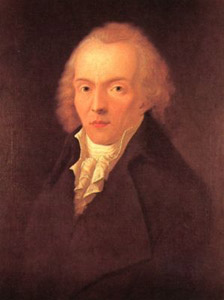
让·保罗
- 生卒
- 1763 – 1825
- 国籍
- 神圣罗马帝国、巴伐利亚王国
- 外文名
- Jean Paul
照片:Heinrich Pfenninger (1749-c.1815),公有领域,来自维基共享资源「Jeanpaul.jpg」(经缩小)。
生平与创作
让·保罗(Jean Paul,发音:[ʒɑ̃ paʊl] ;1763年3月21日—1825年11月14日),原名约翰·保罗·弗里德里希·里希特(德语:Johann Paul Friedrich Richter),德国作家,德国浪漫主义文学的先驱。
以上文字摘自维基百科「让·保罗」(去掉了参考文献等尾部小节),按 CC BY-SA 4.0 使用,作者为维基百科的各位编者。
中文维基百科的条目比较短,下面附上英文维基百科的内容(英文原文):
Jean Paul (German: [ʒɑ̃ paʊl] ; born Johann Paul Friedrich Richter, 21 March 1763 – 14 November 1825) was a German Romantic writer, best known for his humorous novels and stories.
Life and work
Jean Paul was born at Wunsiedel, then under the Principality of Bayreuth, in the Fichtel Mountains (Franconia). His father was an organist at Wunsiedel. In 1765 his father became a pastor at Joditz near Hof and, in 1767 at Schwarzenbach, but he died on 25 April 1779, leaving the family in great poverty. Later in life, Jean Paul noted, "The words that a father speaks to his children in the privacy of home are not heard by the world, but as in whispering-galleries, they are clearly heard at the end and by posterity." After attending the Gymnasium at Hof, in 1781 Jean Paul went to the University of Leipzig. His original intention was to enter his father's profession, but theology did not interest him, and he soon devoted himself wholly to the study of literature. Unable to maintain himself at Leipzig he returned in 1784 to Hof, where he lived with his mother. From 1787 to 1789, he served as a tutor at Töpen, a village near Hof; and from 1790 to 1794, he taught the children of several families in a school he had founded in nearby Schwarzenbach.
Jean Paul began his career as a man of letters with Grönländische Prozesse ("Greenland Lawsuits"), published anonymously in Berlin in 1783–84, and Auswahl aus des Teufels Papieren ("Selections from the Devil's Papers", signed J. P. F. Hasus), published in 1789. These works were not received with much favour, and in later life even their author had little sympathy for their satirical tone.
Jean Paul's outlook was profoundly altered by a spiritual crisis he suffered on 15 November 1790, in which he had a vision of his own death. His next book, Die unsichtbare Loge ("The Invisible Lodge"), a romance published in 1793 under the pen-name Jean Paul (in honour of Jean-Jacques Rousseau), had all the qualities that were soon to make him famous, and its power was immediately recognized by some of the best critics of the day.
Encouraged by the reception of Die unsichtbare Loge, Richter composed a number of books in rapid succession: Leben des vergnügten Schulmeisterleins Maria Wutz in Auenthal ("Life of the Cheerful Schoolmaster Maria Wutz", 1793), the best-selling Hesperus (1795), which made him famous, Biographische Belustigungen unter der Gehirnschale einer Riesin ("Biographical Recreations under the Brainpan of a Giantess", 1796), Leben des Quintus Fixlein ("Life of Quintus Fixlein", 1796), Der Jubelsenior ("The Parson in Jubilee", 1797), and Das Kampaner Tal ("The Valley of Campan", 1797). Also among these was the novel Siebenkäs in 1796–97.
Siebenkäs' slightly supernatural theme, involving a Doppelgänger and pseudocide, stirred some controversy over its interpretation of the Resurrection, but these criticisms served only to draw awareness to the author. This series of writings assured Richter a place in German literature, and during the rest of his life every work he produced was welcomed by a wide circle of admirers.
After his mother's death in 1797, Richter went to Leipzig, and in the following year, to Weimar, where he started work on his most ambitious novel, Titan, published between 1800 and 1803. Richter became friends with such Weimar notables as Johann Gottfried Herder, by whom he was warmly appreciated, but despite their close proximity, Richter never became close to Johann Wolfgang von Goethe or Friedrich Schiller, both of whom found his literary methods repugnant; but in Weimar, as elsewhere, his remarkable conversational powers and his genial manners made him a favorite in general society. The British writers Thomas Carlyle and Thomas De Quincey took an interest in Jean Paul's work.
以上文字摘自英文维基百科「Jean Paul」(有删节,去掉了参考文献等尾部小节),按 CC BY-SA 4.0 使用,作者为维基百科的各位编者。
资料卡
- 母语名
- Jean Paul
- 本名
- Johann Paul Friedrich Richter
- 笔名
- Jean Paul、J. P. F. Hasus、Jean-Paul Richter
- 出生
- 1763 年 3 月 21 日
- 出生地
- 文西德尔
- 逝世
- 1825 年 11 月 14 日
- 逝世地
- 拜雷乌特
- 职业
- 作家、小说家、诗人、剧本作者
- 使用语言
- 德语
- 写作语言
- 德语
- 就读学校
- 莱比锡大学
- 领域
- 诗歌、散文、歌剧剧本
- 所属团体
- 巴伐利亚科学人文学院
- 配偶
- Karoline Mayer
资料卡来自 Wikidata Q77079(CC0),众包数据,个别字段可能不全。
本站收录的作品(1)
Open Library 上的全部作品
正在读取…