 书单
Richard Hillary
- 生卒
- 1919 – 1943
- 国籍
- 英国
生平与创作
这个词条暂时没有中文维基百科条目,下面是英文维基百科的内容(英文原文):
Flight Lieutenant Richard Hope Hillary (20 April 1919 – 8 January 1943) was an Anglo-Australian Royal Air Force fighter pilot during the Second World War. He wrote the book The Last Enemy about his experiences during the Battle of Britain.
Early life
Hillary was the son of an Australian government official and his wife (Michael and Edwyna Hillary) and was sent to England to be educated at Shrewsbury School and Trinity College, Oxford. He lived with his parents until the age of seven; from then until he was eighteen he saw them only during the summer holidays. Whilst at Oxford it has been claimed that he was secretary of the Oxford University Boat Club and president of the Rugby Club, but both claims are questionable. He rowed in the successful Trinity College VIII of 1938. He joined the Oxford University Air Squadron and the Royal Air Force Volunteer Reserve in 1939. Hillary was a descendant of Sir William Hillary, founder of the Royal National Lifeboat Institution.
Second World War
Hillary was called up to the Royal Air Force in October 1939 and in July 1940, having completed his training, he was posted to B Flight, No. 603 Squadron RAF, located at RAF Montrose, flying Spitfires. The Squadron moved south to RAF Hornchurch on 27 August 1940 and immediately saw combat. In one week of combat Hillary personally claimed five Bf 109s shot down, claimed two more probably destroyed and one damaged.
Hillary wrote about his first experience in a Supermarine Spitfire in The Last Enemy:
The Spitfires stood in two lines outside 'A' Flight pilots' room. The dull grey-brown of the camouflage could not conceal the clear-cut beauty, the wicked simplicity of their lines. I hooked up my parachute and climbed awkwardly into the low cockpit. I noticed how small was my field of vision. Kilmartin swung himself on to a wing and started to run through the instruments. I was conscious of his voice, but heard nothing of what he said. I was to fly a Spitfire. It was what I had most wanted through all the long dreary months of training. If I could fly a Spitfire, it would be worth it. Well, I was about to achieve my ambition and felt nothing. I was numb, neither exhilarated nor scared. I noticed the white enamel undercarriage handle. "Like a lavatory plug," I thought.
Kilmartin had said, "See if you can make her talk." That meant the whole bag of tricks, and I wanted ample room for mistakes and possible blacking-out. With one or two very sharp movements on the stick I blacked myself out for a few seconds, but the machine was sweeter to handle than any other that I had flown. I put it through every manoeuvre that I knew of and it responded beautifully. I ended with two flick rolls and turned back for home. I was filled with a sudden exhilarating confidence. I could fly a Spitfire; in any position I was its master. It remained to be seen whether I could fight in one.
On 3 September 1940 he had just made his fifth "kill" when he was shot down by a Messerschmitt Bf 109 flown by Hauptmann Helmuth Bode of II./JG 26:
I was peering anxiously ahead, for the controller had given us warning of at least fifty enemy fighters approaching very high. When we did first sight them, nobody shouted, as I think we all saw them at the same moment. They must have been 500 to 1,000 feet above us and coming straight on like a swarm of locusts. I remember cursing and going automatically into line astern; the next moment we were in among them and it was each man for himself. As soon as they saw us they spread out and dived, and the next ten minutes was a blur of twisting machines and tracer bullets. One Messerschmitt went down in a sheet of flame on my right, and a Spitfire hurtled past in a half-roll; I was weaving and turning in a desperate attempt to gain height, with the machine practically hanging on the airscrew.
Then, just below me and to my left, I saw what I had been praying for – a Messerschmitt climbing and away from the sun. I closed in to 200 yards, and from slightly to one side gave him a two-second burst: fabric ripped off the wing and black smoke poured from the engine, but he did not go down. Like a fool, I did not break away, but put in another three-second burst. Red flames shot upwards and he spiralled out of sight. At that moment, I felt a terrific explosion which knocked the control stick from my hand, and the whole machine quivered like a stricken animal. In a second, the cockpit was a mass of flames: instinctively, I reached up to open the hood. It would not move. I tore off my straps and managed to force it back; but this took time, and when I dropped back into the seat and reached for the stick in an effort to turn the plane on its back, the heat was so intense that I could feel myself going. I remember a second of sharp agony, remember thinking "So this is it!" and putting both hands to my eyes. Then I passed out.
Unable to bail out of the flaming aircraft immediately, Hillary sustained extensive burns to his face and hands. Before it crashed he fell out of the stricken Spitfire unconscious. Regaining his senses whilst falling through space, he deployed a parachute and landed in the North Sea, where he was subsequently rescued by lifeboat Lord Southborough (ON 688) from the Margate Station.
Hillary was taken for medical treatment to the Royal Masonic Hospital, Hammersmith, London; and afterwards, under the direction of the surgeon Archibald McIndoe, to the Queen Victoria Hospital, East Grinstead, in Sussex. He endured three months of repeated surgery in an attempt to repair the damage to his hands and face, and went on to become one of the best known members of McIndoe's "Guinea Pig Club". He wrote an account of his experiences, published in 1942 under the title Falling Through Space in the United States, and as The Last Enemy in Great Britain.
以上文字摘自英文维基百科「Richard Hillary」(有删节,去掉了参考文献等尾部小节),按 CC BY-SA 4.0 使用,作者为维基百科的各位编者。
资料卡
- 出生
- 1919 年 4 月 20 日
- 出生地
- 悉尼
- 逝世
- 1943 年 1 月 8 日
- 逝世地
- 格林劳
- 职业
- 作家
- 使用语言
- 英语
- 就读学校
- 三一学院、什鲁斯伯里学校
资料卡来自 Wikidata Q7326460(CC0),众包数据,个别字段可能不全。
本站收录的作品(1)
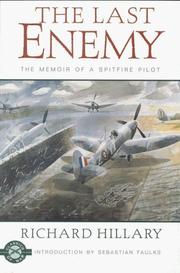
作品年表(1 本)
本站书库里署名Richard Hillary的书(Open Library 上至少 10 人加过书架的才收),其中 1 本记的年份比作者去世晚 50 年以上或者早于他出生(多半是后世的版本、译本或占位年份),不列年份,按首版年份排(有本站书页的用 Wikidata 记的首版年,其余用 Open Library 的);年份偶尔记成后来的版本或译本,以原书为准。全部作品见 Open Library。
- 年份不详Falling through space书架 18