 书单
理查德·卫斯里·汉明
- 生卒
- 1915 – 1998
- 国籍
- 美国
- 外文名
- Richard Hamming
生平与创作
理查德·卫斯里·汉明(英语:Richard Wesley Hamming,1915年2月11日—1998年1月7日)是一名美国数学家,主要贡献在计算机科学和电讯。
生平
1937年芝加哥大学学士学位毕业,1939年内布拉斯加大学硕士学位毕业,1942年伊利诺伊大学香槟分校博士学位毕业,博士论文为《一些线性微分方程边界值理论上的问题》(Some Problems in the Boundary Value Theory of Linear Differential Equations)。二战期间在路易斯维尔大学当教授,1945年参加曼哈顿计划,负责编写计算机程序,计算物理学家所提供方程的解。该程式是判断引爆核弹会否燃烧大气层,结果是不会,于是核弹便开始试验。
1946至76年在贝尔实验室工作。他曾和约翰·怀尔德·杜奇、克劳德·艾尔伍德·香农合作。1956年他参与了IBM 650的编程语言发展工作。
1976年7月23日起在海军研究生院担当兼任教授,1997年成为名誉教授。
他是美国电脑协会(ACM)的创立人之一,曾任该组织的主席。
1997年12月在逝世前几周完成他最后的授课;1998年1月7日死于心脏病。
奖项
1968年ACM图灵奖
1968年IEEE院士
1979年Emanuel R. Piore奖
1980年美国国家工程学院院士
1981年宾夕法尼亚大学Harold Pender奖
1988年IEEE理查·卫斯里·汉明奖
以上文字摘自维基百科「理查德·衛斯里·漢明」(去掉了参考文献等尾部小节),按 CC BY-SA 4.0 使用,作者为维基百科的各位编者。
中文维基百科的条目比较短,下面附上英文维基百科的内容(英文原文):
Richard Wesley Hamming (February 11, 1915 – January 7, 1998) was an American mathematician whose work had many implications for computer engineering and telecommunications. His contributions include the Hamming code (which makes use of a Hamming matrix), the Hamming window, Hamming numbers, the sphere-packing or Hamming bound, Hamming graph concepts, and the Hamming distance.
Born in Chicago, Hamming attended the University of Chicago, the University of Nebraska and the University of Illinois Urbana-Champaign, where he wrote his doctoral thesis in mathematics under the supervision of Waldemar Trjitzinsky (1901–1973). In April 1945, he joined the Manhattan Project at the Los Alamos Laboratory, where he programmed the IBM calculating machines that computed the solution to equations provided by the project's physicists. He left to join the Bell Telephone Laboratories in 1946. Over the next fifteen years, he was involved in nearly all of the laboratories' most prominent achievements. For his work, he received the ACM Turing Award in 1968, being its third recipient.
After retiring from Bell Labs in 1976, Hamming took a position at the Naval Postgraduate School in Monterey, California, where he worked as an adjunct professor and senior lecturer in computer science, and devoted himself to teaching and writing books. He delivered his last lecture in December 1997, just a few weeks before he died from a heart attack on January 7, 1998.
Early life
Hamming was born in Chicago, Illinois, on February 11, 1915, the son of Richard J. Hamming, a credit manager, and Mabel G. Redfield. His father was Dutch, and his mother was a Mayflower descendant. He grew up in Chicago, where he attended Crane Technical High School and Crane Junior College.
Hamming initially wanted to study engineering, but money was scarce during the Great Depression, and the only scholarship offer he received came from the University of Chicago, which had no engineering school. Instead, he became a science student, majoring in mathematics, and received his Bachelor of Science degree in 1937. He later considered this a fortunate turn of events. "As an engineer," he said, "I would have been the guy going down manholes instead of having the excitement of frontier research work."
He went on to earn a Master of Arts degree from the University of Nebraska in 1939, and then entered the University of Illinois Urbana-Champaign, where he wrote his doctoral thesis on Some Problems in the Boundary Value Theory of Linear Differential Equations under the supervision of Waldemar Trjitzinsky. His thesis was an extension of Trjitzinsky's work in that area. He looked at Green's function and further developed Jacob Tamarkin's methods for obtaining characteristic solutions. While he was a graduate student, he discovered and read George Boole's The Laws of Thought.
The University of Illinois Urbana-Champaign awarded Hamming his Doctor of Philosophy in 1942, and he became an instructor in mathematics there. He married Wanda Little, a fellow student, on September 5, 1942, immediately after she was awarded her own Master of Arts in English literature. They would remain married until his death, and had no children. In 1944, he became an assistant professor at the J. B. Speed School of Engineering at the University of Louisville.
以上文字摘自英文维基百科「Richard Hamming」(有删节,去掉了参考文献等尾部小节),按 CC BY-SA 4.0 使用,作者为维基百科的各位编者。
资料卡
- 母语名
- Richard Wesley Hamming
- 出生
- 1915 年 2 月 11 日
- 出生地
- 芝加哥
- 逝世
- 1998 年 1 月 7 日
- 逝世地
- 蒙特雷
- 职业
- 数学家、计算机科学家、工程师、大学教师
- 使用语言
- 英语
- 就读学校
- 芝加哥大学、伊利诺伊大学厄巴纳-香槟分校、内布拉斯加大学林肯分校(1939)、克兰高中
- 领域
- 数学、信息论、信息学、电信
- 所属团体
- 电气电子工程师学会、计算机协会(1994)
- 代表作
- 汉明码、汉明距离、Hamming window、汉明权重、Hamming graph、Error Detecting and Error Correcting Codes、Hamming bound
- 获奖
- 图灵奖(1968)、哈罗德·彭德奖(1981)、理查德·W·海明奖章(1988)、IEEE皮奥尔奖(1979)、ACM会士(1994)、IEEE Fellow(1968)、奖品(1996)
资料卡来自 Wikidata Q92619(CC0),众包数据,个别字段可能不全。
本站收录的作品(1)
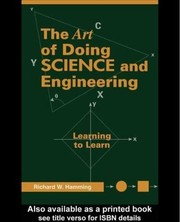
作品年表(2 本)
本站书库里署名理查德·卫斯里·汉明的书(Open Library 上至少 10 人加过书架的才收),按首版年份排(有本站书页的用 Wikidata 记的首版年,其余用 Open Library 的);年份偶尔记成后来的版本或译本,以原书为准。全部作品见 Open Library。
- 1990The Art of Probability书架 15
- 1996The art of doing science and engineering书架 73