 书单
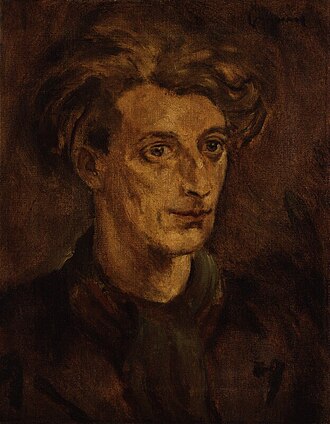
James Hanley
- 生卒
- 1897 – 1985
- 国籍
- 英国
照片:Sydney Earnshaw Greenwood,公有领域,来自维基共享资源「Mw02882.jpg」(经缩小)。
生平与创作
这个词条暂时没有中文维基百科条目,下面是英文维基百科的内容(英文原文):
James (Joseph) Hanley (3 September 1897 – 11 November 1985) was a British novelist, short story writer, and playwright from Kirkdale, Liverpool, Lancashire, of Irish descent. Hanley came from a seafaring family and spent two years at sea himself, during World War I. He published his first novel Drift in 1930. In the 1930s and 1940s his novels and short stories focussed on seamen and their families, and included Boy (1931), the subject of an obscenity trial. After World War II there was less emphasis on the sea in his works. While frequently praised by critics, Hanley's novels did not sell well. In the late 1950s, 1960s, and early 1970s he wrote plays, mainly for the BBC, for radio and then for television, and also for the theatre. He returned to the novel in the 1970s. His last novel, A Kingdom, was published in 1978, when he was eighty. His brother Gerald was also a novelist.
Biography
Born in Kirkdale, Liverpool, Lancashire, in 1897 (not Dublin, nor 1901 as he generally implied) to a working-class family. Both his parents were, on the other hand, born in Ireland, his father Edward Hanley around 1865, in Dublin, and his mother, Bridget Roache, in Queenstown, County Cork, around 1867. However, both were "well established in Liverpool by 1891", when they were married. Hanley's father worked most of his life as a stoker, particularly on Cunard liners, and other relatives had also gone to sea. James also grew up living close to the docks. He left school in the summer of 1910 and worked for four years in an accountants' office. Then early in 1915, during the First World War aged 17 he went to sea for the first time (not 13 as he again implied). Thus life at sea was a formative influence and much of his early writing is about seamen.
Then, in April 1917, Hanley jumped ship in Saint John, New Brunswick, Canada, and shortly thereafter joined the Canadian Army in Fredericton, New Brunswick. Hanley fought in France in the summer of 1918, but was invalided out shortly thereafter. After the war he worked as a railway porter in Bootle and he devoted himself "to a prodiguous range of autodidactic, high cultural activities – learning the piano, regularly attending […] concerts […] reading voraciously and, above all, writing." However, it was not until 1930 that his novel Drift was accepted.
Hanley moved from Liverpool to near Corwen, North Wales in 1931, where he met Dorothy Enid "Timothy" Thomas, née Heathcote, a descendant of Lincolnshire nobility. They lived together and had a child, Liam Powys Hanley, in 1933, but did not marry until 1947.
As World War II was approaching, in July 1939, Hanley moved to London, to write documentaries and plays for the BBC, but he moved back to Wales, to Llanfechain, the other side of the Berwyn Mountains from Corwen, in the early years of the war, where he remained until 1963, when the Hanleys moved to North London, close to their son Liam.
Hanley published an autobiographical work, Broken Water: An Autobiographical Excursion in 1937, and while this generally presents a true overall picture of his life, it is seriously flawed, incomplete and inaccurate. Chris Gostick describes it as "a teasing palimpsest of truth and imagination".
Hanley's brother was the novelist Gerald Hanley and his nephew the American novelist and playwright William Hanley. James Hanley's wife also published three novels, as Timothy Hanley. She died in 1980. James Hanley himself died in 1985. He was buried in Llanfechain, Wales.
Works
1930s and 1940s
Hanley's first publication, the novel Drift (1930), was written under the influence of James Joyce. While Drift is about an Irish Catholic family, the setting is Liverpool, and in the 1930s Hanley wrote largely about the Irish community in Liverpool, especially with the semi-autobiographical novels about the Fury family, The Furys (1935), The Secret Journey (1936), and Our Time is Gone (1940), as well as Ebb and Flood (1932). Hanley's novels of the 1930s and 1940s also focus on life at sea. Hanley wrote two further novels about the Furys of Liverpool, Winter Song (1950), and An End and a Beginning (1958), though Irish and especially Roman Catholic characters continue to have a significant role throughout most of Hanley's career.
James Hanley consistently explored the lives of men and women in extremes, that is in dramatically precarious states of fear and isolation, which tend to lead to violence and madness. A grim early example is in the novella The Last Voyage (1931). John Reilly is a fireman who is still working only because he has lied about his age, and now faces his last voyage. Reilly although he is in his mid-sixties has a young family, and therefore the family will have to live on his inadequate pension. In another sense this is Reilly's last voyage, because despairing as to the future he throws himself into the ship's furnace: "Saw all his life illuminated in those flames. 'Not much for us. Sweat, sweat. Pay off. Sign on. Sweat, sweat. Pay off. Finish. Ah, well!".
In Boy (1931) young Fearon's isolation and suffering arise because no one cares for him. The story of Boy is "sordid and horrible". The young protagonist's parents are only interested in the wages he can earn, and encourage him to leave school as soon as possible. Likewise society is unconcerned about the harsh, unhealthy conditions he endures cleaning ships' boilers. Then, when he goes to sea, he is sexually abused by his fellow seamen. Finally, when young Fearon is dying in agony from a venereal disease caught in a Cairo brothel, his Captain smothers him.
以上文字摘自英文维基百科「James Hanley (novelist)」(有删节,去掉了参考文献等尾部小节),按 CC BY-SA 4.0 使用,作者为维基百科的各位编者。
资料卡
- 出生
- 1897 年 9 月 3 日
- 出生地
- 利物浦
- 逝世
- 1985 年 11 月 11 日
- 逝世地
- 伦敦
- 职业
- 小说家、作家、剧作家
- 使用语言
- 英语
- 领域
- 散文、戏剧、广播剧、电视单本剧、文献
- 配偶
- Dorothy Enid Heathcote(1931)
- 代表作
- Boy
资料卡来自 Wikidata Q174181(CC0),众包数据,个别字段可能不全。
同时代的英国作家
Open Library 上的全部作品
正在读取…