 书单
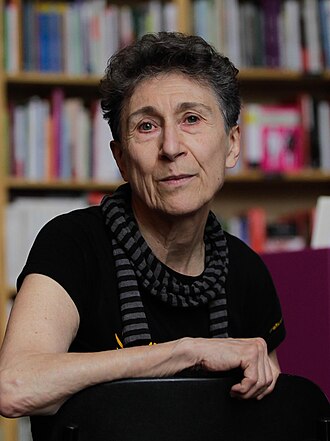
西尔维亚·费德里奇
- 生卒
- 1942 –
- 国籍
- 美国、意大利
- 外文名
- Silvia Federici
照片:Marta Jara (eldiario.es),CC BY-SA 3.0 es,来自维基共享资源「La escritora y activista feminista Silvia Federici (cropped).jpg」(经缩小)。
生平与创作
这个词条暂时没有中文维基百科条目,下面是英文维基百科的内容(英文原文):
Silvia Federici (Italian pronunciation: [ˈsilvja fedeˈriːtʃi]; born April 1942) is an Italian-American scholar, teacher, and Marxist feminist activist based in New York. She is considered one of the leading theoreticians in Marxist feminist theory, women's history, political philosophy, and the history and theory of the commons. Her most famous book, Caliban and the Witch (2004), has been translated into numerous languages and adopted in college courses.
For several decades, she has worked with a variety of international feminist organizations, such as Women in Nigeria (WIN) and the Latin American-based Ni una menos, to combat gender-based violence. In the 2010s, she organized a project with feminist collectives in Spain to reconstruct the history of women persecuted as witches in early modern Europe, and to raise awareness about what she believes are contemporary witch-hunts still taking place around the world.
Early life and education
Federici was born in Parma in Fascist-ruled Italy in April 1942. She left for Casalmaggiore with her parents after the Allied invasion of Italy in 1943 and grew up there until returning to Parma, where her father taught secondary-level philosophy, in 1955. She received a bachelor's degree in modern languages and literature from the University of Bologna in 1965. With the aid of a Fulbright scholarship, she moved to the United States in 1967 to study for a PhD in philosophy at the University at Buffalo. After obtaining an MA degree in philosophy in 1971, she completed her doctorate in 1980 with a dissertation entitled The Development of Lukács' Realism, an examination of the philosophical and aesthetic development of György Lukács. The dissertation challenges interpretations that divide Lukács's intellectual development into sharply separated pre-Marxist, Marxist-Hegelian and later aesthetic periods, instead emphasizing continuities in his attempts to reconcile idealism, Marxism and a realist conception of an objective world. During the period in which she was developing this work, Federici published "Notes on Lukács' Aesthetics" in Telos in 1972.
Academic career
Federici taught at the University of Port Harcourt in Nigeria from 1984 to 1986. In 1987, she became an associate professor and later professor of political philosophy and international studies at Hofstra University in New York. Following her retirement in 2005, she holds the title of professor emerita at Hofstra.
Activism
In 1972, with Mariarosa Dalla Costa and Selma James, Federici co-founded the International Feminist Collective, the organization that launched the campaign Wages for Housework. In 1973, she helped start "Wages for Housework" groups in the U.S. In 1975, she published the pamphlet Wages Against Housework, the document most associated with the Wages for Housework movement.
In the 1980s and 1990s, Federici was a member of the Midnight Notes Collective. In 1990, she co-founded the Committee for Academic Freedom in Africa (CAFA) and, with Ousseina Alidou, edited the CAFA bulletin for over a decade. Her involvement with CAFA led to her serving for several years as an Executive member of the Association of Concerned Africa Scholars (ACAS).
In 1995, during the campaign to free African-American journalist Mumia Abu-Jamal from death row, Federici helped launch the Anti-Death Penalty Project (ADPP) within the Radical Philosophy Association. Along with ADPP co-leaders George Caffentzis and Everet Green, Federici encouraged the global academic community to agitate against the death penalty.
She has been involved in the anti-globalization movement.
In March 2022, Federici was among the 151 feminists worldwide who signed Feminist Resistance Against War: A Manifesto, in solidarity with the Russian Feminist Anti-War Resistance.
Scholarly contributions
Federici's best-known book, Caliban and the Witch: Women, the Body and Primitive Accumulation (2004), expands on the work of Leopoldina Fortunati to investigate the reasons for the witch hunts that occurred in the early modern period, but Federici puts greater emphasis on a feminist interpretation. In the book, she argues against the traditional understanding of Karl Marx's concept of primitive accumulation, which is viewed as a necessary precursor for capitalism. Instead, she posits that primitive accumulation is a fundamental characteristic of capitalism itself—that the economic system, in order to perpetuate itself, requires a constant infusion of expropriated capital. She connects this expropriation to women's unpaid labour, via reproduction and otherwise, which she frames as a historical precondition to the rise of a capitalist economy predicated upon wage labor. Related to this, she outlines the historical struggles for the commons and for communalism. Instead of seeing capitalism as a liberatory defeat of feudalism, Federici interprets the ascent of capitalism as a reactionary move to subvert the rising tide of communalism and to retain the basic social contract.
She situates the institutionalization of rape and prostitution—as well as the heretic and witch-hunt trials, burnings and torture—at the center of a systematic suppression of women and appropriation of their labor. This is tied into colonial expropriation and provides a framework for understanding the work of the International Monetary Fund, World Bank, and other proxy institutions as engaging in a renewed cycle of primitive accumulation, by which everything held in common—from water, to seeds, to our genetic code—becomes privatized in what amounts to a new round of enclosures.
Often described as a counterpoint to Marx's account of "primitive accumulation", Caliban reconstructs the history of capitalism, highlighting the continuity between the capitalist subjugation of women, the transatlantic slave trade, and the colonization of the Americas. The book has been described as "a retelling of the birth of capitalism that places women at the center of the story".
以上文字摘自英文维基百科「Silvia Federici」(有删节,去掉了参考文献等尾部小节),按 CC BY-SA 4.0 使用,作者为维基百科的各位编者。
资料卡
- 母语名
- Silvia Federici
- 出生
- 1942 年 4 月 20 日
- 出生地
- 帕尔马
- 职业
- 哲学家、作家、大学教师、女权活动家、社运人士、社会科学家、作者
- 使用语言
- 英语、意大利语
- 就读学校
- 布法罗大学、博洛尼亚大学
- 领域
- 社会学、性别研究、政治哲学、社会科学、哲学 等 6 项
- 配偶
- 乔治·卡芬特齐斯
- 代表作
- Caliban and the Witch
资料卡来自 Wikidata Q597248(CC0),众包数据,个别字段可能不全。
本站收录的作品(2)
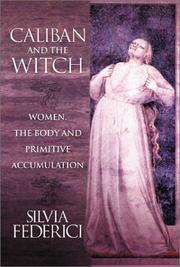

作品年表(5 本)
本站书库里署名西尔维亚·费德里奇的书(Open Library 上至少 10 人加过书架的才收),按首版年份排(有本站书页的用 Wikidata 记的首版年,其余用 Open Library 的);年份偶尔记成后来的版本或译本,以原书为准。全部作品见 Open Library。
- 2004Caliban and the Witch书架 92
- 2012Revolution at Point Zero书架 21
- 2018Witches, Witch-Hunting, and Women书架 13
- 2018Re-Enchanting the World书架 12
- 2020Beyond the Periphery of the Skin书架 14