 书单
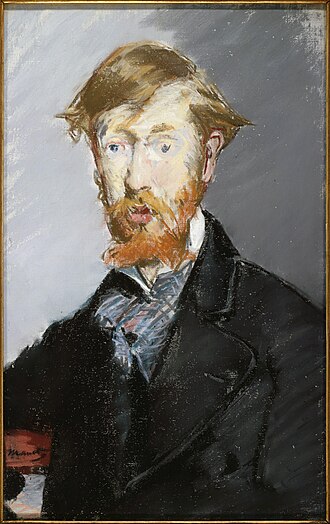
乔治·摩尔
- 生卒
- 1852 – 1933
- 国籍
- 爱尔兰
- 外文名
- George Moore
照片:作者不详,公有领域,来自维基共享资源「Edouard Manet Georges Moore.jpg」(经缩小)。
生平与创作
这个词条暂时没有中文维基百科条目,下面是英文维基百科的内容(英文原文):
George Augustus Moore (24 February 1852 – 21 January 1933) was an Irish novelist, short-story writer, poet, art critic, memoirist and dramatist. Moore came from a landed family of Catholics who lived at Moore Hall in Carra, County Mayo. He originally wanted to be a painter, and studied art in Paris during the 1870s. There, he befriended many of the leading French artists and writers of the day.
As a naturalistic writer, he was amongst the first English-language authors to absorb the lessons of the French realists, and was particularly influenced by the works of Émile Zola. His writings influenced James Joyce, according to the literary critic and biographer Richard Ellmann, and, although Moore's work is sometimes seen as outside the mainstream of both Irish and British literature, he is as often regarded as the first great modern Irish novelist.
Life
Family origins
George Moore's family had lived in Moore Hall, near Lough Carra, County Mayo, for almost a century. The house was built by his paternal great-grandfather—also called George Moore—who had made his fortune as a wine merchant in Alicante. The novelist's grandfather—another George—was a friend of Maria Edgeworth, and author of An Historical Memoir of the French Revolution. His great-uncle, John Moore, was president of the Province of Connacht in the short-lived Irish Republic of 1798 during the Irish Rebellion of 1798.
George Moore's father, George Henry Moore, sold his stable and hunting interests during the Great Irish Famine, and from 1847 to 1857 served as an Independent Member of Parliament (MP) for County Mayo in the British House of Commons. George Henry was renowned as a fair landlord, fought to uphold the rights of tenants, and was a founder of the Catholic Defence Association. His estate consisted of 5000 ha (50 km2) in Mayo, with a further 40 ha in County Roscommon.
Early life
Moore was born in Moore Hall in 1852. As a child, he enjoyed the novels of Walter Scott, which his father read to him. He spent a good deal of time outdoors with his brother, Maurice George Moore, and also became friendly with the young Willie and Oscar Wilde, who spent their summer holidays at nearby Moytura. Oscar was to later quip of Moore: "He conducts his education in public".
His father had again turned his attention to horse breeding and in 1861 brought his champion horse, Croagh Patrick, to England for a successful racing season, together with his wife and nine-year-old son. For a while, George was left at Cliff's stables until his father decided to send him to his alma mater facilitated by his winnings. Moore's formal education started at St. Mary's College, Oscott, a Catholic boarding school near Birmingham, where he was the youngest of 150 boys. He spent all of 1864 at home, having contracted a lung infection brought about by a breakdown in his health. His academic performance was poor while he was hungry and unhappy. In January 1865, he returned to St. Mary's College with his brother Maurice, where he refused to study as instructed and spent time reading novels and poems. That December the principal, Spencer Northcote, wrote a report that "he hardly knew what to say about George." By the summer of 1867, he was expelled for, as he wrote in 1903's The Untilled Field, "idleness and general worthlessness", and returned to Mayo. His father said that he feared about George and his brother Maurice, "[that] those two redheaded boys are stupid", an observation which proved untrue for all four sons.
London and Paris
In 1868, Moore's father was again elected MP for Mayo and the family moved to London the following year. Here, Moore senior tried, unsuccessfully, to have his son follow a career in the military though, prior to this, he attended the School of Art in the South Kensington Museum where his achievements were no better. He was freed from any burden of education when his father died in 1870. Moore, though still a minor, inherited the family estate that generated a yearly income of £3,596. He handed the estate over to his brother Maurice to manage and in 1873, on attaining his majority, moved to Paris to study art. It took him several attempts to find an artist who would accept him as a pupil. Rodolphe Julian, who had previously been a shepherd and circus masked man, took him on for 40 francs a month. At Académie Julian he met Louis Welden Hawkins who became Moore's flatmate and whose trait, as a failed artist, shows up in Moore's own characters. He met many of the key artists and writers of the time, including Pissarro, Degas, Renoir, Monet, Daudet, Mallarmé, Turgenev and, above all, Zola, who was to prove an influential figure in Moore's subsequent development as a writer.
以上文字摘自英文维基百科「George Moore (novelist)」(有删节,去掉了参考文献等尾部小节),按 CC BY-SA 4.0 使用,作者为维基百科的各位编者。
资料卡
- 出生
- 1852 年 2 月 24 日
- 出生地
- Ballyglass
- 逝世
- 1933 年 1 月 21 日
- 逝世地
- 皮米里科
- 职业
- 诗人、剧作者、编剧、小说家、剧作家、作家、艺术评论家、美术史学家
- 使用语言
- 英语
- 写作语言
- 英语
- 就读学校
- 朱利安艺术学校
- 受谁影响
- 埃米尔·左拉
- 代表作
- Confessions of a Young Man
资料卡来自 Wikidata Q965927(CC0),众包数据,个别字段可能不全。
本站收录的作品(1)
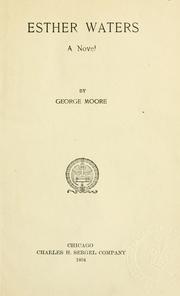
作品年表(1 本)
本站书库里署名乔治·摩尔的书(Open Library 上至少 10 人加过书架的才收),按首版年份排(有本站书页的用 Wikidata 记的首版年,其余用 Open Library 的);年份偶尔记成后来的版本或译本,以原书为准。全部作品见 Open Library。
- 1890Esther Waters, a novel书架 16