 书单
Gregory Berns
- 生卒
- 1960 年代 –
- 国籍
- 美国
生平与创作
这个词条暂时没有中文维基百科条目,下面是英文维基百科的内容(英文原文):
Gregory Scott Berns (born June 1964) is an American neuroeconomist, neuroscientist, professor of psychiatry, and psychologist. He lives with his family in Atlanta, Georgia, US.
Berns holds the Distinguished Chair of Neuroeconomics in the Department of Psychiatry and Behavioral Sciences, Emory University School of Medicine in Atlanta where he is a professor of both psychiatry and economics. He is the director of the Center for Neuropolicy; the author of the books Satisfaction: The Science of Finding True Fulfillment, Iconoclast: A Neuroscientist Reveals How to Think Differently, How Dogs Love Us: A Neuroscientist and His Adopted Dog Decode the Canine Brain; and has made numerous media appearances.
Life and career
Education
Berns graduated with an A.B. in physics from Princeton University in 1986 after completing a senior thesis titled "The measurement of force distributions in the foot during running." In 1990 he went on to study for a Ph.D. in Biomechanical engineering, and then for an M.D. Medicine in 1994, both at the University of California.
After graduating, Berns was a Research Assistant / Postdoctoral Fellow at Salk Institute for Biological Studies from 1990 to 1994; had a General Psychiatry and Medicine Internship at University of Pittsburgh Medical Center's Western Psychiatric Institute and Clinic from 1994 to 1995, followed by an Adult Psychiatry Residency there from 1995 to 1998.
Authorship
To date, Berns has written three books. In his first book Satisfaction: the science of finding true fulfillment, published in 2005, Berns challenges the theory that people are driven to pursue pleasure and avoid pain (see pleasure principle, for example). He argues instead that true satisfaction comes from novel experiences which are undergone in the process of achieving an aim, rather than the achievement itself, and this involves an active striving rather than a "passive feeling of happiness."
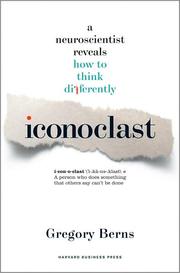
Berns' second book Iconoclast: A Neuroscientist Reveals How to Think Differently continues the theme developed in Satisfaction and the exploration of the neurological bases of human creativity. It describes and investigates iconoclasts: innovative and creative people who break with the established, traditional way of thinking or of doing things; 'break' cultural icons, and manage to do what others say cannot be done. The work profiles a number of famous 'free-thinkers' such as Warren Buffett; Dale Chihuly; the Dixie Chicks; Richard Feynman; Henry Ford; Steve Jobs; Martin Luther King Jr. and Picasso.
Berns argues that iconoclasts manage to break through three major 'mental roadblocks' which he enumerates as (a) perception (often having insights triggered through visual imagery); (b) the human fear response (fear of failure, of the unknown, and of ridicule), and (c) social skills, social intelligence and social networking abilities. Berns' work is mainly interested in successful iconoclasts, not with those who show such innovation in their 'log cabin in the woods' but do not go on to market the idea.
His third book, How Dogs Love Us: A Neuroscientist and His Adopted Dog Decode the Canine Brain, was published in October 2013. The book describes Berns' efforts to train dogs to voluntarily undergo functional magnetic resonance imaging (fMRI). Because MRI machines are loud and require subjects to remain still during scans, prior to Berns' work, all brain imaging conducted on living dogs was performed with the animals under sedation. The book details the techniques that Berns and his team developed to train and test two dogs, including Berns' feist Callie, to undergo the imaging procedure. It also describes a study that the team conducted using this method, which observed increases in caudate activity in response to hand signals associated with food rewards. A later study replicated the procedure and results in a larger sample of dogs, and further supported the reliability of the technique.
Reception
Satisfaction
Berns' book Satisfaction was reviewed by Jonathan Beard in the December 2005 edition of the Scientific American Mind magazine.
Writing in CNN Money's Fortune magazine, John Simons sums up the main thrust of Satisfaction by quoting Berns: "The sense of satisfaction after you've successfully handled unexpected tasks or sought out unfamiliar, physically and emotionally demanding activities is your brain's signal that you're doing what nature designed you to do." Though the reviewer found that Berns can be "somewhat professorial, Satisfaction is no plodding textbook". He noted that "nothing escapes the author's investigative eye" and concluded that "Berns's gumshoe approach to scientific theory offers its own proof that a fresh take on the familiar can be most gratifying".
Iconoclast
Writing in the Winter 2009 edition of Stanford Social Innovation Review and reviewing Iconoclast, Robert J. Sternberg points to the three major mental roadblocks that people need to overcome if they wish to be iconoclasts. "First, see things differently from other people—see what others do not see. Second, conquer your fear of failure, of the unknown, and of ridicule. Third, be socially intelligent: Figure out how to interest people in your ideas and how to sell those ideas to opinion leaders." Sternburg also points out that iconoclasts' brains are wired differently. For example, the amygdala, situated within the medial temporal lobes of the brain, of the iconoclast tends to reduce their emotional reactions and fear response.
以上文字摘自英文维基百科「Gregory Berns」(有删节,去掉了参考文献等尾部小节),按 CC BY-SA 4.0 使用,作者为维基百科的各位编者。
资料卡
- 出生
- 1960 年代
- 职业
- 精神科医师、神经学家、心理学家
- 使用语言
- 英语
- 就读学校
- 普林斯顿大学、圣迭戈加利福尼亚大学、戴维斯加利福尼亚大学
资料卡来自 Wikidata Q5606814(CC0),众包数据,个别字段可能不全。
本站收录的作品(1)
作品年表(1 本)
本站书库里署名Gregory Berns的书(Open Library 上至少 10 人加过书架的才收),按首版年份排(有本站书页的用 Wikidata 记的首版年,其余用 Open Library 的);年份偶尔记成后来的版本或译本,以原书为准。全部作品见 Open Library。
- 2008Iconoclast书架 10