 书单
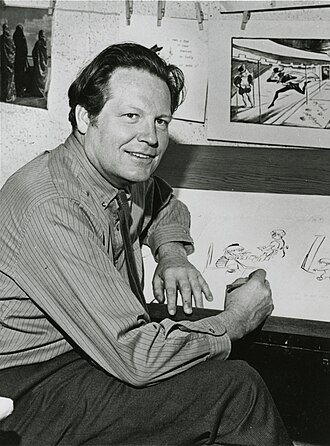
Don Freeman
- 生卒
- 1908 – 1978
- 国籍
- 美国
照片:Roy Freeman,CC BY 3.0,来自维基共享资源「DonFreeman.jpg」(经缩小)。
生平与创作
这个词条暂时没有中文维基百科条目,下面是英文维基百科的内容(英文原文):
Don Freeman (August 11, 1908 – February 1, 1978) was an American painter, printmaker, cartoonist, and an illustrator and writer of children's books. He was active from the 1930s to the 1970s and often used Times Square as the backdrop of his memorable works.
Early life
Freeman was born in San Diego, California. He attended high school in St. Louis, and moved to New York City in late 1928. He studied at the San Diego School of Fine Arts and, after graduation, he earned passage to New York by playing the cornet with a ship's orchestra. He arrived at the city days before the stock market crash of 1929 and earned money as a dance band musician. He enrolled at the Art Students League of New York where he studied graphic design and lithography under John Sloan, Harry Wickey, and Kathryn E. Cherry.
Career
Frequent subjects of Freeman's included Broadway theater, politics, and the circus. Freeman was known for carrying a sketchbook with him wherever he went. His images depicted New York City, and the faces of the people he observed on the streets, in the theaters, and in the subways. They often included images of showgirls, Bowery Boys, drunks, apple sellers, window washers and numerous citizens of the city that were down on their luck. Freeman was also a jazz musician and the brother of hotel entrepreneur Warren Freeman.
As Freeman's career progressed, he lightened his palette and depicted more upbeat subjects. In 1951, he began illustrating children's books. His wife, Lydia, who was also an accomplished artist, authored some of the books Freeman illustrated. The Freemans eventually moved to Santa Barbara, California, where they spent the remainder of their lives.
Don Freeman was first introduced to children's literature when William Saroyan asked him to illustrate several books. These include Human Comedy, which is considered one of his best-known works. However, his greatest influence came from the artist Honoré Daumier. Freeman studied many of Daumier's works, particularly his caricatures. He also owned a large collection of books on the artist.
Throughout Don Freeman's career, he was the writer and illustrator of more than 20 children's books. He is best known for his publication of Corduroy. Although he came up with many of his ideas on his own, his wife Lydia Freeman contributed greatly to his success; she co-wrote two books with him, Chuggy and the Blue Caboose and Pet of the Met. She was very influential on her husband's work, as he relied on her for inspiration for his pieces. He would read his work aloud to her as well as any children around in order to gain feedback on a particular piece. Lydia too became a well-known artist in her later life. In his autobiography Come One, Come All!, Don humorously admits that of the two, she was the better (watercolor) artist.
"Simplicity is the essence of children's-book stories, not simple-mindedness", Don Freeman once stated when speaking to an audience that was interested in writing, illustrating, and publishing children's books.
When Freeman lived in New York City during the 1930s, 1940s, and early 1950s, he was an illustrator of city life in the tradition of Social Realism. His subjects included actors, actresses, and manual laborers. His cartoons and other illustrations appeared regularly in the New York Herald Tribune, The New York Times, The Christian Science Monitor, and Theater Magazine.
From 1936 to 1968, Freeman self-published Don Freeman's Newsstand. It was published as a quarterly magazine for its first decade and then irregularly. The tagline read "Signs of the Times in Lithographs." The periodical documented the daily life in New York City during and after the Great Depression and during the Second World War and featured articles by many well known writers and personalities of the time. In later volumes, Freeman illustrated life in post-war Los Angeles. The journal contained original lithographs.
In 1976, Freeman was recognized by the City of New York for his body of work portraying the city. The New York Daily News reported on the Citation from Mayor Abraham D. Beame, which was presented to Freeman at the opening of a one-man retrospective exhibition. In a measure of Freeman's national fame, The Christian Science Monitor covered the 1976 exhibition, as well as a 1978 retrospective, both of which showcased Freeman's drawings, oils, prints, and his limited-edition self-published periodical, Don Freeman's Newsstand.
In 2018, Freeman's work was featured in "A City for Corduroy", an exhibit at the Museum of the City of New York.
Selected works
It Shouldn't Happen (Harcourt, Brace, 1945), 212 pp., LCCN 45-7182 ;
Come One, Come All! (Rinehart, 1949) – "drawn from memory by Don Freeman", LCCN 49-11554
Chuggy and the Blue Caboose, written by Don and Lydia Freeman (Viking, 1951)
Pet of the Met, Don and Lydia Freeman (1953)
Gregory's Shadow (Viking, 2000)
Manuelo the Playing Mantis (2004)
Earl the Squirrel (2005)
The two Corduroy books by Freeman (1968 and 1978) were also issued in one volume as All About Corduroy (1998). Other writers and illustrators have extended the series "based on the character created by Don Freeman".
As illustrator only
Diedrich Knickerbocker's History of New-York, written by Washington Irving (The Heritage Press, 1940), LCCN 40-31939; original, 1809
My Name Is Aram, by William Saroyan (Harcourt, Brace, 1940), collection
The Human Comedy, by William Saroyan (Harcourt, 1943)
The White Deer, by James Thurber (1945) – "illustrated by the author and Don Freeman" LCCN 45-35191
The Saroyan Special: selected short stories, by William Saroyan (Harcourt, 1948)
Bill Bergson Lives Dangerously, by Astrid Lindgren (Viking, 1954); original, 1951, Swedish
Mike's House, Julia L. Sauer (1954)
Ghost Town Treasure, Clyde Robert Bulla (1957)
This For That, Ann Nolan Clark (Golden Gate Junior Books, 1966), OCLC 276516
Joey's Cat, Robert J. Burch (1969)
Edward and the Night Horses, Jacklyn Meek Matthews (Golden Gate Junior Books, 1971), LCCN 78-141156
Monster Night at Grandma's House, Richard Peck (1977)
以上文字摘自英文维基百科「Don Freeman」(有删节,去掉了参考文献等尾部小节),按 CC BY-SA 4.0 使用,作者为维基百科的各位编者。
资料卡
- 出生
- 1908 年 8 月 11 日
- 出生地
- 圣迭戈
- 逝世
- 1978 年 1 月 1 日
- 职业
- 漫画师、画家、蚀刻家、儿童文学作家、平面设计师
- 使用语言
- 英语
资料卡来自 Wikidata Q5292635(CC0),众包数据,个别字段可能不全。
本站收录的作品(3)

作品年表(13 本)
本站书库里署名Don Freeman的书(Open Library 上至少 10 人加过书架的才收),按首版年份排(有本站书页的用 Wikidata 记的首版年,其余用 Open Library 的);年份偶尔记成后来的版本或译本,以原书为准。全部作品见 Open Library。
- 1954Beady Bear书架 11
- 1957Ghost town treasure书架 24
- 1959Norman the Doorman书架 18
- 1964Dandelion书架 26
- 1966A Rainbow of My Own书架 20
- 1968小熊可可Corduroy书架 198
- 1969Tilly Witch书架 16
- 1969Quiet! There's A Canary in the Library书架 10
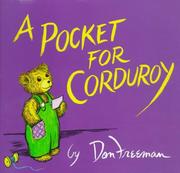
- 1978A Pocket for Corduroy书架 64
- 1985Corduroy's Party书架 13
- 1997The Book of Children's Classics书架 23
- 2000Gregory's Shadow书架 36
- 2005Earl the Squirrel书架 19