 书单
Jean Hatzfeld
- 生卒
- 1949 –
- 国籍
- 法国
- 获奖
- 美第奇文学奖(2007)
生平与创作
这个词条暂时没有中文维基百科条目,下面是英文维基百科的内容(英文原文):
Jean Hatzfeld is a French author and journalist who wrote extensively about the Bosnian War and the Rwandan Genocide in Rwanda.
Biography
Youth
Born on 14 September 1949 in Madagascar, Hatzfeld was the fourth child in the family of Olivier and Maud Hatzfeld. He is the grandson of Hellenist Jean Hatzfeld. He spent his childhood in Chambon-sur-Lignon, a village in the mountains of Auvergne in France, the town where his parents took refuge in 1942 and whose inhabitants distinguished themselves by welcoming thousands of Jews during the war. During World War II, German occupation forces deported his grandparents from France, but they survived.
In 1968, Hatzfeld travelled to Kabul and Peshawar, Pakistan. On his return to France, he worked in several factories before settling in Paris.
Work as a journalist
In 1975, Hatzfeld published his first article in the French newspaper Libération as a sports journalist. He then wrote serialized stories. Hatzfeld finally became a foreign correspondent, traveling to Israel, Palestine, Poland, Romania and other places in Eastern Europe.
Hatzfeld's first trip to Beirut convinced him to become a war correspondent. For 22 years, he covered wars in Africa and the Middle East, as well as the Bosnian War.
After his arrival in Rwanda as a reporter, shortly after the Rwandan genocide, Hatzfeld was struck by the collective failure of journalists covering the event and their incapacity to face up to the silence of the survivors. He decided to live in Rwanda to work with the Tutsi survivors of Nyamata, a village in the Bugesera district.
Literary work
Hatzfeld has written books based on his experience of being on war frontlines. In some of the books, Hatzfeld returns to speak with people he encountered during his years as a reporter. He also returns in his thoughts to places and restages various war themes, as well as the writings of war. In his last novels, he revisits the world of sport, especially in imbued by wars of the past.
In his Rwandan books, Hatzfeld uses the narratives of the people who lived through the experience of extermination. The first book, Dans le nu de la vie (Life laid bare: The Survivors in Rwanda speak), was written with the help of fourteen survivors living in the hills of Nyamata. He continues his work with a group of Hutu who took part in the genocide, who lived in the same hills and who were imprisoned in the Rilima penitentiary. As a result of these conversations, in 2003 he published Une saison de machettes (Machete Season: The Killers in Rwanda speak). He then wrote a novel, "La ligne de flottaison" (The Waterline), about a war correspondent struggling to return to his life in Paris.
In Englebert des collines, Hatzfeld talks about Englebert, a survivor of the swamps, a vagabond and alcoholic whom he has known since his first days in Nyamata. In this book, Hatzfeld narrates the passage of time, the life of the protagonists of his first books “after” the genocide, the impossible dialogue between survivors and killers after the latter have left prison, their fears, doubts and lack of understanding, and above all their phantoms. Twenty years after the butchery, he returns to the banks of the swamps to work with the children of the killers and the survivors, who already appeared in his former books, youths who have not experienced the machetes, but who have inherited the memory of them and who share a language consisting of metaphorical and often poetic vocabulary.
Several of Hatzfeld's books have been translated into different European and Asian languages, among them English.
Hatzfeld contributed to L’Autre Journal, GEO, Autrement, Rolling Stone, Cahiers du cinéma, Le Monde, Actuel. He has also written for various magazines and collective books in France and abroad (such as The Paris Review and the collection BPI Centre Pompidou); he also acted as a co-author of screen-writings.
Some of Hatzfeld's books have been adapted for the theatre. These include plays such as Igishanga, adapted and played by Isabelle Lafon; Une saison de machettes, adapted and staged by Dominique Lurcel; Dans le nu de la vie, directed by Jacques Taroni and produced by France-Culture for the Avignon Festival; Les voix de Nyamata, adapted and staged by Anna Feissel-Leibovici; Exil, adapted, staged and played by Sonia Wieder-Atherton on her cello at the Philharmonie of Paris.
Participations
Serge Daney, Petite bibliothèque des Cahiers du Cinéma
Après-guerre(s), Autrement
Bosnia (in small part), British Library
Claude Lanzmann, Un Voyant dans le siècle, Gallimard
Armistice, Gallimard
Notable distinctions
1998: prix Bayeux for war correspondents
2000: prix France-Culture, for Dans le nu de la vie
2003: prix Femina essai, for Une saison de machettes
2003: prix Joseph Kessel, for Une saison de machettes
2006: The Freedom of Expression Award (category of books), Great-Britain
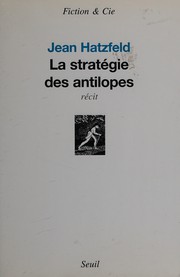
2007: Prix Médicis, for La stratégie des antilopes
2010: Ryszard Kapuściński Award, in Warsaw, for La stratégie des antilopes
2011: grand prix de Littérature sportive, for Où en est la nuit?
2016: prix Mémoire Albert Cohen, for Un papa de sang
2018: Jules Rimet Prize for Deux mètres dix
以上文字摘自英文维基百科「Jean Hatzfeld」(去掉了参考文献等尾部小节),按 CC BY-SA 4.0 使用,作者为维基百科的各位编者。
资料卡
- 出生
- 1949 年 9 月 14 日
- 出生地
- 马达加斯加
- 职业
- 新闻工作者、作家
- 使用语言
- 法语
- 写作语言
- 法语
- 获奖
- 十二月奖(1994)、Prix Femina essai(2003)、Index Award(2006)、美第奇文学奖(2007)、Ryszard Kapuściński Award for literary reportage(2010)、Jules Rimet Prize(2018)、Seligman Prize(2023)、Prix France Culture(2001)、约瑟夫·凯塞尔奖(2004)
资料卡来自 Wikidata Q764937(CC0),众包数据,个别字段可能不全。
本站收录的作品(1)
同时代的法国作家
前后几届的美第奇文学奖得主
全部得主 ›Open Library 上的全部作品
正在读取…