 书单
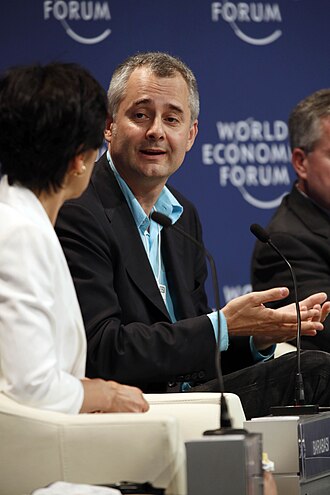
巴拉巴西
- 生卒
- 1967 –
- 国籍
- 匈牙利、罗马尼亚
- 外文名
- Albert-László Barabási
照片:World Economic Forum from Cologny, Switzerland,CC BY-SA 2.0,来自维基共享资源「Albert-Laszlo Barabasi - Annual Meeting of the New Champions 2012.jpg」(经缩小)。
生平与创作
这个词条暂时没有中文维基百科条目,下面是英文维基百科的内容(英文原文):
Albert-László Barabási (born March 30, 1967) is a Romanian-born Hungarian-American physicist, known for his research in network science and network medicine.
He is a distinguished university professor and Robert Gray Professor of Network Science at Northeastern University, holding additional appointments at the Department of Medicine, Harvard Medical School and the Department of Network and Data Science at Central European University. Barabási previously served as the former Emil T. Hofmann Professor of Physics at the University of Notre Dame and was an associate member of the Center of Cancer Systems Biology at the Dana–Farber Cancer Institute, Harvard University.
In 1999 Barabási discovered the concept of scale-free networks and proposed the Barabási–Albert model, which explains the widespread emergence of such networks in natural, technological and social systems, including the World Wide Web and online communities. Barabási is the founding president of the Network Science Society, which sponsors the flagship NetSci Conference established in 2006.
Birth and education
Barabási was born on March 30, 1967 to an ethnic Hungarian family in Cârța, Harghita County, Romania. His father, László Barabási, was a historian, museum director and writer, while his mother, Katalin Keresztes, taught literature, and later became director of a children's theater. He attended a high school specializing in science and mathematics; where he won a local physics olympiad in the 9th and 12th grade. Between 1986 and 1989, he studied physics and engineering at the University of Bucharest; during which time he began researching chaos theory and published three papers.
In 1989, Barabási emigrated to Hungary, together with his father. He received a master's degree in 1991 at Eötvös Loránd University in Budapest, under the supervision of Tamás Vicsek. Barabási then enrolled in the Physics program at Boston University, where he earned his PhD in 1994. His doctoral thesis, conducted under the direction of H. Eugene Stanley, was published by Cambridge University Press under the title Fractal Concepts in Surface Growth.
Academic career
After a one-year postdoc at the IBM Thomas J. Watson Research Center, Barabási joined the faculty at the University of Notre Dame in 1995. In 2000, at the age of 32, he was named the Emil T. Hofman Professor of Physics, becoming the youngest endowed professor. In 2004 he founded the Center for Complex Network Research.
In 2005–6 he was a visiting professor at Harvard University. In fall 2007, Barabási left Notre Dame to become a Distinguished University Professor and director of the Center for Network Science at Northeastern University. Concurrently, he took up an appointment in the Department of Medicine at Harvard Medical School.
As of 2008, Barabási holds Hungarian, Romanian and U.S. citizenship.
Research and achievements
Scale-free networks
Barabási's work challenged the prevailing notion that complex networks could be adequately modeled as random networks. In 1999 he created a map of the World Wide Web and found that its degree distribution does not follow the Poisson distribution expected for random networks, but instead it is best approximated by a power law, naming such networks scale-free networks. Collaborating with his student, Réka Albert, he introduced the Barabási–Albert model, which proposed that growth and preferential attachment are jointly responsible for the emergence of the scale-free property in real-world networks. The following year, Barabási demonstrated that the power law degree distribution is not limited to the World Wide Web, but also appear in metabolic networks and protein–protein interaction networks, demonstrating the universality of the scale-free property. In 2009 Science, for the ten-year anniversary of the 1999 paper on scale-free networks, dedicated a special issue to Complex Systems and Networks.
Network robustness and resilience
In a 2001 paper with Réka Albert and Hawoong Jeong, Barabási demonstrated that networks exhibit robustness to random failures but are highly vulnerable to targeted attacks, a characteristic known as the Achilles' heel property. Specifically, networks can easily withstand the random failure of a large number of nodes, highlighting their significant robustness. However, they are prone to rapid collapse when the most connected hubs are deliberately removed. The breakdown threshold of a network was analytically linked to the second moment of the degree distribution, whose convergence to zero for large networks explain why heterogenous networks can survive the failure of a large fraction of their nodes. In 2016, Barabási extended these concepts to network resilience, demonstrating that the network structure determines a system's capacity for resilience. While robustness refers to the system's ability to carry out its basic functions despite the loss of some nodes and links, resilience involved the system's ability to adapt to internal and external disturbances by modifying its mode of operation without losing functionality. Therefore, resilience is a dynamical property that requires a fundamental shift in the system's core activities.
以上文字摘自英文维基百科「Albert-László Barabási」(有删节,去掉了参考文献等尾部小节),按 CC BY-SA 4.0 使用,作者为维基百科的各位编者。
资料卡
- 出生
- 1967 年 3 月 30 日
- 出生地
- Cârța
- 职业
- 物理学家、大学教师、统计物理学家
- 使用语言
- 英语、匈牙利语、罗马尼亚语
- 就读学校
- 布加勒斯特大学(1986)、波士顿大学、罗兰大学
- 领域
- 网络理论
- 所属团体
- 欧洲科学院(2007)、匈牙利科学院(2004)、美国物理学会、美国文理科学院、罗马尼亚科学院 等 7 项
- 代表作
- The Formula: the science behind why people succeed or fail
- 获奖
- 利林费尔德奖章(2023)、美国科学促进会会士(2011);另有 4 项只有外文名
资料卡来自 Wikidata Q725467(CC0),众包数据,个别字段可能不全。
本站收录的作品(1)
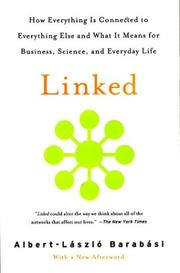
作品年表(1 本)
本站书库里署名巴拉巴西的书(Open Library 上至少 10 人加过书架的才收),按首版年份排(有本站书页的用 Wikidata 记的首版年,其余用 Open Library 的);年份偶尔记成后来的版本或译本,以原书为准。全部作品见 Open Library。
- 2002Linked书架 12