 书单
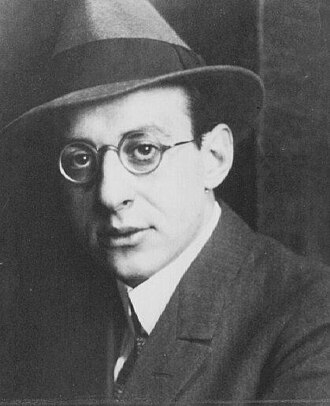
弗里茨·波尔斯
- 生卒
- 1893 – 1970
- 国籍
- 普鲁士王国、南非
- 外文名
- Fritz Perls
照片:作者不详,公有领域,来自维基共享资源「Fritz Perls.jpg」(经缩小)。
生平与创作
这个词条暂时没有中文维基百科条目,下面是英文维基百科的内容(英文原文):
Friedrich Salomon Perls (July 8, 1893 – March 14, 1970), better known as Fritz Perls, was a German-born psychiatrist, psychoanalyst and psychotherapist. Perls coined the term "Gestalt therapy" to identify the form of psychotherapy that he developed with his wife, Laura Perls, in the 1940s and 1950s. In 1964, Perls became associated with the Esalen Institute (U.S.) where he lived until 1969.
The core of the Gestalt therapy process is enhanced awareness of sensation, perception, bodily feelings, emotion, and behavior, in the present moment. Relationship is emphasized, along with contact between the self, its environment, and the other.
Life
Fritz Perls was born in Berlin, Germany, in 1893. He grew up in the bohemian scene in Berlin, participated in Expressionism and Dadaism, and experienced the turning of the artistic avant-garde toward the revolutionary left. Deployment to the front line, the trauma of war, antisemitism, intimidation, escape, and the Holocaust are further key sources of biographical influence.
He was expected to practice law, following his distinguished uncle Herman Staub, but instead he studied medicine. Perls joined the German Army during World War I and spent time in the trenches. After the war in 1918 he returned to his medical studies graduating two years later, specializing in neuropsychiatry as a medical doctor, and then became an assistant to Kurt Goldstein, who worked with brain injured soldiers. Perls gravitated toward psychoanalysis.
In 1927, Perls became a member of Wilhelm Reich's technical seminars in Vienna. Reich's concept of character analysis influenced Perls to a large extent. And in 1930 Reich became Perls' supervising senior analyst in Berlin.
In 1930, Perls married Laura Perls (born Lore Posner) and they had two children together, Renate and Stephen. In 1933, soon after the Hitler regime came to power, being of Jewish descent and because of their anti-fascist political activities in the time before, Perls, Laura, and their eldest child Renate fled to the Netherlands, and one year later they emigrated to South Africa, where Perls started a psychoanalytic training institute. In 1936 he had a brief and unsatisfactory meeting with Freud.
In 1942, Perls joined the South African army, and he served as an army psychiatrist with the rank of captain until 1946. While in South Africa, Perls was influenced by the "holism" of Jan Smuts. During this period Fritz Perls co-wrote his first book, Ego, Hunger, and Aggression (published in 1942 and re-published in 1947). Laura Perls wrote two chapters of the book, although when it was re-published in the United States she was not given any recognition for her work.
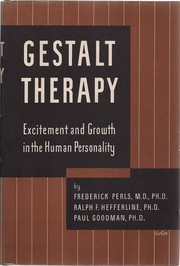
Fritz and Laura Perls left South Africa in 1946 and ended up in New York City, where Fritz Perls worked briefly with Karen Horney, and Wilhelm Reich. After living through a peripatetic episode, during which he lived in Montreal and served as a cruise ship psychiatrist, Perls finally settled in Manhattan. Perls wrote his second book with the assistance of New York intellectual and author, Paul Goodman, who drafted the theoretical second part of the book based upon Perls' hand-written notes. Perls and Goodman were influenced by the work of Kurt Lewin and Otto Rank. Along with the experiential first part, written with Ralph Hefferline, the book was entitled Gestalt Therapy and published in 1951.
Thereafter, Fritz and Laura Perls started the first Gestalt Institute in their Manhattan apartment. Fritz Perls began traveling throughout the United States in order to conduct Gestalt workshops and training.
In 1960 Fritz Perls left Laura Perls behind in Manhattan and moved to Los Angeles, where he practiced in conjunction with Jim Simkin. He started to offer workshops at Esalen Institute in Big Sur, California, in 1963. Perls became interested in Zen during this period, and incorporated the idea of mini-satori (a brief awakening) into his practice. He also traveled to Japan, where he stayed in a Zen monastery.
Eventually, he settled at Esalen, and even built a house on the grounds. One of his students at Esalen was Dick Price, who developed Gestalt Practice, based in large part upon what he learned from Perls. At Esalen, Perls collaborated with Ida Rolf, founder of Rolfing, to address the relationship between the mind and the body.
Perls has been widely cited outside the realm of psychotherapy for a quotation often described as the "Gestalt prayer":
I do my thing and you do your thing.
I am not in this world to live up to your expectations, and you are not in this world to live up to mine.
You are you, and I am I, and if by chance we find each other, it's beautiful.
If not, it can't be helped.
In 1969 Perls left Esalen and started a Gestalt community at Lake Cowichan on Vancouver Island, Canada. There, he hosted eight educational films on his gestalt therapy, which were directed by Stanley Fox for Aquarian Productions, a film production company started by Perls associate Norman Hirt.
Fritz Perls died of heart failure in Chicago, on March 14, 1970, after heart surgery at the Louis A. Weiss Memorial Hospital.
Lifestyle
Perls was a heavy smoker, first experiencing cigarettes at the age of eight but then becoming a chain smoker due to his experiences in the Second World War, Perls also used LSD recreationally during the 1960s.
Perls practiced non-monogamy and had many sexual and romantic encounters outside of his marriage to Laura Perls. He describes his marriage to Laura as partners with shared goals that had episodes of love.
Reception
Perls' approach to therapy was included in criticism by Jeffrey Masson, a psychoanalyst who feuded with journalists and with the psychoanalytic community generally over his controversial theories disputing the effectiveness of psychotherapy. Masson said that Perls was sexist, as well as physically and emotionally abusive towards women in his private life. Masson quoted Perls from his autobiography, In and Out the Garbage Pail, where Perls wrote:
以上文字摘自英文维基百科「Fritz Perls」(有删节,去掉了参考文献等尾部小节),按 CC BY-SA 4.0 使用,作者为维基百科的各位编者。
资料卡
- 母语名
- Fritz Perls
- 出生
- 1893 年 7 月 8 日
- 出生地
- 柏林
- 逝世
- 1970 年 3 月 14 日
- 逝世地
- 芝加哥
- 职业
- 心理学家、精神科医师、心理治疗师
- 使用语言
- 德语、英语
- 领域
- 格式塔治疗
- 配偶
- Laura Perls(1930)
- 受谁影响
- 威廉·赖希
- 代表作
- Gestalt Therapy
资料卡来自 Wikidata Q60750(CC0),众包数据,个别字段可能不全。
本站收录的作品(1)
作品年表(8 本)
本站书库里署名弗里茨·波尔斯的书(Open Library 上至少 10 人加过书架的才收),按首版年份排(有本站书页的用 Wikidata 记的首版年,其余用 Open Library 的);年份偶尔记成后来的版本或译本,以原书为准。全部作品见 Open Library。
- 1945Ego, hunger, and aggression书架 50
- 1951Gestalt Therapy书架 46
- 1951Gestalt therapy: excitement and growth in the human personality书架 23
- 1951Gestalt therapy: excitement and growth in the human personality书架 14
- 1969Gestalt therapy verbatim书架 61
- 1969In and Out the Garbage Pail书架 17
- 1972In and out the garbage pail.书架 16
- 1981The Gestalt approach and Eye witness to therapy书架 15