 书单
兰斯洛特·霍格
- 生卒
- 1895 – 1975
- 国籍
- 英国
- 外文名
- Lancelot Hogben
生平与创作
这个词条暂时没有中文维基百科条目,下面是英文维基百科的内容(英文原文):
Lancelot Thomas Hogben FRS FRSE (9 December 1895 – 22 August 1975) was a British experimental zoologist and medical statistician. He developed the African clawed frog (Xenopus laevis) as a model organism for biological research in his early career, attacked the eugenics movement in the middle of his career, and wrote popular books on science, mathematics and language in his later career.
Early life and education
Hogben was born and raised in Southsea near Portsmouth in Hampshire. He attended Tottenham County School in London, his family having moved to Stoke Newington, where his mother had grown up, in 1907, and then as a medical student studied physiology at Trinity College, Cambridge. Hogben had matriculated into the University of London as an external student before he could apply to Cambridge and he graduated as a Bachelor of Science (BSc) in 1914. He took his Cambridge degree in 1915, graduating with an Ordinary BA. He had acquired socialist convictions, changing the name of the university's Fabian Society to Socialist Society and went on to become an active member of the Independent Labour Party. Later in life he preferred to describe himself as 'a scientific humanist'.
In the First World War he was a pacifist, and joined the Quakers. He worked for six months with the Red Cross in France, under the auspices of the Friends' War Victims Relief Service and then the Friends' Ambulance Unit. He then returned to Cambridge, and was imprisoned in Wormwood Scrubs as a conscientious objector in 1916. His health collapsed and he was released in 1917. His brother George was also a conscientious objector, serving with the Friends' Ambulance Unit.
Career
After a year's convalescence he took lecturing positions in London universities and in 1921 he became a Doctor of Science (D.Sc.) in Zoology of the University of London. He moved in 1922 to the University of Edinburgh and its Animal Breeding Research Department. In 1923, Hogben was a founder of the Society for Experimental Biology and its organ the British Journal of Experimental Biology (renamed Journal of Experimental Biology in 1930), along with Julian Huxley and geneticist Francis Albert Eley Crew (1886–1973). According to Gary Werskey, Hogben was the only one of the founders not holding any eugenic ideas. In 1923 he was also elected a Fellow of the Royal Society of Edinburgh. His proposers were James Hartley Ashworth, James Cossar Ewart, Francis Albert Eley Crew and John Stephenson. He won the Society's Keith Prize for the period 1933–35. He then went to McGill University.
In 1927 he became zoology chair at the University of Cape Town. He worked in endocrinology, studying chameleon properties of the Xenopus frog. The frog's adult color depended on its early environment; wild frogs became brownish-green, while frogs raised in a dark environment became black, and in a light environment, light-colored. Hogben theorized that the frog's ability to develop differences in color was related to the pituitary gland. After removing the pituitary gland, the frogs became white regardless of their environment.
The frogs also developed a side effect that Hogben tried to counteract by injecting the frogs with pituitary extract from an ox. He noticed that female Xenopus frogs ovulated within hours of being injected with the extract. In this way, Hogben serendipitously discovered a human pregnancy test. He knew that the ox extract chemically resembled human chorionic gonadotropin (HCG), a hormone released by pregnant women. He confirmed that female Xenopus frogs, when injected with urine from a pregnant woman, ovulated within hours. Hogben found the job in South Africa attractive, but his antipathy to the country's racial policies drove him to leave.
In 1930 Hogben moved to the London School of Economics, in a chair for social biology. There he continued to develop the Hogben Pregnancy Test. Previous pregnancy tests required several days to carry out and resulted in the deaths of mice or rabbits. Hogben's pregnancy test took hours and could be carried out without harm to the frogs, which could be reused for future tests. It became the major, international pregnancy test for about fifteen years, from the mid-1930s through the 1940s.
The social biology position at the London School of Economics was funded by the Rockefeller Foundation, and when it withdrew funding Hogben moved to Aberdeen, becoming Regius Professor of Natural History at the University of Aberdeen in 1937.
During World War II Hogben had responsibility for the British Army's medical statistics. From 1941 to 1947 he was Mason Professor of Zoology at the University of Birmingham and professor of medical statistics there 1947–1961, when he retired.
In 1963, he became the first Vice-Chancellor of the University of Guyana, a post he abandoned in April 1964, resigning in 1965.
以上文字摘自英文维基百科「Lancelot Hogben」(有删节,去掉了参考文献等尾部小节),按 CC BY-SA 4.0 使用,作者为维基百科的各位编者。
资料卡
- 母语名
- Lancelot Hogben
- 出生
- 1895 年 12 月 9 日
- 出生地
- 朴次茅斯
- 逝世
- 1975 年 8 月 22 日
- 逝世地
- 雷克瑟姆
- 职业
- 数学家、遗传学家、统计学家、动物学家、作家、语言学家
- 使用语言
- 英语
- 就读学校
- 剑桥大学三一学院、Woodside High School
- 领域
- 动物学、统计学
- 所属团体
- 英国皇家学会
- 配偶
- Enid Charles
- 代表作
- Interglossa
- 获奖
- 英国皇家学会院士、克鲁内演讲(1942)、基思奖(1933)
资料卡来自 Wikidata Q562117(CC0),众包数据,个别字段可能不全。
本站收录的作品(1)
作品年表(1 本)
本站书库里署名兰斯洛特·霍格的书(Open Library 上至少 10 人加过书架的才收),按首版年份排(有本站书页的用 Wikidata 记的首版年,其余用 Open Library 的);年份偶尔记成后来的版本或译本,以原书为准。全部作品见 Open Library。
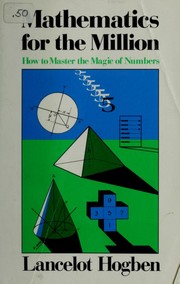
- 1937Mathematics for the million书架 138