 书单
阿特米多鲁斯
- 生卒
- 2 世纪 – 2 世纪
- 外文名
- Artemidorus
生平与创作
阿特米多鲁斯(英语:Artemidorus),约活动于公元2世纪前后。古希腊占卜家和释梦家。出生于以弗所(今属土耳其)。他著有《解梦》一书,此著主要辑录前人的著作而成,有助于后世了解古代迷信、神话和宗教礼仪。
以上文字摘自维基百科「阿特米多鲁斯」(去掉了参考文献等尾部小节),按 CC BY-SA 4.0 使用,作者为维基百科的各位编者。
中文维基百科的条目比较短,下面附上英文维基百科的内容(英文原文):
Artemidorus Daldianus (Ancient Greek: Ἀρτεμίδωρος ὁ Δαλδιανός) or Ephesius was a professional diviner and dream interpreter who lived in the 2nd century AD. He is known from an extant five-volume Greek work, the Oneirocritica or Oneirokritikon (English: The Interpretation of Dreams).
Life and work
Artemidorus was surnamed Ephesius, from Ephesus, on the west coast of Asia Minor, but was also called Daldianus, from his mother's native city, Daldis in Lydia. He lived in the 2nd century AD.
According to Artemidorus, the material for his work was gathered during lengthy travels through Greece, Italy and Asia, from diviners of high and low station. Another major source were the writings of Artemidorus' predecessors, sixteen of whom he cites by name. It is clear he built on a rich written tradition, now otherwise lost. Artemidorus' method is, at root, analogical. He writes that dream interpretation is "nothing other than the juxtaposition of similarities" (2.25). But like other types of Greek divination, including astrology, celestial divination and pallomancy, Greek dream divination (Oneiromancy) became exceedingly complex, a given dream subject to a number of interpretations depending on secondary considerations, such as the age, sex, and status of the dreamer. At other times, subtle distinctions within the dream itself are significant. In a particularly memorable passage, Artemidorus expounds upon the meaning of dreams involving sex with one's mother:
The case of one's mother is both complex and manifold and admits of many different interpretations—a thing not all dream interpreters have realized. The fact is that the mere act of intercourse by itself is not enough to show what is portended. Rather, the manner of the embraces and the various positions of the bodies indicate different outcomes. (Trans. Robert J. White)
There follows a lengthy and minute recitation of the divinatory significance of having sex with one's mother in various sexual positions.
The first three books of the Oneirocritica are dedicated to one Cassius Maximus, usually identified with the rhetorician Maximus of Tyre, and were intended to serve as a detailed introduction for both diviners and the general public. Books four and five were written for Artemidorus' son, also named Artemidorus, to give him a leg-up on competitors, and Artemidorus cautions him about making copies.
According to the Suda, Artemidorus also penned a Oiônoscopica (Οἰωνοσκοπικὰ) (Interpretation of Birds) and a Chiroscopica (Χειροσκοπικά) (Palmistry), but neither has survived, and the authorship is discounted. In the Oneirocritica, Artemidorus displays a hostile attitude to palmistry.
Among the authors Artemidorus cites are Antiphon (possibly the same as Antiphon the Sophist), Aristander of Telmessus, Demetrius of Phalerum, Alexander of Myndus in Caria, and Artemon of Miletus. The fragments of these authors, from Artemidorus and other sources, were collected by Del Corno in his Graecorum de re onirocritica scriptorum reliquiae (1969).
Editions and translations
The definitive edition of the Greek text is by Roger Pack, Artemidori Daldiani Onirocriticon Libri V (Teubner 1963)
The most recent edition including Greek text (slightly revised from Pack's), English translation and commentary is: Daniel E. Harris-McCoy, Artemidorus' Oneirocritica: Text, Translation, and Commentary (Oxford: Oxford University Press, 2012). For an earlier English translation: R.J. White, The Interpretation of Dreams (2nd Edition, Torrance, CA: Original Books, 1990).
A medieval Arabic version was made of the first three books (i.e., the "public" books) in 877 AD by Hunayn ibn Ishaq, and published by Toufic Fahd with a French introduction in 1964 under the title Le livre des songes [par] Artémidore d'Éphèse
The most recent English translation is by Martin Hammond, The Interpretation of Dreams (Oxford World's Classics, 2020)
The most recent Italian translation is by Dario Del Corno, Libro dei sogni (1974)
以上文字摘自英文维基百科「Artemidorus of Daldis」(有删节,去掉了参考文献等尾部小节),按 CC BY-SA 4.0 使用,作者为维基百科的各位编者。
资料卡
- 出生
- 2 世纪
- 出生地
- 以弗所
- 逝世
- 2 世纪
- 职业
- 作家
- 使用语言
- 古希腊语
- 写作语言
- 古希腊语
资料卡来自 Wikidata Q445848(CC0),众包数据,个别字段可能不全。
本站收录的作品(1)
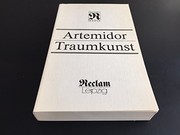
作品年表(1 本)
本站书库里署名阿特米多鲁斯的书(Open Library 上至少 10 人加过书架的才收),其中 1 本记的年份比作者去世晚 50 年以上或者早于他出生(多半是后世的版本、译本或占位年份),不列年份,按首版年份排(有本站书页的用 Wikidata 记的首版年,其余用 Open Library 的);年份偶尔记成后来的版本或译本,以原书为准。全部作品见 Open Library。
- 年份不详Oneirocritica书架 10