 书单
Dhan Gopal Mukerji
- 生卒
- 1890 – 1936
- 国籍
- 英属印度
- 获奖
- 纽伯瑞儿童文学奖(1928)
生平与创作
这个词条暂时没有中文维基百科条目,下面是英文维基百科的内容(英文原文):
Dhan Gopal Mukerji (Bengali: ধন গোপাল মুখোপাধ্যায়; Dhan Gōpāl Mukhōpādhyāy) (6 July 1890 – 14 July 1936) was the first successful Indian man of letters in the United States and won a Newbery Medal in 1928. He studied at Duff School (now known as Scottish Church Collegiate School), and at Duff College, both within the University of Calcutta in India, at the University of Tokyo in Japan and at the University of California, Berkeley and Stanford University in the US.
Biography
Early life in India
Dhan Gopal Mukerji was born in a Bengali Brahmin family on 6 July 1890, in a village near Calcutta on the edge of a jungle called Kajangal. His father was a lawyer who gave up his practice due to ill health and studied music instead, while also officiating as priest at the village temple. Dhan Gopal describes his childhood and adolescence in the first part ('Caste') of his autobiography, Caste and Outcast (1923). Caste details Dhan Gopal's induction into the Brahminical tradition of his ancestors, and his experiences of wandering for a year as an ascetic, as was the custom for boys in strict priestly households. However, disillusioned with the traditional role and impatient of the backward-looking element in strict Hindu society, he left the ascetic life to study at the University of Calcutta. Here, in the circle of his brother Jadugopal Mukherjee's friends, he came in contact with the ideas of the Bengal resistance. Jadu Gopal was subsequently jailed without trial from 1923 to 1927. Dhan Gopal later wrote a memoir about Jadu Gopal, titled My Brother's Face.
Dhan Gopal's family sent him to Japan to study industrial machinery and textiles in 1910. He became deeply disillusioned by the assembly line method of production and proclivity towards sheer efficiency which he viewed as dehumanizing, degrading and debasing. He was particularly shocked by how assembly line workers who had suffered serious accidents were quickly replaced by other workers, without consideration by the factory owners or employers for either their medical recovery, health benefits or adequate compensation. After a short stay in Japan, he boarded a ship for San Francisco.
In the San Francisco Bay Area
Barely out of his teens, Dhan Gopal had absorbed enough revolutionary ideology from his peers to have been well on the way to following in his brother's footsteps, and may not have left India entirely willingly. Dhan Gopal took his ideology with him to America where he fell in with a number of dirt-poor 'anarchists' like himself. His experiences among them, in San Francisco and New York, are detailed in 'Outcast', the second section of his autobiography.
In 1910, he enrolled at University of California, Berkeley but transferred to Stanford University, where he eventually received his A.B. degree in philosophy in 1914. In the San Francisco Bay Area, he looked about for a way to support himself and pay for his college education, and soon lit upon writing. Around 1916 he wrote Sandhya, Songs of Twilight and Rajani or Songs of the Night, two books of poems, and Laila Majnu, a musical play in three acts, all published by Paul Elder and Company of San Francisco.
He married Ethel Ray Dugan, an American artist and educator, and in 1918 they had a son, also called Dhan "Dan" Gopal Jr.
In New York City
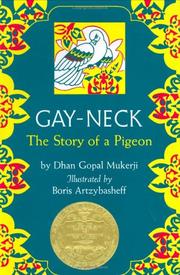
In the 1920s, Mukerji moved to New York City and began his most prolific period of writing, published mainly by E.P. Dutton. Of his many children's books, Kari the Elephant was the first to see publication, in 1922, followed by Hari, the Jungle Lad two years later and Gay Neck, the Story of a Pigeon in 1927. Gay was the most successful; Mukerji won the 1928 Newbery Medal from the American Library Association recognising it as the year's best American children's book. The story features a carrier pigeon, Gay-Neck: his training and care in the flock owned by the narrator, his drafting as a messenger for the Indian army in France during World War I, and his return to India where he and his handler deal with the wounds and memories of war in the seclusion of a lamasery. One theme is "man and winged animals as brothers". Mukerji's other children's books include Ghond, the Hunter (1928), The Chief of the Herd (1929), Hindu Fables for Little Children (1929), Rama, the Hero of India (1930, produced for the children of Dalton School where his wife taught), The Master Monkey (1932), and Fierce-Face, the Story of a Tiger (1936). All these children's books were published by Dutton with professional illustrations, most in about 200 pages. Many of his works were reworkings of stories he had heard as a child. Others were inspired by his own experiences in India as a child among the jungles of Bengal, or as a yogi in various holy places.
Among Mukerji's writings for adults are A Son of Mother India Answers (1928) (partly in response to Katherine Mayo's Mother India), Devotional Passages from the Hindu Bible and Visit India with Me (1929), Disillusioned India (1930) and My Brother's Face (1932). The Face of Silence (1926) is about the nineteenth-century saint and visionary Ramakrishna Paramhansa and is said to have deeply influenced Romain Rolland.
The details of his later life are hazy, but there is some evidence to believe that relations with his wife entered a difficult phase at the end of his life. In spite of his many friends he felt isolated and marginalised in America, as he could do very little, beyond raising funds and entertaining visiting celebrities, to further the cause of the Indian independence movement. The choices he had made in life prevented him from ever returning permanently to India. The unhappiness of his final years drove him further into spirituality, fuelled his interest in the spiritual heritage of his motherland and gave urgency to his desire to interpret and explain India to the West.
Death and legacy
On 14 July 1936, his wife discovered Mukerji had hanged himself in his New York City apartment. No note was left.
以上文字摘自英文维基百科「Dhan Gopal Mukerji」(有删节,去掉了参考文献等尾部小节),按 CC BY-SA 4.0 使用,作者为维基百科的各位编者。
资料卡
- 出生
- 1890 年 7 月 6 日
- 出生地
- 加尔各答
- 逝世
- 1936 年 7 月 14 日
- 逝世地
- 纽约
- 职业
- 作家、剧作家、儿童文学作家、小说家
- 使用语言
- 英语
- 写作语言
- 英语
- 就读学校
- 斯坦福大学、加尔各答大学、加州大学伯克利分校、东京大学、苏格兰基督学院 等 6 项
- 获奖
- 纽伯瑞儿童文学奖(1928)
资料卡来自 Wikidata Q5268884(CC0),众包数据,个别字段可能不全。
本站收录的作品(1)
同时代的英属印度作家
前后几届的纽伯瑞儿童文学奖得主
全部得主 ›Open Library 上的全部作品
正在读取…