 书单
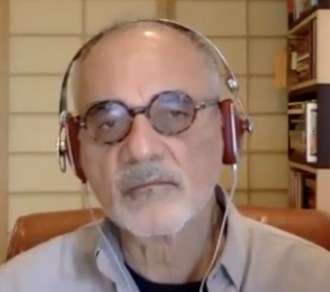
马哈茂德·马姆达尼
- 生卒
- 1946 –
- 国籍
- 乌干达
- 外文名
- Mahmood Mamdani
照片:@soasuni,CC BY 3.0,来自维基共享资源「Mahmood Mamdani.png」(经缩小)。
生平与创作
这个词条暂时没有中文维基百科条目,下面是英文维基百科的内容(英文原文):
Mahmood Mamdani (born 23 April 1946) is a Ugandan anthropologist, academic, and political commentator. He is the Herbert Lehman Professor of Government and a professor of anthropology, political science, and African studies at Columbia University. He also served as the chancellor of Kampala International University in Uganda, and honorary professor at the Centre for African Studies at the University of Cape Town.
He was previously the director of the Makerere Institute of Social Research (MISR) in Kampala, Uganda, from 2010 until 2022. Mamdani specialises in the study of African and international politics, colonialism and post‐colonialism, and the politics of knowledge production. He is married to filmmaker Mira Nair, and is the father of New York City Mayor Zohran Mamdani.
Early life and education
Mahmood Mamdani was born on 23 April 1946 in Bombay (now Mumbai), India, the year before the end of British Raj. He was raised in Kampala, Uganda, as part of the Indian diaspora in Southeast Africa. Both his parents were born and raised in the British territory of Tanganyika (present-day Tanzania) in East Africa. His parents moved to Bombay while his father attended college there. The family returned to Dar es Salaam, Tanganyika, when Mamdani was two, and moved to Uganda when he was five or six years old.
At the time, Uganda was racially segregated, including where people lived, the schools, the mosques, and children's play areas. For his primary school education, Mamdani first attended a madrasa, and then the Government Indian Primary School. He grew up speaking Gujarati, Urdu, and Swahili. He started studying English in sixth grade. After junior secondary school, he attended Old Kampala Senior Secondary School, where he was secretary of the Do-it-Yourself Physics club.
Mamdani was one of 23 Ugandan students in the 1963 group of the Kennedy Airlift, a US-funded scholarship program that brought hundreds of East Africans to universities in the United States and Canada between 1959 and 1963. Mamdani graduated with a Bachelor of Arts degree from the University of Pittsburgh in 1967.
He was among the many students in the northern United States who made the bus journey south to Montgomery, Alabama in March 1965 to participate in the civil rights movement for a march organized by the Student Nonviolent Coordinating Committee. Mamdani was jailed during the march and allowed to make a phone call. He contacted the Ugandan ambassador in Washington, DC for assistance. The ambassador asked him why he was "interfering in the internal affairs of a foreign country", to which he responded that this was not an internal affair but a freedom struggle and that Ugandans, too, had gotten their freedom only the year before. Soon after, Mamdani learned about the work of Karl Marx when two FBI agents visited him to find out why he had attended the march and, during the questioning, asked him whether he liked Marx, with whom he was not familiar before their visit.
Mamdani attended the Fletcher School of Law and Diplomacy of Tufts University and graduated with a Master of Arts degree in political science in 1968 and a Master of Arts degree in law and diplomacy in 1969. He obtained his doctor of philosophy degree in government from Harvard University in 1974, under the direction of Karl Deutsch. His thesis was titled Politics and Class Formation in Uganda.
Career
Mamdani returned to Uganda in early 1972 and was employed by Makerere University in Kampala as a teaching assistant, at the same time conducting his doctoral research. He and most Asians were expelled later that year by Ugandan dictator Idi Amin because of their ethnicity; Amin intended to "reclaim" Asian-owned businesses and properties. Mamdani left Uganda for a refugee camp in the United Kingdom in early November.
He left England in mid-1973 after being recruited to the University of Dar es Salaam in Tanzania, where he completed his dissertation. He was active in anti-Amin groups in Tanzania. In 1979, he attended the Moshi Conference as an observer. He returned to Uganda after Amin was overthrown following the Uganda–Tanzania War in 1979. During this period, he was employed as an intern with the All Africa Conference of Churches, an ecumenical Christian alliance based in Nairobi, Kenya, working at the Church of Uganda's Kampala office.
From 1980 (following Amin's ouster in 1979) until 1993 he was again employed by Makerere University. In 1984, while attending a conference in Dakar, Senegal, he became stateless after his Ugandan citizenship was withdrawn by the government under Milton Obote because of his criticism of its policies. He returned to Dar es Salaam. After Obote was deposed for the second time, Mamdani once again returned to Uganda in June 1986.
He was the founding director of the Centre for Basic Research (CBR), Uganda's first non-governmental research organisation, where he served from 1987 to 1996.
He was also a visiting professor at the University of Durban-Westville in South Africa (January to June 1993), at the Nehru Memorial Museum & Library in New Delhi (January to June in 1995), and at Princeton University (1995–96).
以上文字摘自英文维基百科「Mahmood Mamdani」(有删节,去掉了参考文献等尾部小节),按 CC BY-SA 4.0 使用,作者为维基百科的各位编者。
资料卡
- 母语名
- Mahmood Mamdani
- 出生
- 1946 年 4 月 23 日
- 出生地
- 孟买
- 职业
- 人类学家、大学教师、作家、政治学家
- 使用语言
- 英语
- 就读学校
- 匹兹堡大学、哈佛大学、弗莱彻法律与外交学院
- 领域
- 非洲研究、政治学、人类学
- 配偶
- 米拉·奈儿(1991)
- 获奖
- 英国科学院院士;另有 1 项只有外文名
资料卡来自 Wikidata Q723502(CC0),众包数据,个别字段可能不全。
本站收录的作品(1)
作品年表(5 本)
本站书库里署名马哈茂德·马姆达尼的书(Open Library 上至少 10 人加过书架的才收),按首版年份排(有本站书页的用 Wikidata 记的首版年,其余用 Open Library 的);年份偶尔记成后来的版本或译本,以原书为准。全部作品见 Open Library。
- 1996Citizen and subject书架 11
- 2001When victims become killers书架 33
- 2004Good Muslim, bad Muslim书架 25
- 2004Good Muslim, Bad Muslim书架 18
- 2020Neither Settler nor Native书架 11