 书单
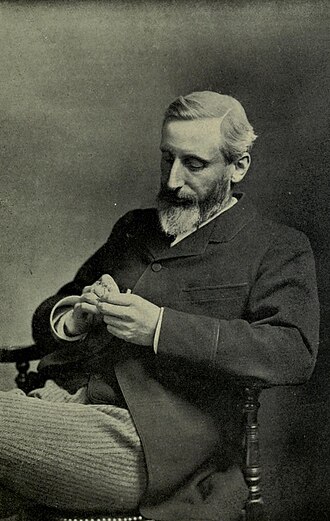
格兰特·艾伦
- 生卒
- 1848 – 1899
- 国籍
- 美国、英国
- 外文名
- Grant Allen
照片:Elliott & Fry,公有领域,来自维基共享资源「Portrait of Grant Allen.jpg」(经缩小)。
生平与创作
这个词条暂时没有中文维基百科条目,下面是英文维基百科的内容(英文原文):
Charles Grant Blairfindie Allen (February 24, 1848 – October 25, 1899) was a Canadian science writer and novelist, educated in England. He was a public promoter of evolution in the second half of the nineteenth century.
Early life, family and education
Allen was born on Wolfe Island near Kingston, Canada West (known as Ontario after Confederation), the second son of Catharine Ann Grant and the Rev. Joseph Antisell Allen, a Protestant minister from Dublin, Ireland. His mother was a daughter of the fifth Baron de Longueuil. Allen was educated at home until, at age 13, he and his parents moved to the United States, then to France, and finally to the United Kingdom. He was educated in the UK: at King Edward's School in Birmingham and at Merton College in Oxford.
After graduation, Allen studied in France.
Career
Instructor
Allen taught at Brighton College in 1870–71. In his mid-twenties, he became a professor at Queen's College, a black college in Jamaica. Despite being the son of a minister, Allen became an atheist and a socialist.
Writer
After leaving his professorship, in 1876 he returned to England, where he turned his talents to writing, gaining a reputation for his essays on science and for literary works. A 2007 book by Oliver Sacks cites with approval one of Allen's early articles, "Note-Deafness" (a description of what became known as amusia, published in 1878 in the learned journal Mind).
Allen's first books dealt with scientific subjects, and include Physiological Æsthetics (1877) and Flowers and Their Pedigrees (1886) He was first influenced by associationist psychology as expounded by Alexander Bain and by Herbert Spencer, the latter who especially espoused the transition from associationist psychology to Darwinian functionalism. In Allen's many articles on flowers and on perception in insects, Darwinian arguments replaced the old Spencerian terms. Allen argued that evolution in color sense linked flowers to insects and birds, and mammals to humans. This led to a radically new vision of plant life that influenced H.G. Wells and helped transform later botanical research. The 1892 edition of the book was supported by both Darwin and Spencer. It attacked Hugo Magnus’s idea that color sense had developed in historical times due to old literature only having simple color names.
On a personal level, a long friendship that started when Allen met Spencer on his return from Jamaica grew uneasy over the years. Allen wrote a critical and revealing biographical article on Spencer that was published after Spencer's death.
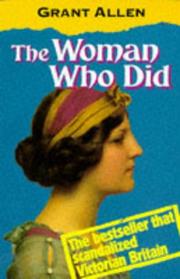
After assisting Sir W. W. Hunter with his Gazetteer of India in the early 1880s, Allen turned his attention to fiction. Between 1884 and 1899, he wrote about 30 novels. In 1895, his scandalous book The Woman Who Did, promulgating certain startling views on marriage and kindred questions, became a bestseller. The book told the story of an independent woman who has a child out of wedlock. Owing to his concern with these subjects, Allen was associated with Thomas Hardy, whose novel Jude the Obscure (1895) was published the same year as The Woman Who Did.
In his career, Allen wrote two novels under female pseudonyms. One of these, the short novel The Type-writer Girl, he wrote under the name Olive Pratt Rayner.
Another work, The Evolution of the Idea of God (1897), propounds a theory of religion on heterodox lines comparable to Herbert Spencer's "ghost theory". Allen's theory became well known. Brief references to it appear in a review by Marcel Mauss, Durkheim's nephew, in the articles of William James, and in the works of Sigmund Freud. G. K. Chesterton wrote on what he considered the flawed premise of the idea, arguing that the idea of God preceded human mythologies, rather than developing from them. Chesterton said of Allen's book on the evolution of the idea of God: "it would be much more interesting if God wrote a book on the evolution of the idea of Grant Allen".
Allen also became a pioneer in science fiction. His novel The British Barbarians (1895), published about the same time as H. G. Wells's The Time Machine (which appeared in January–May 1895, and which includes a mention of Allen), also describes time travel, although the plot is quite different. Allen's short story "The Thames Valley Catastrophe" (published December 1897 in The Strand Magazine) describes the destruction of London by a sudden and massive volcanic eruption.
Personal life
Allen married twice, first to Caroline Ann Bootheway (1846–1871) and secondly, in 1873, to Ellen Jerrard (1851–1936) with whom he had one son, Jerrard Grant Allen (1878–1946), a theatrical agent/manager who in 1913 married the actress and singer Violet Englefield. They had a son, Reginald "Reggie" Grant Allen (1910–1985).
Grant Allen's nephew, Grant Richards, was a writer and publisher who founded the Grant Richards publishing house. Allen encouraged his nephew's interest in books and publishing and helped him obtain his first positions in the book trade. Richards was later to publish a number of books written by his uncle, including The Evolution of the Idea of God and those in the book series Grant Allen's Historical Guides.
Allen's nieces by marriage, novelist Netta Syrett and artists Mabel Syrett and Nellie Syrret, all contributed work to The Yellow Book.
In 1893, Allen left London for the hills around the Devil's Punch Bowl, enthusing on the advantages of the change of scene: "Up here on the free hills, the sharp air blows in upon us, limpid and clear from a thousand leagues of open ocean; down there in the stagnant town, it stagnates and ferments."
Death and posthumous publication
Grant Allen died of liver cancer at his home on Hindhead, Haslemere, Surrey, England, on 25 October 1899. He died before finishing Hilda Wade. The novel's final two episodes were completed by his friend and neighbour Dr Arthur Conan Doyle; the final episode appeared under the appropriate title "The Episode of the Dead Man Who Spoke" in the Strand Magazine in 1900.
以上文字摘自英文维基百科「Grant Allen」(有删节,去掉了参考文献等尾部小节),按 CC BY-SA 4.0 使用,作者为维基百科的各位编者。
资料卡
- 本名
- Charles Grant Blairfindie Allen
- 笔名
- J. Arbuthnot Wilson、Martin Leach Warborough、Cecil Power、Olive Pratt Rayner
- 出生
- 1848 年 2 月 24 日
- 出生地
- 金斯顿
- 逝世
- 1899 年 10 月 25 日
- 逝世地
- 欣德黑德
- 职业
- 自然科学家、作家、科幻作家、科普作家、小说家、植物学家、教师、历史学家 等 9 项
- 使用语言
- 英语
- 写作语言
- 英语
- 就读学校
- 默顿学院
- 配偶
- Ellen Jerrard(1873)
- 代表作
- The Woman Who Did
资料卡来自 Wikidata Q725248(CC0),众包数据,个别字段可能不全。
本站收录的作品(1)
作品年表(2 本)
本站书库里署名格兰特·艾伦的书(Open Library 上至少 10 人加过书架的才收),其中 1 本记的年份比作者去世晚 50 年以上或者早于他出生(多半是后世的版本、译本或占位年份),不列年份,按首版年份排(有本站书页的用 Wikidata 记的首版年,其余用 Open Library 的);年份偶尔记成后来的版本或译本,以原书为准。全部作品见 Open Library。
- 1895The Woman Who Did书架 10
- 年份不详The Penguin Book of Gaslight Crime书架 10