 书单
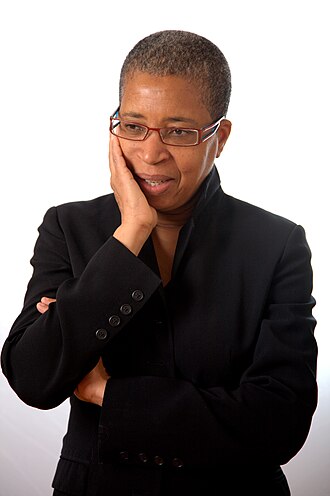
Dionne Brand
- 生卒
- 1953 –
- 国籍
- 加拿大
照片:Simon Fraser University - Communications & Marketing,CC BY 2.0,来自维基共享资源「Dionne Brand.jpg」(经缩小)。
生平与创作
这个词条暂时没有中文维基百科条目,下面是英文维基百科的内容(英文原文):
Dionne Brand (born 7 January 1953) is a Canadian poet, novelist, essayist and documentarian. She was Toronto's third poet laureate from September 2009 to November 2012 and its first Black poet laureate. She was admitted to the Order of Canada in 2017 and has won the Governor General's Award for English-language poetry, the Trillium Book Award, the Pat Lowther Award, the Harbourfront Festival Prize, and the Toronto Book Award. Brand lives in Toronto.
Early life and education
Dionne Brand was born in Guayaguayare, Trinidad and Tobago. She graduated from Naparima Girls' High School in San Fernando in 1970 and emigrated to Canada. She attended Erindale College at the University of Toronto and earned a Bachelor of Arts degree in English and philosophy in 1975. She later attained an Master of Arts in Philosophy of Education from the Ontario Institute for Studies in Education in 1989.
Career
Her first book, Fore Day Morning: Poems, came out in 1978, and since then Brand has published numerous works of poetry, fiction, and non-fiction, as well as editing anthologies and working on documentary films with the National Film Board of Canada.
She has held a number of academic positions, including assistant professor of English at the University of Guelph (1992–1994), Ruth Wynn Woodward Professor in Women's Studies at Simon Fraser University (2000–2002), Distinguished Visiting Scholar and Writer-in-Residence at St. Lawrence University (2004–2005), and Ralph Gustafson Distinguished Poet at Vancouver Island University (2006). She is a professor emeritus of English at the School of English and Theatre Studies at the University of Guelph, where she held a University Research Chair.
In 2017, she was appointed as poetry editor of McClelland & Stewart, holding the position until 2021. Brand is a co-editor of the literary journal Brick.
Writing
In her writing, Brand explores themes of gender, race, sexuality, feminism, diaspora, nation, white male domination, injustice, and "the moral hypocrisies of Canada." Despite being often characterized as a Caribbean writer, Brand identifies as a "black Canadian."
She has written about topics including the violent killings of Black people, the École Polytechnique massacre, racism against Indigenous women in Canada, and the sexual exploitation of African women.
Writer Myriam Chancy says Brand found "it possible [...] to engage in personal/critical work which uncovers the connections between us as Black women at the same time as re-discovering that which has been kept from us: our cultural heritage, the language of our grandmothers, ourselves."
A Map to the Door of No Return
Brand explores inter-generational trauma in her piece A Map to A Door of No Return. She explores her own experiences through an autobiographical perspective as well as diving into explain a concept she calls the "Door of No Return". The Door is the space in which the history of Black people is lost, specifically when enslaved people from Africa were transported through the Atlantic slave trade. Brand defines the Door of No Return as "that place where our ancestors departed one world for another; the Old World for the New." The Door can bring profound grief and pain to many in the diaspora when they encounter it. The Door is a site of traceable beginnings that are eventually lost in historical memory, as demonstrated when Brand's grandfather can no longer remember the name of the ancestral people they belong to. When passing through The Door, people lose their history, their humanity, and their ancestry.
Brand also describes how her interactions with her grandfather became "mutually disappointing" and led to estrangement, as he could not remember the name of the people they came from and thus could not remember their family history. She marks this as being the first time she felt a burning desire to know her ancestry. In this moment, she is confronted with the reality that her life will consist of a never ending battle to complete her identity. Brand notes that her desire only came into full effect when she was denied knowledge of her ancestry. The onset of her inner struggle to find belonging occurred in an entirely Black space, not dependent on the white world. Brand argues that this feeling of being incomplete is common among Black people throughout the diaspora.
Another theme explored in A Map to the Door of No Return is the theory and praxis of geography. She begins to deconstruct and challenge the systems of logic that constitute geography and borders, the way geography has been constructed as truth, the emphasis placed on origins, and the violence of the nation-state.
Rivers Have Sources, Trees Have Roots
In Rivers Have Sources, Trees Have Roots (1986), Brand and co-author Krisantha Sri Bhaggiyadatta interviewed a hundred people from the Canadian Indigenous, Black, Chinese, and South Asian communities about their perceptions of racism and its impact on their lives. The authors argue that racism prevails in their interviewees' lives both through "the culture of racism" and through institutional structures. They sees racism as a powerful tool to censor oppositional voices and disagree with the conception of racism as isolated or unusual.
No Language Is Neutral
No Language is Neutral was originally published in 1990 by Coach House Books. In its 50 pages, it tackles issues of immigration, environmentalism, slavery, lesbianism, identity, place, and the female body, all from a Black feminist perspective. It is in conversation with writers of the Black diaspora, namely Derek Walcott. In her opinion, Walcott wrongly plays to the belief that "colonization brought civilization [and] culture." Susan Gingell calls Walcott Brand's "antithetical literary ancestor." The critic Winfried Siemerling described No Language is Neutral as a "breakthrough volume" for its unrestraint. No Language Is Neutral sold over 6,000 copies and was nominated for a Governor General's Award.
以上文字摘自英文维基百科「Dionne Brand」(有删节,去掉了参考文献等尾部小节),按 CC BY-SA 4.0 使用,作者为维基百科的各位编者。
资料卡
- 母语名
- Dionne Brand
- 出生
- 1953 年 1 月 7 日
- 出生地
- 西班牙港 等 2 项
- 职业
- 作家、诗人、小说家、电影导演
- 使用语言
- 英语
- 就读学校
- 多伦多大学密西沙加分校、Naparima Girls' High School、Ontario Institute for Studies in Education
- 领域
- 诗歌
- 所属团体
- 加拿大皇家学会
- 代表作
- 'Fore Day Morning: Poems、Earth Magic
- 获奖
- 葛理芬诗奖、加拿大皇家学会院士、加拿大员佐勋章;另有 5 项只有外文名
资料卡来自 Wikidata Q543625(CC0),众包数据,个别字段可能不全。
本站收录的作品(1)
作品年表(5 本)
本站书库里署名Dionne Brand的书(Open Library 上至少 10 人加过书架的才收),按首版年份排(有本站书页的用 Wikidata 记的首版年,其余用 Open Library 的);年份偶尔记成后来的版本或译本,以原书为准。全部作品见 Open Library。
- 1990No Language is Neutral书架 13
- 1996In Another Place, Not Here书架 20
- 1999At the Full and Change of the Moon书架 14
- 2001A Map to the Door of No Return书架 10
- 2005What We All Long For书架 25