 书单
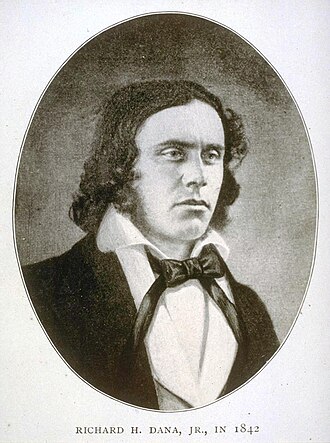
小丹纳
- 生卒
- 1815 – 1882
- 国籍
- 美国
- 外文名
- Richard Henry Dana
照片:作者不详,公有领域,来自维基共享资源「Richard H Dana Jr 1842.jpg」(经缩小)。
生平与创作
这个词条暂时没有中文维基百科条目,下面是英文维基百科的内容(英文原文):
Richard Henry Dana Jr. (August 1, 1815 – January 6, 1882) was an American lawyer and politician from Massachusetts, a descendant of a colonial family, who gained renown as the author of the classic American memoir Two Years Before the Mast and as an attorney who successfully represented the U.S. government before the U.S. Supreme Court during the Civil War in the Prize Cases. Both as a writer and as a lawyer, he was a champion of the downtrodden, from seamen to fugitive slaves and freedmen.
Early life and education
Dana was born in Cambridge, Massachusetts, on August 1, 1815 into a family that had settled in colonial America in 1640, counting Anne Bradstreet among its ancestors. His father was the poet and critic Richard Henry Dana Sr. As a boy, Dana studied in Cambridgeport under a strict schoolmaster named Samuel Barrett, alongside fellow Cambridge native and future writer James Russell Lowell. Barrett was infamous as a disciplinarian who punished his students for any infraction by flogging. He also often pulled students by their ears and, on one such occasion, nearly pulled Dana's ear off, causing the boy's father to protest enough that the practice was abolished.
In 1825, Dana enrolled in a private school overseen by Ralph Waldo Emerson, whom Dana later mildly praised as "a very pleasant instructor", though he lacked a "system or discipline enough to ensure regular and vigorous study." In July 1831, Dana enrolled at Harvard College, where in his freshman year his support of a student protest cost him a six-month suspension. In his junior year, he contracted measles, which in his case led to ophthalmia.
This worsening vision inspired him to take a sea voyage. But rather than going on a fashionable Grand Tour of Europe he decided, despite his social standing, to enlist as a merchant seaman.
On August 14, 1834, he departed Boston aboard the brig Pilgrim, captained by Frank Thompson, bound for Alta California, at that time still a part of Mexico. This voyage would bring Dana to a number of settlements in California (including Monterey, San Buenaventura, San Pedro, San Juan Capistrano and the Dana Point headlands, San Diego, Santa Barbara, Santa Clara and San Francisco). After witnessing Thompson's sadistic practices, including a flogging on board the ship, he vowed that he would try to help improve the lot of the common seaman.
The Pilgrim collected cowhides for shipment to Boston, and Dana spent much of his time in California at San Diego's Point Loma and the Dana Point headlands (referred to by Dana as San Juan), curing cowhides and loading them onto the ship.
Dana relates his difficult task of getting the cowhides from the headlands cliff edge to the beach and boats 400 hundred feet below by a process called "hide-droghing," where cowhides were flung with great strength far enough out to avoid them catching on the cliff outcrops below. F. Benedict Coleman's bronze sculpture The Hide Drogher, installed at the same Dana Point headlands cliffs, intentionally illustrates Dana's account with a realistic life-size statue/sculpture.
Dana's description of his time on Point Loma expressed love and concern for the Hawaiians (referred to as "Sandwich Islanders") who worked there alongside him. He may have been predisposed to feel positively toward them by a previous stay in Andover, Massachusetts, among evangelicals who had embraced Hawaiians in New England and sent the first Protestant missionaries to Hawaii.
Wishing to return home sooner, Dana was reassigned by the ship's owners to a different ship: the Alert. Dana gives the classic account of the return trip around Cape Horn in the middle of the Antarctic winter. He describes terrifying storms and profound beauty, giving vivid descriptions of icebergs which he called incomparable. He found the most incredible part of the journey the weeks and weeks it took to negotiate passage against winds and storms—all the while having to race up and down the ice-covered rigging to furl and unfurl sails. The public art sculpture titled The Topmen by Christopher Pecharka was installed at the Dana Point harbor to realistically illustrate this dangerous work.
At one point he had an infected tooth, and his face swelled up so that he was unable to work for several days, despite the need for all hands. He also describes the scurvy that afflicts members of the crew after the rounding of the Horn. In White-Jacket, Herman Melville wrote, "But if you want the best idea of Cape Horn, get my friend Dana's unmatchable Two Years Before the Mast. But you can read, and so you must have read it. His chapters describing Cape Horn must have been written with an icicle."
On September 22, 1836, Dana arrived back in Massachusetts. He then enrolled at what is now Harvard Law School, then called the Dane Law School after Nathan Dane. He graduated in 1837, and was admitted to the bar in 1840.
Career
Dana went on to specialize in maritime law. In the October 1839 issue of a magazine, he took a local judge, one of his own instructors in law school, to task for letting off a ship's captain and mate with a slap on the wrist for murdering the ship's cook, beating him to death for not "laying hold" of a piece of equipment. The judge had sentenced the captain to ninety days in jail and the mate to thirty days.
In 1841, Dana published The Seaman's Friend, which became a standard reference on the legal rights and responsibilities of sailors. He defended many common seamen in court.
During his voyages he had kept a diary, and in 1840 (coinciding with his admission to the bar) he published a memoir, Two Years Before the Mast. The term "before the mast" refers to sailors' quarters, which were located in the forecastle (the ship's bow), officers' quarters being near the stern. His writing evinces his later sympathy for the oppressed. With the California Gold Rush later in the decade, Two Years Before the Mast would become highly sought after as one of the few sources of information on California.
以上文字摘自英文维基百科「Richard Henry Dana Jr.」(有删节,去掉了参考文献等尾部小节),按 CC BY-SA 4.0 使用,作者为维基百科的各位编者。
资料卡
- 母语名
- Richard Henry Dana, Jr
- 出生
- 1815 年 8 月 1 日
- 出生地
- 剑桥
- 逝世
- 1882 年 1 月 6 日
- 逝世地
- 罗马
- 职业
- 作家、日记作者、律师、政治人物、法学家
- 使用语言
- 英语
- 写作语言
- 英语
- 就读学校
- 哈佛大学、哈佛学院
- 所属团体
- 美国文理科学院
- 配偶
- Sarah Watson Dana
资料卡来自 Wikidata Q527981(CC0),众包数据,个别字段可能不全。
本站收录的作品(1)

作品年表(2 本)
本站书库里署名小丹纳的书(Open Library 上至少 10 人加过书架的才收),其中 1 本记的年份比作者去世晚 50 年以上或者早于他出生(多半是后世的版本、译本或占位年份),不列年份,按首版年份排(有本站书页的用 Wikidata 记的首版年,其余用 Open Library 的);年份偶尔记成后来的版本或译本,以原书为准。全部作品见 Open Library。