 书单
John Edgar Wideman
- 生卒
- 1941 –
- 国籍
- 美国
- 获奖
- 笔会 / 福克纳小说奖(1984)
生平与创作
这个词条暂时没有中文维基百科条目,下面是英文维基百科的内容(英文原文):
John Edgar Wideman (born June 14, 1941) is an American novelist, short story writer, memoirist, and essayist. He was the first person to win the PEN/Faulkner Award for Fiction twice. His writing is known for experimental techniques and a focus on the African-American experience.
Raised in Pittsburgh, Pennsylvania, United States, Wideman excelled as a student athlete at the University of Pennsylvania. In 1963, he became the second African American to win a Rhodes Scholarship to attend the University of Oxford. In addition to his work as a writer, Wideman has had a career in academia as a literature and creative writing professor at both public and Ivy League universities.
In his writing, Wideman has explored the complexities of race, family, trauma, storytelling, and justice in the United States. His personal experience, including the incarceration of his brother, has played a significant role in his work.
He is a professor emeritus at Brown University and lives in New York City and France.
Early life and education
Wideman was born on June 14, 1941, in Washington, D.C., the oldest of five children of Edgar (1918–2001) and Bette (née French; 1921–2008) Wideman.
Wideman traces his roots to the period of American slavery. On his mother's side, his great-great-great-grandmother was a slave from Maryland who had children with her master's son. Together, they relocated to Pittsburgh either during or immediately after the American Civil War. According to Wideman family lore, this ancestor first settled the area that eventually became the Pittsburgh neighborhood of Homewood, despite the fact that a white lawyer and politician, William Wilkins, is credited with founding the community. On Wideman's father's side, his ancestors have been traced to rural South Carolina, where records indicate there were both white and African-American Widemans, including one who owned slaves. Wideman's paternal grandfather moved to Pittsburgh as part of the Great Migration of the early 20th century, when many African Americans fled Southern states.
Wideman's father, Edgar, graduated high school in Pittsburgh, where he was an avid basketball player. After marrying Wideman's mother, Bette, he moved with her to Washington, D.C., for a job in the U.S. Government Printing Office. The couple moved back to Pittsburgh's Homewood neighborhood after Wideman was born in 1941. During World War II, Wideman's father enlisted in the U.S. Army and was stationed in Charleston, South Carolina, and on Saipan. After the War, he worked several jobs simultaneously, including as a waiter and sanitation worker, in order to support the family. Wideman's youngest brother, Robert, was born in 1951 while the family was living in Homewood. With the support of Edgar's earnings, the family was able to move to Shadyside, a predominantly white neighborhood, allowing Wideman to attend Peabody High School.
Wideman's teachers had noted his intelligence from an early age, and he proved to be an outstanding student. In high school, he was a star basketball player, president of the student body, and valedictorian of his class. However, Wideman was socially cautious, especially around white students. Interviewed for an article in 1963, one of his white classmates recalled Wideman telling her that "he wouldn't want to be seen on the street alone with a white girl" and that "when class breaks came, he would seldom walk to the next class with the white students".
College
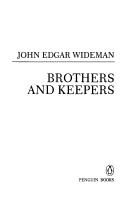
Wideman attended the University of Pennsylvania, where he was offered a Benjamin Franklin Scholarship for academic merit and was one of a small number of African Americans to enroll in 1959. In his memoir, Brothers and Keepers, he described a heated freshman-year encounter with a white student in the dorm room of an African-American friend: the white student claimed to know more about blues music than Wideman did, and his friend refused to offer support. According to Wideman, the encounter left him feeling that he had "no place to hide", and he was in an environment "that continually set me against them and against myself". Feeling alienated, he decided to quit college, but was stopped by his basketball coach at a bus station, where Wideman was about to board a bus back to Pittsburgh.
Addressing his brother in Brothers and Keepers, he summarized his motivation:I was running away from Pittsburgh, from poverty, from blackness. To get ahead, to make something of myself, college had seemed a logical, necessary step; my exile, my flight from home began with good grades, with good English, with setting myself apart long before I'd earned a scholarship and a train ticket over the mountains to Philadelphia... if I ever had any hesitations or reconsiderations about the path I'd chosen, youall were back home in the ghetto to remind me how lucky I was.Once again, Wideman excelled academically and in athletics, becoming a star basketball player. By his senior year, he was captain of the basketball team, which he led in scoring, and was named to the "All Ivy League" team. While his team lost the Ivy League championship to Princeton University his senior year, they won the "Big 5" tournament, which has traditionally determined the best college basketball team in Philadelphia, pitting Penn against Villanova, Saint Joseph's, La Salle, and Temple universities. For his academic achievements, which included winning campus-wide awards for both creative and scholarly writing, Wideman was inducted into the Phi Beta Kappa national honor society.
以上文字摘自英文维基百科「John Edgar Wideman」(有删节,去掉了参考文献等尾部小节),按 CC BY-SA 4.0 使用,作者为维基百科的各位编者。
资料卡
- 出生
- 1941 年 6 月 14 日
- 出生地
- 华盛顿哥伦比亚特区
- 职业
- 作家、小说家、散文家、文化批评、大学教师、篮球运动员
- 使用语言
- 英语
- 就读学校
- 宾夕法尼亚大学、牛津大学新学院、马萨诸塞州立大学艾莫斯特分校、Peabody High School
- 领域
- creative and professional writing、memoir literature、文化批评、非洲文学
- 所属团体
- 美国文理科学院、美国艺术暨文学学会
- 代表作
- Brothers and Keepers
- 获奖
- 笔会 / 福克纳小说奖(1984)、Society of American Historians Prize for Historical Fiction(1997)、Dos Passos Prize(1986)、麦克阿瑟天才奖(1993)、美国图书奖(1991)、安斯非德-禾夫图书奖(2011)、Honorary doctor at the University of Bern、欧·亨利奖(2000)、罗德奖学金(1963)
资料卡来自 Wikidata Q688739(CC0),众包数据,个别字段可能不全。
本站收录的作品(1)
同时代的美国作家
前后几届的笔会 / 福克纳小说奖得主
全部得主 ›Open Library 上的全部作品
正在读取…