 书单
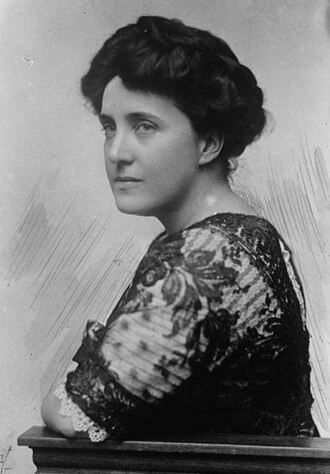
玛丽·罗伯茨·莱因哈特
- 生卒
- 1876 – 1958
- 国籍
- 美国
- 外文名
- Mary Roberts Rinehart
照片:Bain News Service, publisher,公有领域,来自维基共享资源「Mary Roberts Rinehart 1920.jpg」(经缩小)。
生平与创作
这个词条暂时没有中文维基百科条目,下面是英文维基百科的内容(英文原文):
Mary Roberts Rinehart (August 12, 1876 – September 22, 1958) was an American writer, often called the American Agatha Christie. Rinehart published her first mystery novel, The Circular Staircase, in 1908, which introduced the "had I but known" narrative style. Rinehart is also considered the earliest known source of the phrase "the butler did it", in her novel The Door (1930), although the exact phrase does not appear in her work and the plot device had been used prior to that time. She also worked to tell the stories and experiences of front line soldiers during World War I, one of the first women to travel to the Belgian front lines.
Biography
Rinehart was born Mary Ella Roberts in Allegheny City, Pennsylvania, now a part of Pittsburgh. A sister, Olive Louise, four years Mary's junior, would later gain recognition as an author of children's books and as a nationally syndicated newspaper columnist. Her father was a frustrated inventor, and throughout her childhood, the family often had financial problems. Her father committed suicide when Mary was 19 years old. Tending to be left-handed at a time when that was considered disadvantageous, she was trained to use her right hand instead.
She attended public schools and graduated at age 16, then enrolled at the Pittsburgh Training School for Nurses at Pittsburgh Homeopathic Hospital, where she graduated in 1897. She described the experience as "all the tragedy of the world under one roof." After graduation, she married Stanley Marshall Rinehart (1867–1932), a physician she had met there. They had three sons: Stanley Jr., Alan, and Frederick.
During the stock market crash of 1903, the couple lost their savings, spurring Rinehart's efforts at writing as a way to earn income. She was 27 that year, and produced 45 short stories. In 1907, she wrote The Circular Staircase, the novel that propelled her to national fame. According to her obituary in the Pittsburgh Post-Gazette in 1958, the book sold 1.25 million copies. Her regular contributions to The Saturday Evening Post were immensely popular and helped the magazine mold American middle-class taste and manners.
In 1911, after the publication of five successful books and two plays, the Rineharts moved to the Pittsburgh suburb of Glen Osborne, where they purchased a large home at the corner of Orchard and Linden Streets called "Cassella." Before they could move into the house, however, Mrs. Rinehart had to have it completely rebuilt because it had fallen into disrepair. "The venture was mine, and I had put every dollar I possessed into the purchase. All week long I wrote wildly to meet the payroll and contractor costs,” she wrote in her autobiography. In 1925, the Rineharts sold the house to the Marks family; the house was demolished in 1969. Today, a Mary Roberts Rinehart Nature Park sits in the borough of Glen Osborne at 1414 Beaver Street, Sewickley, Pennsylvania.
Rinehart's commercial success sometimes conflicted with her expected domestic roles of wife and mother, yet she often pursued adventure, including a job as a war correspondent for The Saturday Evening Post at the Belgian front during World War I. During her time in Belgium, she interviewed Albert I of Belgium, Winston Churchill and Mary of Teck, writing of the latter "This afternoon I am to be presented to the queen of England. I am to curtsey and to say 'Your majesty,' the first time!" Rinehart was working in Europe in 1918 to report on developments to the War Department and was in Paris when the armistice was signed.
In 1922, the family moved to Washington, DC, when Dr. Rinehart was appointed to a post in the Veterans Administration. She was a member of the Literary Society of Washington from 1932 to 1936. Her husband died in 1932, but she continued to live in Washington until 1935, when she moved to New York City. There she helped her sons found the publishing house Farrar & Rinehart, serving as its director.
She also maintained a vacation home in Bar Harbor, Maine. In 1947, a Filipino chef who had worked for her for 25 years fired a gun at her and then attempted to slash her with knives until other servants rescued her. The chef committed suicide in his cell the next day.
Rinehart suffered from breast cancer, which led to a radical mastectomy. She eventually went public with her story, at a time when such matters were not openly discussed. The interview "I Had Cancer" was published in a 1947 issue of the Ladies' Home Journal; in it, Rinehart encouraged women to have breast examinations.
Rinehart received a Mystery Writers of America special award a year after she published her last novel, and an honorary doctorate in literature from George Washington University.
Her correspondence, manuscripts, and personal documents are held in the ULS Archives & Special Collections at the University of Pittsburgh.
The Mary Roberts Rinehart Foundation, established by her sons after her death, underwrites an annual “Mary Roberts Rinehart Award” that is presented to a woman writer of a major nonfiction work.
On November 9, 1956, Rinehart appeared on the interview program Person to Person. She died at age 82 at her apartment at 630 Park Avenue in New York City.
Writing
Rinehart wrote hundreds of short stories, poems, travelogues and articles. Many of her short stories, books, and plays were adapted for movies, such as Bab: A Sub-Deb (1917), The Bat (1926), The Bat Whispers (1930), Miss Pinkerton (1932), and The Bat (1959 remake). The novel The Circular Staircase was first adapted to the screen as a silent film in 1915, and later as an episode in the TV show Climax! in 1956. In 1933 RCA Victor released The Bat as one of the early talking book recordings. She co-wrote the 1920 play The Bat which was later adapted into the 1930 film The Bat Whispers. The latter influenced Bob Kane in the creation of Batman's iconography.
Carole Lombard and Gary Cooper starred in I Take This Woman (1931), an early sound film based on Rinehart's novel Lost Ecstasy (1927).
以上文字摘自英文维基百科「Mary Roberts Rinehart」(有删节,去掉了参考文献等尾部小节),按 CC BY-SA 4.0 使用,作者为维基百科的各位编者。
资料卡
- 母语名
- Mary Roberts Rinehart
- 出生
- 1876 年 8 月 12 日
- 出生地
- 匹兹堡
- 逝世
- 1958 年 9 月 22 日
- 逝世地
- 纽约
- 职业
- 新闻工作者、小说家、诗人、作家、编剧、护理人员、幽默家、散文家 等 10 项
- 使用语言
- 英语
- 写作语言
- 英语
- 就读学校
- UPMC Shadyside School of Nursing
- 领域
- 诗歌
- 获奖
- 爱伦·坡奖(1954)
资料卡来自 Wikidata Q460366(CC0),众包数据,个别字段可能不全。
作品年表(19 本)
本站书库里署名玛丽·罗伯茨·莱因哈特的书(Open Library 上至少 10 人加过书架的才收),按首版年份排(有本站书页的用 Wikidata 记的首版年,其余用 Open Library 的);年份偶尔记成后来的版本或译本,以原书为准。全部作品见 Open Library。
- 1908The Circular Staircase书架 77
- 1909The Man in Lower Ten书架 12
- 1910The Window At The White Cat书架 15
- 1914The After House书架 30
- 1914The Street of Seven Stars书架 15
- 1915K书架 30
- 1915The Case of Jennie Brice书架 18
- 1917Long Live the King!书架 11
- 1919Dangerous Days书架 12
- 1925The Red Lamp书架 14
- 1926The Bat书架 27
- 1930The Door书架 22
- 1932Miss Pinkerton书架 17
- 1933The album书架 13
- 1938The wall书架 16
- 1940The great mistake书架 20
- 1942Haunted lady书架 36
- 1945The Yellow Room书架 21
- 1952The swimming pool书架 11