 书单
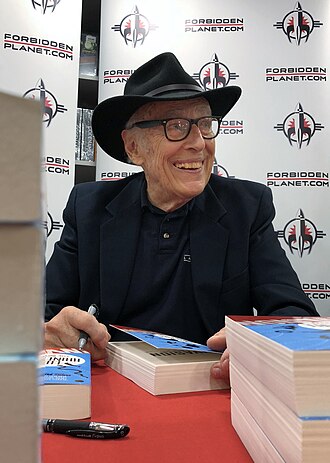
Luke Rhinehart
- 生卒
- 1932 – 2020
- 国籍
- 美国
照片:Christian Payne,CC BY-SA 4.0,来自维基共享资源「George Cockroft aka Luke Rheinhart signing books.jpg」(经缩小)。
生平与创作
这个词条暂时没有中文维基百科条目,下面是英文维基百科的内容(英文原文):
George Powers Cockcroft (November 15, 1932 – November 6, 2020), widely known by the pen name Luke Rhinehart, was an American novelist, screenwriter, and nonfiction writer. He is best known for his 1971 novel The Dice Man, the story of a psychiatrist who experiments with making life decisions based on the roll of a dice.
The Dice Man was critically well received and a commercial success. It quickly became and remains a cult classic. It was followed by two spiritual sequels in Adventures of Wim (1986) and The Search for the Dice Man (1993) as well as a companion volume called The Book of the Die (2000). Rhinehart wrote several other novels between 1986 and 2016, though none achieved the success of The Dice Man.
Biography
Early life
George Powers Cockcroft was born on November 15, 1932, in Albany, New York, to Donald and Elizabeth Cockcroft, both college graduates, his mother from Wellesley College. He was raised in Albany, where his father was an electrical engineer, and his ancestry included Vermont political notables. He attended The Albany Academy, graduating in 1950, and received a BA from Cornell University in 1954 and an MA from Columbia University in 1956. In 1964, he received a PhD in American literature from Columbia. After obtaining his PhD, he went into teaching. During his years as a university professor he taught, among other things, courses in Zen and Western literature.
In 1969, while Cockcroft was teaching a study abroad program on the island of Mallorca, an Englishman starting a new publishing house stopped at a cafe in the same village, Deià, and was given a partial manuscript of The Dice Man to read by Cockcroft. Cockcroft was subsequently offered an advance payment for publication. Shortly afterwards, Cockcroft was encouraged by his course Director to take an early sabbatical from his teaching duties. He remained in Mallorca to complete the novel, after which the publisher sold the American rights to the novel for a large sum, and within a year the film rights, allowing Cockcroft to retire from teaching and become a full time novelist.
Personal life and family
Cockcroft married his wife, Ann, who later became a writer of two romance novels and a volume of poetry, in June 1956. Together they have three children.
The author and his family spent a number of years traveling, sailing, and returning to Mallorca, living in Deià in the late 1960s and early 70s, including time spent on a large catamaran, which became the inspiration for the boat in his novel Long Voyage Back. In the mid-1970s they returned to the United States. They spent 1975 in a sufi commune, before moving to a large old farmhouse and former religious retreat in the foothills of the Berkshires in upstate New York.
Later life and death
I am old now. Illusions are losing their grip. They are dropping off me like leaves from an autumn tree. How nice.
On 1 August 2012, the "death" of Rhinehart at the age of 79 was announced by email to 25 friends, beginning with the words "It is our pleasure to inform you that Luke Rhinehart is dead"; it was later revealed the "Death Letter" was instigated as a playful hoax by Cockcroft. Reactions ranged from sorrow to gratitude and amusement.
In 2018, Rhinehart expressed a wish to be cremated after his death if he could not be naturally buried legally in the one-acre lake upon his property.
George Cockroft died, aged 87, on 6 November 2020.
The Dice Man
Rhinehart's famous novel The Dice Man was published in 1971 and tells the story of a psychiatrist who makes daily decisions based on the casting of dice. The cover bore the confident tagline, "Few novels can change your life. This one will"; in the United States this was altered to read, "This book will change your life".
Cockcroft has described the origin of the idea for this work variously, and at the time of the publication of this work, "it was not clear whether the book was fiction or autobiography", because its protagonist and author were eponymous. Curiosity over its authorship has persisted since its publication.
Emmanuel Carrère, writing for The Guardian, presented a long-form expose on Cockcroft and the relationship between author and legend in 2019, and in following others, established the author Cockcroft as a life-long English professor living "in an old farmhouse with a yard that slopes down to a duck pond", a husband of fifty-years, father of three, and a caregiver to a special needs child.
The Dice Man was critically well received. It quickly became, and remains thought of as a cult classic. It initially sold poorly in the United States, but well in Europe, particularly England, Sweden, Denmark, and Spain. Writing in 2017 for The Guardian, Tanya Gold noted that "over the course of 45 years" it was still in print, had become famous, had devoted fans, and had "sold more than 2m copies in multiple languages", with as many as 27 languages and 60 countries have been claimed.
In 1995, the BBC called it "one of the fifty most influential books of the last half of the twentieth century,". In 1999, after one of their reporters experimented, controversially, with dicing, Loaded magazine named it "Novel of the Century". In 2013, Alex Clark of the Telegraph chose it as one of the fifty greatest cult books of the last hundred years.
Works after The Dice Man
Comic philosophical novels
A number of works by Luke Rhinehart have a similar style and themes to The Dice Man, alternating between first- and third-person voices with selections from fictional documents. In one case, he even quotes from a future book that he did not actually write until more than two decades later. The voices having different characteristics, the novel's mood changes accordingly.
Presenting these multiple fragments from multiple viewpoints together results in a "cubist" narrative structure. Of this, Rhinehart stated that they had "always conceived of myself as being multiple – having, you know, a dozen different selves, if not a thousand different selves, at any given moment."
以上文字摘自英文维基百科「Luke Rhinehart」(有删节,去掉了参考文献等尾部小节),按 CC BY-SA 4.0 使用,作者为维基百科的各位编者。
资料卡
- 母语名
- Luke Rhinehart
- 本名
- George Powers Cockcroft
- 出生
- 1932 年 11 月 15 日
- 出生地
- 奥尔巴尼
- 逝世
- 2020 年 11 月 6 日
- 逝世地
- 纽约州
- 职业
- 作家、小说家、心理学家
- 使用语言
- 英语
- 写作语言
- 英语
- 就读学校
- 哥伦比亚大学、康奈尔大学、奥尔巴尼学院
- 领域
- 心理学小说
- 代表作
- The Dice Man、Adventures of Wim、The Search for the Dice Man
资料卡来自 Wikidata Q1855263(CC0),众包数据,个别字段可能不全。
本站收录的作品(1)
作品年表(1 本)
本站书库里署名Luke Rhinehart的书(Open Library 上至少 10 人加过书架的才收),按首版年份排(有本站书页的用 Wikidata 记的首版年,其余用 Open Library 的);年份偶尔记成后来的版本或译本,以原书为准。全部作品见 Open Library。
- 1971The Dice Man书架 11