 书单
安东尼·唐斯
- 生卒
- 1930 – 2021
- 国籍
- 美国
- 外文名
- Anthony Downs
生平与创作
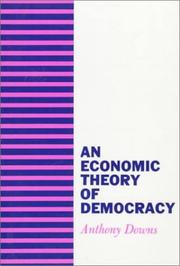
安东尼·唐斯(英语:Anthony Downs,1930年11月20日—2021年10月2日)是美国的经济学家,专攻公共政策和公共行政。他的研究重点包括政治选择理论、不动产租金价格管控、经济适用房和交通经济学。他撰写了多部著作,包括《民主的经济理论》(英语:An Economic Theory of Democracy,1957年)和《官僚内部》(英语:Inside Bureaucracy,1967年),这些著作对政治经济学的公共选择学派产生了重大影响。在其论著Downs's Law of Peak-Hour Traffic Congestion(1962年)中,他准确地预测,扩大高速公路并不能减少交通拥堵,因为需求也会增加,而降低速度会增加通行能力。
生平
他曾任华盛顿布鲁金斯学会高级研究员、芝加哥大学教员和加州公共政策研究所(英语:Public Policy Institute of California)客座研究员。 他也是美国国家公共行政学院(英语:National Academy of Public Administration)的当选院士。
以上文字摘自维基百科「安東尼·唐斯」(去掉了参考文献等尾部小节),按 CC BY-SA 4.0 使用,作者为维基百科的各位编者。
中文维基百科的条目比较短,下面附上英文维基百科的内容(英文原文):
James Anthony Downs (November 21, 1930 – October 2, 2021) was an American economist specializing in public policy and public administration. His research focuses included political choice theory, rent control, affordable housing, and transportation economics. He wrote a number of books including, An Economic Theory of Democracy (1957) and Inside Bureaucracy (1967), which have been major influences on the public choice school of political economy. In Downs's Law of Peak-Hour Traffic Congestion (1962), he predicted that expanding expressways could not reduce traffic congestion, since demand would increase as well, and that reducing speeds increases capacity.
He served as a senior fellow at the Brookings Institution in Washington, D.C., member of faculty at the University of Chicago and a visiting fellow at the Public Policy Institute of California in San Francisco. Downs was also an elected fellow of the National Academy of Public Administration.
Early life
James Anthony Downs was born on November 21, 1930, in Evanston, Illinois. His father was the founder of a consulting firm, Real Estate Research Corporation, and a frequent speaker on real estate related topics. He grew up in Park Ridge, Illinois, a suburb of Chicago.
He received a B.A. in international relations and political theory from Carleton College in 1952. During this time he was the elected president of the college student body. He would later credit this experience for some of his interests in studying democracy. He went to the Graduate School of Business at Stanford University on a scholarship to pursue his M.A. and Ph.D. in economics, obtaining his doctorate in 1956.
He enlisted in the Navy and served as an intelligence officer when he was drafted. During this time he also served on an aircraft carrier in the Mediterranean Sea. He quit the service after three years to join his father's consulting firm and also briefly served as a member of the faculty at the University of Chicago.
Career
Downs served as a consultant to many of the nation's largest corporations and public institutions, including the U.S. Department of Housing and Urban Development (HUD) and the White House. President Lyndon B. Johnson appointed him to the National Commission on Urban Problems in 1967, and HUD Secretary Jack Kemp appointed him to the Advisory Commission on Regulatory Barriers to Affordable Housing in 1989. He was an officer or trustee of the NAACP Legal Defense and Educational Fund.
Democracy and the left–right continuum
In his seminal work, An Economic Theory of Democracy (1957), Downs introduced a left–right axis to economic theory. On the "left" he placed communist parties that want entirely state-planned economies, and on the "right" he placed conservative parties that demand an entirely deregulated economy.
He claimed that most voters have incomplete information when voting for political candidates in a democracy, and therefore will resort to economic issues of "how much government intervention in the economy there should be" and how parties will control this. Downs borrowed the curve from Harold Hotelling, who developed it to explain how grocery stores targeted customers. Downs's book has since become one of the most cited books in political science. His left–right axis model has been integrated into the median voter theory first articulated by Duncan Black.
In An Economic Theory of Democracy (1957), an early work in rational choice theory, Downs posited the paradox of voting, which claimed that significant elements of political life could not be explained in terms of voter self-interest. Downs showed that in democracies the aggregate distribution of political opinion forms a bell-shaped curve, with most voters possessing moderate opinions; he argued that this fact forces political parties in democracies to adopt centrist positions.
以上文字摘自英文维基百科「Anthony Downs」(有删节,去掉了参考文献等尾部小节),按 CC BY-SA 4.0 使用,作者为维基百科的各位编者。
资料卡
- 母语名
- Anthony Downs
- 本名
- James Anthony Downs
- 出生
- 1930 年 11 月 21 日
- 出生地
- 埃文斯顿
- 逝世
- 2021 年 10 月 2 日
- 逝世地
- 贝塞斯达
- 职业
- 经济学家、政治学家、哲学家
- 使用语言
- 英语
- 就读学校
- 斯坦福大学、卡尔顿学院(1952)
- 所属团体
- 美国文理科学院
- 受谁影响
- 约瑟夫·熊彼特、肯尼斯·约瑟夫·阿罗
- 代表作
- 民主的经济理论
资料卡来自 Wikidata Q573170(CC0),众包数据,个别字段可能不全。
本站收录的作品(1)
作品年表(2 本)
本站书库里署名安东尼·唐斯的书(Open Library 上至少 10 人加过书架的才收),按首版年份排(有本站书页的用 Wikidata 记的首版年,其余用 Open Library 的);年份偶尔记成后来的版本或译本,以原书为准。全部作品见 Open Library。
- 1957民主的经济理论An economic theory of democracy书架 15
- 1964Inside bureaucracy书架 10