 书单
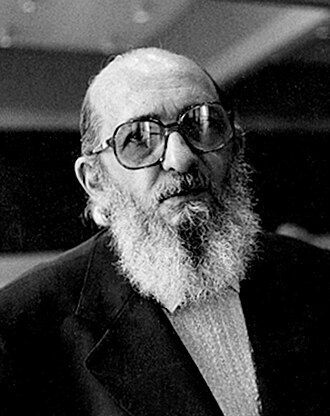
保罗·弗莱雷
- 生卒
- 1921 – 1997
- 国籍
- 巴西
- 外文名
- Paulo Freire
照片:Slobodan Dimitro,CC BY-SA 3.0,来自维基共享资源「Paulo Freire 1977.jpg」(经缩小)。
生平与创作
保罗·雷古勒斯·内维斯·弗莱雷(葡萄牙语:Paulo Reglus Neves Freire,1921年9月19日—1997年5月2日),巴西教育家、哲学家,批判教育学的主要倡导者。其著作《被压迫者教育学》被认为是批判教育学运动的基础文本之一。
弗莱雷提出的教育哲学不仅源自柏拉图的古典方法,还来自现代马克思主义和反殖民主义思想家。在许多方面,其著作《被压迫者教育学》可视作是对反殖民思想家弗朗茨·法农《大地上的受苦者》的引申或回应,强调了为本土人口提供教育的必要性。
以上文字摘自维基百科「保罗·弗莱雷」(去掉了参考文献等尾部小节),按 CC BY-SA 4.0 使用,作者为维基百科的各位编者。
中文维基百科的条目比较短,下面附上英文维基百科的内容(英文原文):
Paulo Reglus Neves Freire (19 September 1921 – 2 May 1997) was a Brazilian educator and Marxist philosopher whose work has affected global thought on education. He is best known for Pedagogy of the Oppressed, in which he reimagines teaching as a political act of liberation rather than critical cultural transmission of values. A founder of critical pedagogy, Freire’s influence spans literacy movements, liberation theology, postcolonial education, Marxism, and contemporary theories of social justice and learning. He is widely regarded as one of the most important educational theorists of the twentieth century, alongside figures such as John Dewey and Maria Montessori.
Biography
Freire was born on 19 September 1921 to a middle-class family in Recife, the State Capital of Pernambuco in the Brazilian Northeast. He became familiar with poverty and hunger from an early age partly due to the effects of the Great Depression. In 1931, Freire moved with his family to Jaboatão dos Guararapes, located 18 kilometers south of the Historic Center of Recife. His father died on 31 October 1934. Freire was raised Catholic and remained in the faith throughout his life.
During his childhood and adolescence, Freire ended up four grades behind, and his social life revolved around playing pick-up football with other poor children, from whom he claims to have learned a great deal. These experiences shaped his concerns for the poor and helped to construct his particular educational viewpoint. Freire stated that poverty and hunger severely affected his ability to learn. These experiences influenced his decision to dedicate his life to improving the lives of the poor: "I didn't understand anything because of my hunger. I wasn't dumb. It wasn't lack of interest. My social condition didn't allow me to have an education. Experience showed me once again the relationship between social class and knowledge". Eventually, his family's misfortunes turned around and their prospects improved.
Freire enrolled in law school at the University of Recife in 1943. He also studied philosophy, more specifically phenomenology, and the psychology of language. Although admitted to the legal bar, he never practiced law and instead worked as a secondary school Portuguese teacher. In 1944, he married Elza Maia Costa de Oliveira, a fellow teacher. The two worked together and had five children.
In 1946, Freire was appointed director of the Pernambuco Department of Education and Culture. Working primarily among the illiterate poor, Freire began to develop an educational praxis that had an influence on the liberation theology movement of the 1970s. In 1940s Brazil, literacy was a requirement for voting in presidential elections.
In 1961, he was appointed director of the Department of Cultural Extension at the University of Recife. In 1962, he had the first opportunity for large-scale application of his theories, when, in an experiment, 300 sugarcane harvesters were taught to read and write in just 45 days. In response to this experiment, the Brazilian government approved the creation of thousands of cultural circles across the country.
The 1964 Brazilian coup d'état put an end to Freire's literacy effort, as the ruling military junta did not endorse it. Freire was subsequently imprisoned as a traitor for 70 days. After a brief exile in Bolivia, Freire worked in Chile for five years for the Christian Democratic Agrarian Reform Movement and the United Nations Food and Agriculture Organization. In 1967, Freire published his first book, Education as the Practice of Freedom. He followed it up with his most famous work, Pedagogy of the Oppressed, which was first published in 1968.
以上文字摘自英文维基百科「Paulo Freire」(有删节,去掉了参考文献等尾部小节),按 CC BY-SA 4.0 使用,作者为维基百科的各位编者。
资料卡
- 母语名
- Paulo Freire
- 出生
- 1921 年 9 月 19 日
- 出生地
- 累西腓
- 逝世
- 1997 年 5 月 2 日
- 逝世地
- 圣保罗
- 职业
- 教师、作家、律师、哲学家、教育学家、诗人
- 使用语言
- 葡萄牙语、英语、西班牙语
- 就读学校
- Faculdade de Direito do Recife
- 领域
- 哲学、教育学
- 代表作
- 被压迫者教育学
- 获奖
- 文化功绩勋章(2011)、名誉博士(1973);另有 4 项只有外文名
资料卡来自 Wikidata Q164797(CC0),众包数据,个别字段可能不全。
作品年表(9 本)
本站书库里署名保罗·弗莱雷的书(Open Library 上至少 10 人加过书架的才收),按首版年份排(有本站书页的用 Wikidata 记的首版年,其余用 Open Library 的);年份偶尔记成后来的版本或译本,以原书为准。全部作品见 Open Library。
- 1967Pedagogia do Oprimido书架 243
- 1967Education For Critical Consciousness (Continuum Impacts)书架 41
- 1970Pedagogy of the Oppressed书架 103
- 1970Cultural action for freedom书架 12
- 1984The Politics of Education书架 17
- 1989Learning to question书架 15
- 1994Pedagogy of hope书架 18
- 2000Pedagogy of Freedom书架 21
- 2011Pedagogia do Oprimido书架 20