 书单
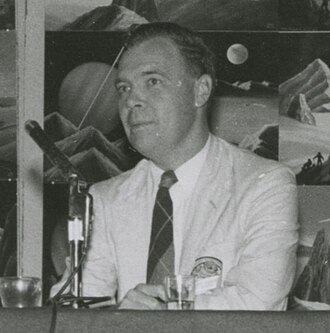
哈尔·克莱门特
- 生卒
- 1922 – 2003
- 国籍
- 美国
- 外文名
- Hal Clement
照片:slomuse,公有领域,来自维基共享资源「14th WSFS 008 - Hal Clement.jpg」(经缩小)。
生平与创作
这个词条暂时没有中文维基百科条目,下面是英文维基百科的内容(英文原文):
Harry Clement Stubbs (May 30, 1922 – October 29, 2003), better known by the pen name Hal Clement, was an American science fiction writer and a leader of the hard science fiction subgenre. He also painted astronomically oriented artworks under the name George Richard.
In 1998, Clement was inducted into the Science Fiction and Fantasy Hall of Fame. He was named the 17th SFWA Grand Master by the Science Fiction and Fantasy Writers of America in 1999.
Biography
Harry Clement Stubbs was born in Somerville, Massachusetts, on May 30, 1922.
He went to Harvard, graduating with a B.S. in astronomy in 1943. While there he wrote his first published story, "Proof", which appeared in the June 1942 issue of Astounding Science Fiction, edited by John W. Campbell; three more appeared in later 1942 numbers. His further educational background includes an M.Ed. (Boston University 1946) and M.S. in chemistry (Simmons College 1963).
During World War II Clement was a pilot and copilot of a B-24 Liberator and flew 35 combat missions over Europe with the 68th Bomb Squadron, 44th Bomb Group, based in England with 8th Air Force. After the war, he served in the United States Air Force Reserve, and retired with the rank of colonel. He taught chemistry and astronomy for many years at Milton Academy in Milton, Massachusetts.
From 1949 to 1953, Clement's first three novels were two-, three-, and four-part Astounding serials under Campbell: Needle (Doubleday, 1950), Iceworld (Gnome Press, 1953), and Mission of Gravity (1954), his best-known novel, published by Doubleday's Science Fiction Book Club (established 1953). The latter novel features a land and sea expedition across the superjovian planet Mesklin to recover a stranded scientific probe. The natives of Mesklin are centipede-like intelligent beings about 50 centimeters long. Various episodes hinge on the fact that Mesklin's fast rotational speed causes it to be considerably deformed from the spherical, with effective surface gravity that varies from approximately 3 gn at the equator to approximately 700 gn at the poles.
Clement's article "Whirligig World" describes his approach to writing a science fiction story:
Writing a science fiction story is fun, not work. ... the fun ... lies in treating the whole thing as a game.... [T]he rules must be quite simple. They are; for the reader of a science-fiction story, they consist of finding as many as possible of the author's statements or implications which conflict with the facts as science currently understands them. For the author, the rule is to make as few such slips as he possibly can... Certain exceptions are made [e.g., to allow travel faster than the speed of light], but fair play demands that all such matters be mentioned as early as possible in the story...
Clement was a frequent guest at science fiction conventions, especially in the eastern United States, where he usually presented talks and slide shows about writing and astronomy.
Clement died in his sleep in Massachusetts at the Milton Hospital on October 29, 2003, at age 81.
Awards and honors
Clement has been honored several times for his cumulative contributions including 1998 Hall of Fame induction, when Clement and Frederik Pohl were the fifth and sixth living persons honored, and the 1999 SFWA Grand Master Award.
For the 1945 short story "Uncommon Sense" he received a 50-year Retro Hugo Award at the 1996 World Science Fiction Convention. Mission of Gravity, first published as a serial during 1953, was named best foreign novel by the Spanish Science Fiction Association in 1994 and it was a finalist for a 50-year Retro Hugo Award in 2004.
The Hal Clement Award for Young Adults for Excellence in Children's Science Fiction Literature was presented in Clement's name from 1992 to 2016.
Wayne Barlowe illustrated two of Clement's fictional species, the Abyormenites and the Mesklinites, in his Barlowe's Guide to Extraterrestrials.
Books
About Hal Clement
Starmont Readers Guide 11: Hal Clement (1982), ISBN 978-0893700423. Donald M. Hassler.
Hal Clement, Scientist with a Mission: a Working Bibliography (1989), ASIN B0006OUUAU. Gordon Benson Jr.
Hal's Worlds: Stories and Essays in Memory of Hal Clement (2005), ISBN 978-0-8095-5073-9. Several authors.
Articles and introductions
Probability Zero! (nov 1942). Published jointly with Malcolm Jameson, Harry Warner Jr., Dennis Tucker and P. Schuyler Miller in Astounding. About Probability Zero, Harry Harrison said in the John Campbell Memorial Anthology: "In the early 1940s, in Astounding, there was a small department called Probability Zero! that ran short-short stories. Or items. Or lies. Things. These things were usually funny and always impossible - echoing the description of the title."
Whirligig World (jun 1953). About how to write science fiction, and specifically, about how he wrote Mission of Gravity. Published in Astounding. Collected in The Essential Hal Clement Volume 3, Heavy Planet and Mission of Gravity (1978).
Some Notes on Xi Bootis. Published by Advent Publishers.
Gravity insufficient (nov 1961). Published in Analog Science Fact.
Chips on Distant Shoulders (1980). Published in The Future at War Vol. 3.
Basic Concepts: Astrophysics, Geology (1985). About Harlan Ellison's world Medea. Published in Medea: Harlan's World.
Second Thoughts (1985). About Harlan Ellison's world Medea, jointly written with Poul Anderson, Thomas M. Disch, Larry Niven & Frederik Pohl. Published in Medea: Harlan's World.
The Home System (oct 1986). Published in Aboriginal.
Intuition: The Guide Who Needs Steering (1987). Published in Intuit.
The Magic Picture (1989). Published in L. Ron Hubbard Presents Writers of the Future v5.
Whatever Happened to the Science in Science Fiction? (sep 1993). Published in Science Fiction Age.
Ardent Thuria, Chilly Cluros: Seeing, and Seeing From, Low Orbiting Satellites (1994). Published in Mindsparks.
Only Once (1994). Published in Fractal.
Will (1998). Introduction to First Contacts: The Essential Murray Leinster.
以上文字摘自英文维基百科「Hal Clement」(有删节,去掉了参考文献等尾部小节),按 CC BY-SA 4.0 使用,作者为维基百科的各位编者。
资料卡
- 母语名
- Hal Clement
- 本名
- Harry Clement Stubbs
- 出生
- 1922 年 5 月 30 日
- 出生地
- 萨默维尔
- 逝世
- 2003 年 10 月 29 日
- 逝世地
- 米尔顿
- 职业
- 作家、小说家、科幻作家、天文学家、飞行员、教师、作者
- 使用语言
- 英语
- 就读学校
- 波士顿大学、哈佛大学、西蒙斯学院、Boston University Wheelock College of Education & Human Development
- 创作体裁
- 科学幻想
- 领域
- 科学幻想、科幻文学
- 配偶
- Mary Stubbs
- 代表作
- 重力使命
- 获奖
- 达蒙·奈特纪念大师奖(1999)、伊格诺特斯奖最佳外国长篇小说奖(1994);另有 2 项只有外文名
资料卡来自 Wikidata Q453329(CC0),众包数据,个别字段可能不全。
本站收录的作品(1)
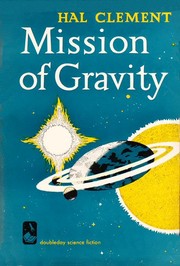
作品年表(2 本)
本站书库里署名哈尔·克莱门特的书(Open Library 上至少 10 人加过书架的才收),按首版年份排(有本站书页的用 Wikidata 记的首版年,其余用 Open Library 的);年份偶尔记成后来的版本或译本,以原书为准。全部作品见 Open Library。
- 1953重力使命Mission of gravity书架 29
- 1974MISSION OF GRAVITY书架 11