 书单
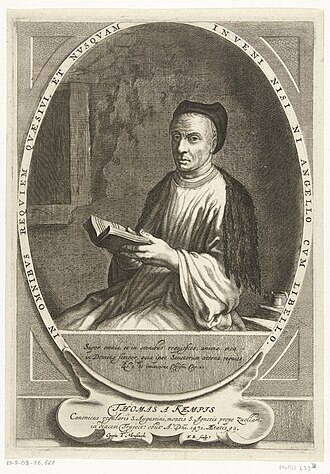
托马斯·肯皮斯
- 生卒
- 1379 – 1471
- 国籍
- 勃艮第尼德兰
- 外文名
- Thomas à Kempis
照片:Rijksmuseum,CC0,来自维基共享资源「Portret van Thomas à Kempis, RP-P-OB-26.661.jpg」(经缩小)。
生平与创作
托马斯·肯皮斯 CRSA (Thomas à Kempis,1380年—1471年7月25日),或译托马斯·肯培、托马斯·厄·肯培,文艺复兴时期欧洲宗教作家。他积极提倡灵修,曾参加新灵修运动。他的一生主要从事于带有宗教内容的创作,为《师主篇》一书的作者。
他名字里的“à”本意为“of”,因此其名的意思是肯彭的托马斯,在德语中,他又称为“Thomas von Kempen”。
以上文字摘自维基百科「托马斯·肯皮斯」(去掉了参考文献等尾部小节),按 CC BY-SA 4.0 使用,作者为维基百科的各位编者。
中文维基百科的条目比较短,下面附上英文维基百科的内容(英文原文):
Thomas à Kempis (c. 1380 – 1 May 1471; German: Thomas von Kempen; Dutch: Thomas van Kempen) was a German-Dutch Catholic canon regular of the Augustinians and the author of The Imitation of Christ, one of the best known Christian devotional books. His name means "Thomas of Kempen", Kempen, Germany, being his home town.
He was a member of the Congregation of Windesheim, which was part of the Modern Devotion, a reform movement during the late medieval period. Therein, he was a follower of Geert Groote and Florens Radewyns, the founders of the Brethren of the Common Life, of which the Windesheim Augustinians were an offshoot.
Life
Thomas was born in Kempen in the Rhineland. His surname at birth was Hemerken (or Hammerlein, Latinized as Malleolus). His father, Johann, was a blacksmith, and his mother, Gertrud, was a schoolmistress. In his writings he signed himself "Thomas Kempensis" or "Thomas Kempis".
In 1392, Thomas followed his brother, Johann, to Deventer in the Netherlands in order to attend the noted Latin school there. While attending this school, Thomas encountered the Brethren of the Common Life, followers of Gerard Groote's Modern Devotion. He attended school in Deventer from 1392 to 1399.
After leaving school, Thomas went to the nearby city of Zwolle to visit his brother again, after Johann had become the prior of the Monastery of Mount St. Agnes there. This community was one of the Canons Regular of the Congregation of Windesheim, founded by disciples of Groote in order to provide a way of life more in keeping with the norms of monastic life of the period. Thomas himself entered Mount St. Agnes in 1406. He was not ordained a priest, however, until almost a decade later. He became a prolific copyist and writer. Thomas received Holy Orders in 1413 and was made sub-prior of the monastery in 1429.
His first tenure of office as subprior was interrupted by the exile of the community from Agnetenberg in 1429. A dispute had arisen in connection with an appointment to the vacant See of Utrecht. Pope Martin V rejected the nomination of Bishop-elect Rudolf van Diepholt, and imposed an interdict. The Canons remained in exile in observance of the interdict until the question was settled in 1432. During this time, Thomas was sent to Arnhem to care for his ailing brother, where he remained until his brother died in November 1432.
Otherwise, Thomas spent his time between devotional exercises in writing and in copying manuscripts. He copied the Bible no fewer than four times, one of the copies being preserved at Darmstadt, Germany, in five volumes. In its teachings he was widely read and his works abound with biblical quotations, especially from the New Testament.
As subprior he was charged with instructing novices, and in that capacity wrote four booklets between 1418 and 1427, later collected and named after the title of the first chapter of the first booklet: The Imitation of Christ. Thomas More said it was one of the three books everybody ought to own. Thirteen translations of The Imitation of Christ and three paraphrases in English seem to have been published between 1500 and 1700. Thomas died near Zwolle in 1471. There is a legend that he was denied canonization some 200 years after his death by the Catholic Church due to the presence of scratch marks on the interior of his coffin lid, which supposedly disqualifies him from sainthood as it would mean he did not peacefully embrace death. However, there is scant evidence to support that he was buried alive or the idea that the Church would have denied him sainthood if they did discover he died in this manner.
Works
Kempis's 1441 autograph manuscript of The Imitation of Christ is available in the Bibliothèque Royale in Brussels (shelfmark: MS 5455-61).
以上文字摘自英文维基百科「Thomas à Kempis」(有删节,去掉了参考文献等尾部小节),按 CC BY-SA 4.0 使用,作者为维基百科的各位编者。
资料卡
- 本名
- Thomas Haemerkken
- 笔名
- Tomáš Hemerken Kempenský
- 出生
- 1379 年
- 出生地
- 肯彭
- 逝世
- 1471 年 7 月 25 日
- 逝世地
- 兹沃勒
- 职业
- 作家、哲学家、天主教神父(1413)、诗人、法政牧师、神秘主义者、天主教神学家
- 使用语言
- 荷兰语、拉丁语
- 写作语言
- 拉丁语
- 领域
- 哲学
- 代表作
- 师主篇、Meditatio de incarnatione Christi、Sermones de vita et passione Domini、Alphabetum monachi、Van goeden woerden to horen ende die to spreken、Orationes de passione domini et beata virgine et aliis sanctis、Hortulus rosarum、Vallis liliorum、Consolatio pauperum、Epitaphium monachorum 等 22 项
资料卡来自 Wikidata Q220976(CC0),众包数据,个别字段可能不全。
本站收录的作品(1)
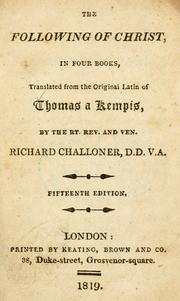
作品年表(1 本)
本站书库里署名托马斯·肯皮斯的书(Open Library 上至少 10 人加过书架的才收),其中 1 本记的年份比作者去世晚 50 年以上或者早于他出生(多半是后世的版本、译本或占位年份),不列年份,按首版年份排(有本站书页的用 Wikidata 记的首版年,其余用 Open Library 的);年份偶尔记成后来的版本或译本,以原书为准。全部作品见 Open Library。
- 年份不详师主篇Imitation of Christ书架 262