 书单
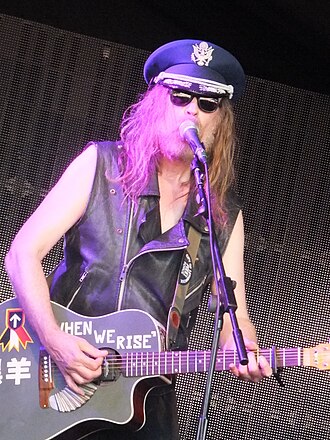
Julian Cope
- 生卒
- 1957 –
- 国籍
- 英国
照片:Adrian Brown,CC BY 2.0,来自维基共享资源「Lunar Festival - Julian Cope (cropped).jpg」(经缩小)。
生平与创作
这个词条暂时没有中文维基百科条目,下面是英文维基百科的内容(英文原文):
Julian David Cope (born 21 October 1957) is an English musician and author. He was the singer and songwriter in Liverpool post-punk band the Teardrop Explodes and has followed a solo career since 1983 in addition to working on musical side projects such as Queen Elizabeth, Brain Donor, and Black Sheep.
Cope is an author on Neolithic culture, publishing The Modern Antiquarian in 1998, and a political and cultural activist with a public interest in occultism and paganism. He has written two volumes of autobiography, Head-On (1994) and Repossessed (1999); two volumes of archaeology, The Modern Antiquarian (1998) and The Megalithic European (2004); and three volumes of musicology, Krautrocksampler (1995), Japrocksampler (2007); and Copendium: A Guide to the Musical Underground (2012).
Early life and career
Cope was born in Deri, Glamorgan, Wales, where his mother's parents lived, while she was staying there. His family resided in Tamworth, Staffordshire. Cope was staying with his grandmother near Aberfan on his ninth birthday, the day of the Aberfan disaster of 1966, which he has described as a key event of his childhood.
Cope grew up in Tamworth with his parents and his younger brother Joss. He played Oliver in Wilnecote High School's production of the musical. He attended C.F. Mott College of Education (now Liverpool John Moores University), and it was here that he first became involved in music.
1976–77: Early bands
In July 1977, Cope was one of the founders of the Crucial Three, a Liverpool punk rock band in which he played bass guitar. Although the Crucial Three lasted for little more than six weeks and disbanded without playing in public, all three members went on to lead successful Liverpool post-punk bands—singer Ian McCulloch with Echo & the Bunnymen and guitarist Pete Wylie with the Mighty Wah! Post-Crucial Three, Cope and McCulloch initially continued together in forming two other short-lived bands, UH? and A Shallow Madness (Cope had also spent time with Wylie in another short-lived band, Nova Mob). When Cope sacked McCulloch from A Shallow Madness, McCulloch went on to form Echo & the Bunnymen. The two former bandmates maintained a frequently antagonistic rivalry from then on, often carried out in public or in the press.
In late 1977, Cope joined the punk band the Mystery Girls with Pete Wylie, Pete Burns (later of Dead or Alive) and Phil Hurst. They had one performance (opening for Sham 69 at Eric's Club in Liverpool in November 1977) before disbanding.
1978–1983: The Teardrop Explodes
In 1978, Cope formed the Teardrop Explodes with drummer Gary Dwyer, organist Paul Simpson and guitarist Mick Finkler, with himself as singer, bass player and principal songwriter. Drawing on a post-punk version of West Coast pop music (which gained the nickname of "bubblegum trance"), the band became part of a wave of neo-psychedelic Liverpool bands. Cope and Dwyer (and later their manager-turned-keyboard player David Balfe, who served both as Cope's creative foil and his personal antagonist) were the only band constants; seven other members passed in and out of the line-up during the band's fractious four-year existence. Several well-received early singles (including "Sleeping Gas" and "Treason") culminated in the band's biggest hit, "Reward", which hit number 6 on the UK singles chart and took the Kilimanjaro album to number 24 on the chart. Cope's photogenic charm and wild, garrulous interview style helped keep the band in the media eye, and made him a short-lived teen idol during the band's peak.
Success brought the Teardrop Explodes attention, but no further stability. Their second album Wilder experimented with different and darker psychedelic styles, as well as delving deeper into Cope's complicated psyche: it spawned no major hits and sold relatively poorly at the time (despite being critically praised in retrospect). Excessive drug use plus continued infighting undermined the band, and a final lineup of Cope, Dwyer and Balfe split apart in 1982 after failed attempts to record a third album and a final disastrous tour.
Despite the relatively short life of the band, the Teardrop Explodes has continued to sustain interest and praise since its demise and the band's back catalogue of recordings has been reissued several times over the last 30 years. Cope, however, has strenuously resisted taking advantage of any nostalgic and commercial opportunities to reunite the band.
1982–85: The Mercury years – World Shut Your Mouth and Fried
In 1982 (accompanied by his new American wife Dorian Beslity), Cope moved to the Staffordshire village of Drayton Bassett (close to his childhood home of Tamworth). Following the break up of the Teardrop Explodes, he spent a period in seclusion recovering from the strain of the group's final year. Cope's well-documented Teardrops-era LSD excesses, eccentric behaviour and subsequent retreat had led to him being labelled an "acid casualty" in the vein of Syd Barrett and Roky Erickson, an image which took him several years to shake off. During this period Cope befriended a teenage Drayton Bassett musician, Donald Ross Skinner, who became his main musical foil for the next twelve years.
以上文字摘自英文维基百科「Julian Cope」(有删节,去掉了参考文献等尾部小节),按 CC BY-SA 4.0 使用,作者为维基百科的各位编者。
资料卡
- 母语名
- Julian Cope
- 本名
- Julian David Cope
- 出生
- 1957 年 10 月 21 日
- 出生地
- Deri
- 职业
- 歌手、作家、词曲作家、创作歌手、录音艺术家、作曲家、音乐家
- 使用语言
- 英语
- 就读学校
- 利物浦约翰摩尔斯大学
- 创作体裁
- 后朋克、摇滚乐
资料卡来自 Wikidata Q1371735(CC0),众包数据,个别字段可能不全。
本站收录的作品(1)
作品年表(1 本)
本站书库里署名Julian Cope的书(Open Library 上至少 10 人加过书架的才收),按首版年份排(有本站书页的用 Wikidata 记的首版年,其余用 Open Library 的);年份偶尔记成后来的版本或译本,以原书为准。全部作品见 Open Library。
- 1995Krautrocksampler书架 10