 书单
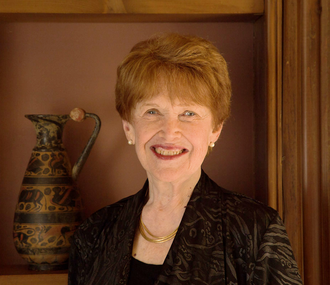
Riane Eisler
- 生卒
- 1931 –
- 国籍
- 美国、奥地利
照片:Don Eddy,CC BY-SA 4.0,来自维基共享资源「Riane Eisler.png」(经缩小)。
生平与创作
这个词条暂时没有中文维基百科条目,下面是英文维基百科的内容(英文原文):
Riane Tennenhaus Eisler (born July 22, 1931) is an Austrian-born American systems scientist, futurist, attorney, and author who writes about the effect of gender and family politics historically on societies, and vice versa. She is best known for her 1987 book, The Chalice and the Blade, in which she coined the terms "partnership" and "dominator".
Eilsler has written and been interviewed in over 500 articles. Her work is covered in publications ranging from Scientific American, Behavioral Science, Futures, Political Psychology, The Christian Science Monitor, Challenge, and UNESCO Courier to Brain and Mind, Human Rights Quarterly, International Journal of Women's Studies, and World Encyclopedia of Peace, as well as chapters for books published by trade and university presses.
Early life and education
Eisler was born in Vienna in 1931. In 1939, her family fled from the Nazis to Cuba. She and her parents lived in a slum in Havana for seven years, after which they emigrated to the United States, to Miami, New York, and Chicago before finally settling in Los Angeles.
Eisler has degrees in Sociology and Law from the University of California. She was part of the Phi Beta Kappa society.
Career
Eisler is an attorney, legal scholar, systems scientist, and author.
Writing
Eisler has published thirteen books. Her first book, published in 1977, was Dissolution: No-Fault Divorce, Marriage, and the Future of Women. Her second book, published in 1979, was on the Equal Rights Amendment.
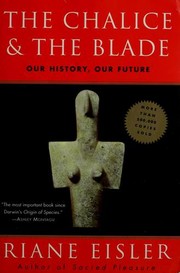
In 1987, Eisler published her third book, The Chalice and the Blade, which drew on ten years of multidisciplinary research. Popęda describes the essence of the book as showing "that human history is not the inevitable march of male domination, that for millenia our ancestors organized themselves around partnership rather than ranking, and that a more peaceful alternative isn't utopian, but [is] our recoverable past and likely future." The book sold over 500,000 copies and been translated into 30 languages. Ashley Montagu called the book "The most important book since Darwin's Origin of Species."
In 1995, Eisler published Sacred Pleasure, which Gloria Steinem called "Eisler's most stunning, far-reaching, and practical gift – both to readers and to a world that must change or perish."
In 2000, she published a memoir, The Gate.
In 2002, Eisler published The Power of Partnership. Marianne Williamson said that the book provides "the map to a world that works for all of us."
In 2019, Eisler Published Nurturing Our Humanity. Jennifer Siebel Newsom described by it saying it "outlines the roadmap for a world that leads with partnership – where empathy, care, and community are valued above all, and each can fulfill our full human potential."
Eisler was the Editor-in-Chief of the Interdisciplinary Journal of Partnership Studies at the University of Minnesota.
The children's troubadour Raffi, called Eisler's book on education, Tomorrow's Children "a pathway toward a child-honoring society."
The Center for Partnership Systems
In 1987, in partnership with her late husband David Elliot Loye, Eisler founded The Center for Partnership Studies, which was later renamed The Center for Partnership Systems. The organization is "dedicated to research, education, and building tools to construct economic and social systems that support human beings and the planet that sustains us."
As of 2024, the Center acts as a digital hub of resources, tools, connections, and community focused on partnership-oriented social change.
Thought
Partnership vs. domination
In The Chalice and the Blade (1987) Eisler coined the terms "partnership" and "domination" to describe two underlying forms of society. These forms transcend conventional social categories like right/left, religious/secular, Eastern/Western, capitalist/socialist.
Eisler argued that partnership-oriented societies are characterized by peace, equity, gender equality, sustainability, and caring. Dominator-oriented societies are characterized by sexism and other forms of in-group versus out-group rankings such as racism and anti-Semitism, as well as chronic war (nuclear bombs, technological warfare), ecological destruction, and climate change.
Eisler's research, which references the work of archaeologists Marija Gimbutas, James Mellaart, and Ian Hodder, as well as anthropologist Douglas Fry, shows that for millennia most human societies were built on a partnership-oriented structure. This meant society supported the human capacity to give, nurture, and sustain life. Caregiving and shared responsibility were both important. According to archaeology, the fall into domination occurred between five and ten thousand years ago.
Eisler's research argues that the switch from partnership to domination led to a shift from in-group versus out-group attitudes. Group hierarchy and relationships were now based on factors such as sex, race, and other differences. Violence was ultimately the basis for maintaining these hierarchies, and was built into the system. The "conquest of nature," massive inequality, and devaluing the work of caring for people started to become common practice. The work of caring for our natural life-support systems was also undervalued, taken for granted, and removed from the money economy. Domination systems also normalize violence – from abusive authoritarian families, to the promotion of violence in modern politics, to destructive warfare between nations. Violence becomes a means to maintain power-over others as a social norm.
Influence
Philosopher Terence McKenna referenced Eisler's work throughout his writings and talks, including in The Archaic Revival. In 1988, Eisler and McKenna gave a talk entitled "Man And Woman At The End Of History" together in Ojai CA and Mill Valley.
Eisler's term dominator culture has been used by writers ranging from bell hooks to Tao Lin.
Awards
Among Eisler's awards are:
2022 Centers for Compassion, Humanitarian Award
Honorary member, Club of Budapest (other honorary members include Mikhail Gorbachev)
2017 Visionary Award, Feminist Press
2014 Pioneer Award, Institute for Women's Leadership
以上文字摘自英文维基百科「Riane Eisler」(有删节,去掉了参考文献等尾部小节),按 CC BY-SA 4.0 使用,作者为维基百科的各位编者。
资料卡
- 出生
- 1931 年 7 月 22 日
- 出生地
- 维也纳
- 职业
- 人类学家、历史学家、社会学家、人权活动家、非虚构文学作家、法学家、大学教师、作家 等 12 项
- 使用语言
- 英语
- 就读学校
- 加利福尼亚大学、University of Valle、加州大学伯克利分校
- 领域
- 性别研究、女权论者、文化史、和平运动、未来主义文学 等 9 项
- 所属团体
- 罗马俱乐部;另有 1 项只有外文名
- 配偶
- David Elliot Loye
- 代表作
- The Chalice and the Blade
资料卡来自 Wikidata Q469551(CC0),众包数据,个别字段可能不全。
本站收录的作品(1)
同时代的美国作家
Open Library 上的全部作品
正在读取…