 书单
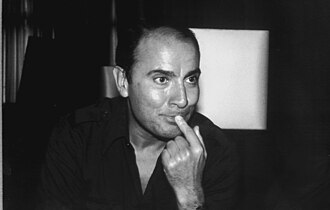
曼努埃尔·普伊格
- 生卒
- 1932 – 1990
- 国籍
- 阿根廷
- 外文名
- Manuel Puig
照片:Elisa Cabot,CC BY-SA 2.0,来自维基共享资源「Manuel Puig, 1979.jpg」(经缩小)。
生平与创作
曼努埃尔·普伊格(西班牙语:Manuel Puig,1932年12月28日—1990年7月22日),阿根廷小说家,著有小说《丽塔·海华斯的背叛》、《蜘蛛女之吻》等。
以上文字摘自维基百科「曼努埃尔·普伊格」(去掉了参考文献等尾部小节),按 CC BY-SA 4.0 使用,作者为维基百科的各位编者。
中文维基百科的条目比较短,下面附上英文维基百科的内容(英文原文):
Juan Manuel Puig Delledonne (December 28, 1932 – July 22, 1990), commonly called Manuel Puig, was an Argentine author and LGBTQ activist. Among his best-known novels are La traición de Rita Hayworth (Betrayed by Rita Hayworth, 1968), Boquitas pintadas (Heartbreak Tango, 1969), and El beso de la mujer araña (Kiss of the Spider Woman, 1976) which was adapted into the film released in 1985, directed by the Argentine-Brazilian director Héctor Babenco; and a Broadway musical in 1993.
Early life, education and early career
Puig was born in General Villegas, Buenos Aires Province. Since there was no high school in General Villegas, his parents sent him to Buenos Aires in 1946. Puig attended Colegio Ward in Villa Sarmiento (Morón County). This is when he began to read systematically, beginning with a collection of texts by Nobel Prize winners. A classmate named Horacio, in whose home Puig rented accommodation when he first moved to Buenos Aires City introduced him to readings from the school of psychoanalysis. The first novel that he read was The Pastoral Symphony by André Gide; he also read Hermann Hesse, Aldous Huxley, Jean-Paul Sartre, and Thomas Mann.
Horacio also introduced Puig to European cinema. After seeing Quai des Orfèvres (1947), he decided that he wanted to be a film director. To prepare for his chosen career, he learned Italian, French, and German, which were considered "the new languages of cinema". He was advised to study engineering in order to specialize in sound-on-film but did not consider this to be the right choice. In 1950, he enrolled in the University of Buenos Aires Faculty of Architecture but only took classes for six months. In 1951, Puig switched to the School of Philosophy. He was a diligent student, although he struggled with subjects such as Latin. When he graduated, he was already working in film as an archivist and editor in Buenos Aires and later, in Italy after winning a scholarship from the Italian Institute of Buenos Aires. However, the world of Hollywood and the stars that had captivated him during his childhood now disappointed him; the exceptions were Marilyn Monroe and Gloria Swanson.
A note in the magazine Radiolandia about the upcoming premiere of the film Deshonra prompted Puig to try and meet its director Daniel Tinayre, whose comedy La vendedora de fantasías he admired. Since the director denied him access to the set, he spoke to the actress Fanny Navarro, who played the main role, without Tinayre's permission. He felt no sympathy for her since she supported Juan Domingo Perón, who had prohibited the importation of American films into Argentina. Navarro sent him to another actress of the cast, Herminia Franco, who got him in. Shortly after, he began to work in Alex laboratories.
In 1953, Puig did his obligatory military service in the area of Aeronautics, working as a translator.
Writing career
In the 1960s, Manuel Puig moved back to Buenos Aires, where he penned his first major novel, La traición de Rita Hayworth. Because he had leftist political tendencies and also foresaw a rightist wave in Argentina, Puig moved to Mexico in 1973, where he wrote his later works (including El beso de la mujer araña).
Much of Puig's work can be seen as pop art. Perhaps due to his work in film and television, Puig managed to create a writing style that incorporated elements of these mediums, such as montage and the use of multiple points of view. He also made much use of popular culture (for example, soap opera) in his works. In Latin American literary histories, he is presented as a writer who belongs to the Postboom and Post-modernist schools.
以上文字摘自英文维基百科「Manuel Puig」(有删节,去掉了参考文献等尾部小节),按 CC BY-SA 4.0 使用,作者为维基百科的各位编者。
资料卡
- 本名
- Juan Manuel Puig Delledonne
- 笔名
- Manuel Puig
- 出生
- 1932 年 12 月 28 日
- 出生地
- General Villegas
- 逝世
- 1990 年 7 月 22 日
- 逝世地
- 库埃纳瓦卡
- 职业
- 作家、剧作家、编剧、小说家、社运人士、散文家、电影编剧、电影制片人
- 使用语言
- 西班牙语
- 写作语言
- 西班牙语
- 就读学校
- 布宜诺斯艾利斯大学
- 领域
- 纯文学、散文、长篇小说、戏剧、短篇小说 等 7 项
资料卡来自 Wikidata Q284560(CC0),众包数据,个别字段可能不全。
本站收录的作品(1)
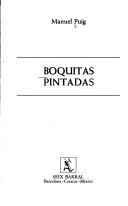
作品年表(3 本)
本站书库里署名曼努埃尔·普伊格的书(Open Library 上至少 10 人加过书架的才收),按首版年份排(有本站书页的用 Wikidata 记的首版年,其余用 Open Library 的);年份偶尔记成后来的版本或译本,以原书为准。全部作品见 Open Library。
- 1969Boquitas pintadas书架 36
- 1973Heartbreak tango书架 12
- 1979El beso de la mujer araña书架 77