 书单
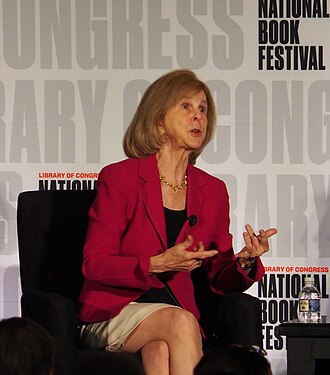
伊莱恩·柏高丝
- 生卒
- 1943 –
- 国籍
- 美国
- 外文名
- Elaine Pagels
照片:slowking4,CC BY-SA 2.0,来自维基共享资源「Elaine pagels 8315812.jpg」(经缩小)。
生平与创作
这个词条暂时没有中文维基百科条目,下面是英文维基百科的内容(英文原文):
Elaine Pagels, née Hiesey (born February 13, 1943), is an American historian of religion. She is the Harrington Spear Paine Professor of Religion Emerita at Princeton University. Pagels has conducted extensive research into early Christianity and Gnosticism.
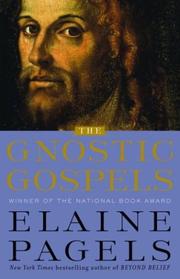
Her best-selling book The Gnostic Gospels (1979) examines the divisions in the early Christian church, and the way that women have been viewed throughout Jewish history and Christian history. Modern Library named it as one of the 100 best nonfiction books of the twentieth century (place 72).
Early life and education
Elaine Hiesey was born February 13, 1943, in California. She is the daughter of Stanford University botanist William Hiesey.
According to Pagels, she has been fascinated with the Gospel of John since her youth. She found it to be "the most spiritual of the four gospels". After joining an Evangelical church at the age of 13, she quit when the church announced that a Jewish friend of hers who had been killed in a car crash would go to hell because he had not been "born again".
Pagels remained fascinated by the power of the New Testament. She started to learn Greek when she entered college, and read the Gospels in their original language. She graduated from Stanford University, earning a BA in 1964 and MA in 1965. After briefly studying dance at Martha Graham's studio, she began studying for a PhD in religion at Harvard University as a student of Helmut Koester and part of a team studying the Nag Hammadi library manuscripts.
Academic work
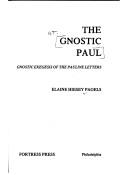
Pagels completed her PhD in 1970, and joined the faculty at Barnard College. She headed its Department of Religion from 1974 until she moved to Princeton in 1982. In 1975, after studying the Pauline Epistles and comparing them to Gnosticism and the early Church, Pagels wrote the book, The Gnostic Paul which argues that Paul the Apostle was a source for Gnosticism and hypothesizes that Paul's influence on the direction of the early Christian church was great enough to inspire the creation of pseudonymous writings such as the Pastoral Epistles (First and Second Timothy and Titus), in order to make it appear that Paul was anti-Gnostic.
Pagels' study of the Nag Hammadi manuscripts was the basis for The Gnostic Gospels (1979), a popular introduction to the Nag Hammadi library. It was a best seller and won both the National Book Award in one-year category Religion/Inspiration and the National Book Critics Circle Award. Modern Library named it as one of the 100 best nonfiction books of the twentieth century (place 72). She follows the well-known thesis that Walter Bauer first put forth in 1934 and argues that the Christian church was founded in a society espousing contradictory viewpoints. A review of the book in the UK newspaper, The Sunday Times, led to the UK broadcaster, Channel 4, commissioning a major three-part series inspired by it, called Jesus: The Evidence. The programme triggered a national furore, and marked a significant moment in the changes that religious broadcasting was already undergoing at that time. As a movement Gnosticism was not coherent and there were several areas of disagreement among the different factions. According to Pagels's interpretation of an era different from ours, Gnosticism "attracted women because it allowed female participation in sacred rites".
In 1982, Pagels joined Princeton University as a professor of early Christian history. Aided by a MacArthur Fellowship grant in 1981, she researched and wrote Adam, Eve, and the Serpent, which examines the creation account and its role in the development of sexual attitudes in the Christian West. In both The Gnostic Gospels and Adam, Eve, and the Serpent, Pagels focuses especially on the way that women have been viewed throughout Jewish and Christian history. Her other books include The Origin of Satan (1995), Beyond Belief: The Secret Gospel of Thomas (2003), Reading Judas: The Gospel of Judas and the Shaping of Christianity (2007), and Revelations: Visions, Prophecy, and Politics in the Book of Revelation (2012).
In April 1987, Pagels's son Mark died after five years of illness, and in July 1988, her husband Heinz Pagels died in a mountain climbing accident. These personal tragedies deepened her spiritual awareness and afterwards Pagels began research leading to The Origin of Satan. This book argues that the figure of Satan became a way for Christians to demonize their religious and cultural opponents, namely, pagans, other Christian sects, and Jews.
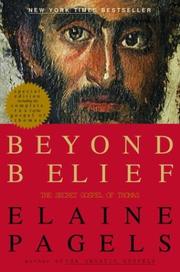
Her New York Times bestseller, Beyond Belief: The Secret Gospel of Thomas (2003), contrasts the Gospel of Thomas with the Gospel of John. It argues that a close reading of the texts reveals distinct theological perspectives: the Gospel of Thomas teaches that "there is a light within each person, and it lights up the whole universe... If it does not shine, there is darkness," emphasizing the divine light within all human beings. In contrast, the Gospel of John presents Jesus Christ as the "light of the world," centralizing the revelation of God through Christ.
Pagels suggests that Gospel of Thomas, along with other non-canonical texts, portrays Jesus not as God, but as a human teacher uncovering the divine light within individuals. This interpretation conflicts with the canonical New Testament gospels, which affirm the divinity of Jesus. Pagels argues that the Gospel of John was written in response to the non-canonical viewpoints found in the Gospel of Thomas. She supports this by noting that in John's Gospel, the apostle Thomas is portrayed as a disciple who struggles with doubt, needing physical proof to believe, while John emphasizes the divine nature of Jesus as central to faith—a key aspect of early Christian orthodoxy.
Beyond Belief also includes Pagels' personal reflection on faith, particularly during a period of personal loss and tragedy.
以上文字摘自英文维基百科「Elaine Pagels」(有删节,去掉了参考文献等尾部小节),按 CC BY-SA 4.0 使用,作者为维基百科的各位编者。
资料卡
- 出生
- 1943 年 2 月 13 日
- 出生地
- 帕洛阿尔托
- 职业
- 历史学家、神学家、大学教师、宗教学家
- 使用语言
- 英语
- 就读学校
- 哈佛大学、斯坦福大学、哈佛神学院
- 领域
- 宗教史
- 所属团体
- 美国文理科学院
- 配偶
- 海兹·帕各斯(1969)、R. Kent Greenawalt
- 获奖
- 古根海姆学者奖(1978)、麦克阿瑟天才奖(1981)、哈佛百年奖章(2005)、美国国家人文奖章(2015)、哈佛大学名誉博士(2013)、美国国家图书奖(1980);另有 1 项只有外文名
资料卡来自 Wikidata Q263099(CC0),众包数据,个别字段可能不全。
本站收录的作品(3)
同时代的美国作家
Open Library 上的全部作品
正在读取…