 书单
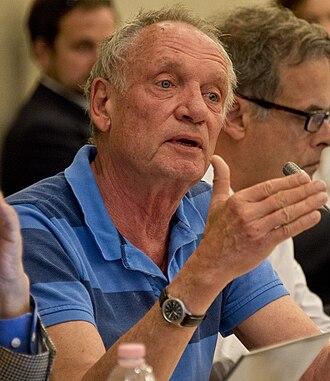
Gøsta Esping-Andersen
- 生卒
- 1947 –
- 国籍
- 丹麦王国
照片:European University Institute,CC BY-SA 2.0,来自维基共享资源「GostaEspingAndersen.jpg」(经缩小)。
生平与创作
这个词条暂时没有中文维基百科条目,下面是英文维基百科的内容(英文原文):
Gøsta Esping-Andersen (born 24 November 1947) is a Danish sociologist whose primary focus has been on the welfare state and its place in capitalist economies. Jacob Hacker describes him as the "dean of welfare state scholars". Over the past decade his research has moved towards family demographic issues. A synthesis of his work was published as Families in the 21st Century (Stockholm, SNS, 2016).
Esping-Andersen is a pioneer of power resource theory.
Academic career
Esping-Andersen completed his doctoral studies at the University of Wisconsin-Madison, writing a dissertation under the supervision of Gerald Marwell. While at Madison, Esping-Andersen also studied with Erik Olin Wright and Aage B. Sørensen, as well as Maurice Zeitlin, who mentored Esping-Andersen until his departure from the University of Wisconsin in 1977.
Esping-Andersen is professor emeritus at Pompeu Fabra University in Barcelona (Spain), and member of the Scientific Committee of the Juan March Institute and of the Board of Trustees and the Scientific Council at the IMDEA Social Sciences Institute, both in Madrid (Spain). He is a member of the American Academy of Social Sciences and the British Academy. He was awarded an honoris doctor causa from the University of Copenhagen in 2012. He is now a research professor at Bocconi University in Milan.
Major works
Esping-Andersen (1990) challenges theories that argue capitalist welfare states tend to become increasingly uniform due to the assumed logic of industrialization. He identifies a connection between the degree of decommodification—the extent to which individuals can maintain their well-being without relying on the market—regarding pensions, healthcare, and unemployment benefits, as well as labor market policies, and the nature of the political regime in 18 member states of the Organization for Economic Co-operation and Development (OECD). He categorizes political regimes based on three key factors:
The extent of left-wing influence and working-class organization within the government,
The level of electoral support for Catholic conservatism,
The presence of an authoritarian past or historical restrictions on voting rights.
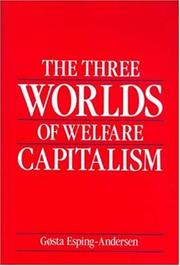
His most influential and highly cited book titled The Three Worlds of Welfare Capitalism was published in 1990 and laid out three main types of welfare states, in which modern developed capitalist nations cluster based on these criteria:
Liberal welfare states are characterized by a lack of strong working-class mobilization and an absence of an absolutist political history. These systems primarily rely on means-tested benefits, offering limited social insurance while actively promoting private welfare provisions. Notable examples include the United States, Canada, and Australia.
Conservative corporatist welfare states are influenced by a Catholic conservative tradition and have a history of political absolutism. They prioritize social insurance schemes over means-tested assistance or private benefits, yet they limit income redistribution. Countries such as Austria, Italy, France, and Germany exemplify this model.
social democratic welfare states are distinguished by significant working-class participation in governance and the presence of influential social democratic parties. These states implement comprehensive welfare policies that emphasize income redistribution and incorporate labor market strategies to support unemployed individuals.
Other sociologists and political scientists went on to apply his theoretical analysis to the real world. One such example is a book entitled Real Worlds of Welfare Capitalism, written by Robert E. Goodin, Bruce Headey, Ruud Muffels, and Henk-Jan Dirven. While some critics claim Esping-Andersen's categories are becoming outdated, many political scientists are attracted by its intuitive simplicity.
In the past decade, his research has moved to demographic issues and in particular to the consequences of women's changing roles. He has developed a multiple equilibrium framework for the understanding of changing family behaviour. See in particular his Families in the 21st Century and Esping-Andersen and Billari (2015) and Retheorizing family demographic change. Population and Development Review (2015).
Criticism
The evolving nature of welfare states often makes it difficult to categorize. Arguably, many welfare states have components from some or all typologies, making them more akin to points on a continuum rather than rigid typologies, a fact Esping-Andersen acknowledges in his writings.
According to the French sociologist Georges Menahem, Esping-Andersen's "decommodification index" aggregates both qualitative and quantitative variables for ”sets of dimensions” which are fluid, and pertain to three very different areas. Similarly, Menahem has concerns regarding the validity of the index, and its potential for replication.
In 1996, the Italian social scientist Maurizio Ferrera further developed Esping-Andersen's Worlds of Welfare by identifying a fourth subtype of the welfare state model, the Southern European Model of Welfare.
以上文字摘自英文维基百科「Gøsta Esping-Andersen」(去掉了参考文献等尾部小节),按 CC BY-SA 4.0 使用,作者为维基百科的各位编者。
资料卡
- 出生
- 1947 年 11 月 24 日
- 出生地
- 奈斯特韦兹
- 职业
- 社会学家、政治学家、大学教师、经济学家
- 使用语言
- 英语
- 就读学校
- 哥本哈根大学、威斯康星大学麦迪逊分校
- 所属团体
- 美国文理科学院
- 代表作
- The three worlds of welfare capitalism
资料卡来自 Wikidata Q704458(CC0),众包数据,个别字段可能不全。
本站收录的作品(1)
同时代的丹麦王国作家
Open Library 上的全部作品
正在读取…