 书单
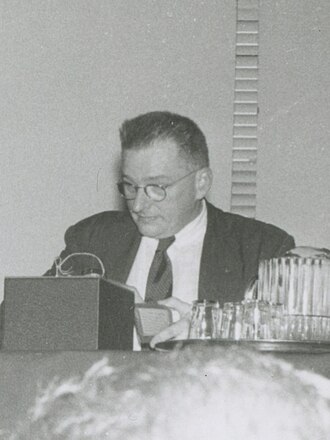
约翰·W·坎贝尔
- 生卒
- 1910 – 1971
- 国籍
- 美国
- 外文名
- John W. Campbell
照片:slomuse,公有领域,来自维基共享资源「14th WSFS 008 - 1956 John Campbell cropped.jpg」(经缩小)。
生平与创作
约翰·W·坎贝尔(英语:John Wood Campbell,1910年6月8日—1971年7月11日)是美国科幻小说作家和编辑。从1937年底直到他去世,约翰·W·坎贝尔为《惊人的科幻》(后来被称为《模拟科幻小说与事实》)主编,他塑造所谓的科幻小说黄金时代。
艾萨克·阿西莫夫称坎贝尔为“有史以来最强大的科幻小说力量,他主编的第一个十年,完全占主导该领域。”
以上文字摘自维基百科「約翰·W·坎貝爾」(去掉了参考文献等尾部小节),按 CC BY-SA 4.0 使用,作者为维基百科的各位编者。
中文维基百科的条目比较短,下面附上英文维基百科的内容(英文原文):
John Wood Campbell Jr. (June 8, 1910 – July 11, 1971) was an American science fiction writer and editor. He was editor of Astounding Science Fiction (later called Analog Science Fiction and Fact) from late 1937 until his death and was part of the Golden Age of Science Fiction. Campbell wrote
"super-science" space opera under his own name and other stories under his primary pseudonym, Don A. Stuart. Campbell also used the pen names Karl Van Kampen and Arthur McCann. His novella Who Goes There? (1938) was adapted as the films The Thing from Another World (1951) and The Thing (1982); as well as a prequel The Thing (2011).
Campbell began writing science fiction at age 18 while attending MIT. He published six short stories, a novel, and eight letters in the science fiction magazine Amazing Stories from 1930 to 1931. This work established Campbell's reputation as a writer of space adventure. In 1934, he began to write science fiction stories of a different sort under the pseudonym Don A. Stuart. From 1930 until 1937, Campbell was prolific and successful under both names; he stopped writing fiction shortly after he became editor of Astounding in 1937. In his capacity as an editor, Campbell published the earliest work, and helped shape the careers of nearly every important science-fiction author to debut between 1938 and 1946, including Isaac Asimov, Robert A. Heinlein, Theodore Sturgeon, and Arthur C. Clarke.
Biography
John Campbell was born in Newark, New Jersey, in 1910. His father, John Wood Campbell Sr., was an electrical engineer. His mother, Dorothy (née Strahern) had an identical twin who visited them often. John was unable to tell them apart and said he was frequently rebuffed by the person he took to be his mother. Campbell attended the Blair Academy, a boarding school in rural Warren County, New Jersey, but did not graduate because of lack of credits for French and trigonometry.
He also attended, without graduating, the Massachusetts Institute of Technology (MIT), where he was befriended by the mathematician Norbert Wiener (who coined the term cybernetics) – but he failed German. MIT dismissed him in his junior year in 1931. After two years at Duke University, he graduated with a Bachelor of Science in physics in 1934.
Campbell began writing science fiction at age 18 while attending MIT and sold his first stories quickly. From January 1930 to June 1931, Amazing Stories published six of his short stories, one novel, and six letters. Campbell was editor of Astounding Science Fiction (later called Analog Science Fiction and Fact) from late 1937 until his death. Between December 11, 1957, and June 13, 1958, he hosted a weekly science fiction radio program called Exploring Tomorrow. The scripts were written by authors such as Gordon R. Dickson and Robert Silverberg.
Campbell and Doña Stewart married in 1931. They divorced in 1949, and he married Margaret (Peg) Winter in 1950. He spent most of his life in New Jersey and died of heart failure at his home in Mountainside, New Jersey. He was an atheist.
Writing career
Editor T. O'Conor Sloane lost Campbell's first manuscript that he accepted for Amazing Stories, entitled "Invaders of the Infinite". "When the Atoms Failed" appeared in January 1930, followed by five more during 1930. Three were part of a space opera series featuring the characters Arcot, Morey, and Wade. A complete novel in the series, Islands of Space, was the cover story in the Spring 1931 Quarterly. During 1934–35 a serial novel, The Mightiest Machine, ran in Astounding Stories, edited by F. Orlin Tremaine, and several stories featuring lead characters Penton and Blake appeared from late 1936 in Thrilling Wonder Stories, edited by Mort Weisinger.
以上文字摘自英文维基百科「John W. Campbell」(有删节,去掉了参考文献等尾部小节),按 CC BY-SA 4.0 使用,作者为维基百科的各位编者。
资料卡
- 母语名
- John Wood Campbell, Jr.
- 笔名
- Don A. Stuart、Karl van Campen、Arthur McCann
- 出生
- 1910 年 6 月 8 日
- 出生地
- 纽瓦克
- 逝世
- 1971 年 7 月 11 日
- 逝世地
- 芒廷赛德
- 职业
- 编辑、小说家、作家、编剧、科幻作家、散文家、采编
- 使用语言
- 英语
- 写作语言
- 英语
- 就读学校
- 杜克大学、麻省理工学院、布莱尔学院
- 创作体裁
- 科学幻想
- 获奖
- 雨果奖最佳职业杂志奖(1953)、雨果奖最佳职业杂志奖(1955)、雨果奖最佳职业杂志奖(1956)、雨果奖最佳职业杂志奖(1957)、雨果奖最佳职业杂志奖(1961)、雨果奖最佳职业杂志奖(1962)、雨果奖最佳职业杂志奖(1964)、雨果奖最佳职业杂志奖(1965);另有 2 项只有外文名
资料卡来自 Wikidata Q435056(CC0),众包数据,个别字段可能不全。
本站收录的作品(1)
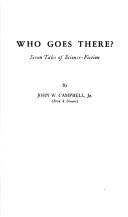
作品改编
同时代的美国作家
Open Library 上的全部作品
正在读取…