 书单
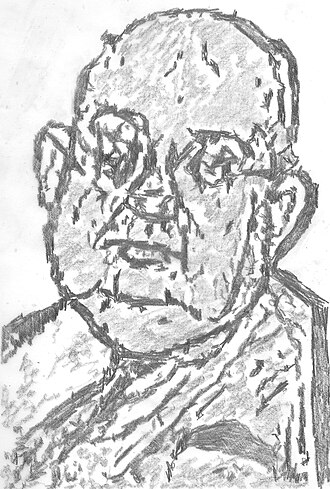
A. J. Liebling
- 生卒
- 1904 – 1963
- 国籍
- 美国
照片:Jburlinson,CC BY-SA 3.0,来自维基共享资源「Liebling-web.jpg」(经缩小)。
生平与创作
这个词条暂时没有中文维基百科条目,下面是英文维基百科的内容(英文原文):
Abbott Joseph Liebling (October 18, 1904 – December 28, 1963) was an American journalist who was closely associated with The New Yorker from 1935 until his death. His New York Times obituary called him "a critic of the daily press, a chronicler of the prize ring, an epicure and a biographer of such diverse personages as Gov. Earl Long of Louisiana and Col. John R. Stingo." He was known for dubbing Chicago "The Second City" and for the aphorism "Freedom of the press is guaranteed only to those who own one." Liebling's boxing book The Sweet Science was named the greatest sports book of all time by Sports Illustrated. Liebling was a connoisseur of French cuisine, a subject he wrote about in Between Meals: An Appetite For Paris. Pete Hamill, editor of a Library of America anthology of Liebling's writings, said "He was a gourmand of words, in addition to food... he retained his taste for 'low' culture too: boxers and corner men, conmen and cigar store owners, political hacks and hack operators. They're all celebrated in [his] pages."
Early life
Liebling was born into a well-off family on the Upper East Side of Manhattan, where his father worked in New York's fur industry. His father was a Jewish immigrant from Austria and his mother, Anna Adelson Slone, came from a Jewish family in San Francisco. After early schooling in New York, Liebling was admitted to Dartmouth College in the fall of 1920. His primary activity during his undergraduate career was as a contributor to the Jack-O-Lantern, Dartmouth's nationally known humor magazine. He left Dartmouth without graduating, later claiming he was "thrown out for missing compulsory chapel attendance." He then enrolled in the School of Journalism at Columbia University.
Career
Early years
After finishing at Columbia, he began his career as a journalist at the Evening Bulletin of Providence, Rhode Island. He worked briefly in the sports department of The New York Times, from which he supposedly was fired for listing the name "Ignoto" (Italian for "unknown") as the referee in results of games.
In 1926, Liebling's father asked if he would like to suspend his career as a journalist to study in Paris for a year.
I sensed my father's generous intention and, fearing that he might change his mind, I told him that I didn't feel I should go, since I was indeed thinking of getting married. "The girl is ten years older than I am," I said, "and Mother might think she is kind of fast, because she is being kept by a cotton broker from Memphis, Tennessee, who only comes North once in a while. But you are a man of the world, and you understand that a woman can't always help herself..." Within the week, I had a letter of credit on the Irving Trust for two thousand dollars, and a reservation on the old Caronia for late in the summer, when the off-season rates would be in effect.
Liebling later wrote that the unsuitable proposed marriage was a fiction intended less to swindle his father than to cover his own pride at being the recipient of such generosity.
Thus in summer 1926, Liebling sailed to Europe where he studied French medieval literature at the Sorbonne in Paris. By his own admission his devotion to his studies was purely nominal, as he saw the year as a chance to absorb French life and appreciate French food. Although he stayed for little more than a year, this interval inspired a lifelong love for France and the French, later renewed in his war reporting. He returned to Providence in autumn 1927 to write for the Journal. He then moved to New York, where he proceeded to campaign for a job on Joseph Pulitzer's New York World, which carried the work of James M. Cain and Walter Lippmann and was known at the time as "the writer's paper". In order to attract the attention of the city editor, James W. Barrett, Liebling hired an out-of-work Norwegian seaman to walk for three days outside the Pulitzer Building, on Park Row, wearing sandwich boards that read Hire Joe Liebling. It turned out that Barrett habitually used a different entrance on another street, and never saw the sign. He wrote for the World (1930–31) and the World-Telegram (1931–35).
The New Yorker
Liebling joined The New Yorker in 1935. His best pieces from the late thirties are collected in Back Where I Came From (1938) and The Telephone Booth Indian (1942).
During World War II, Liebling was active as a war correspondent, filing many stories from Africa, England, and France. His war began when he flew to Europe in October 1939 to cover its early battles, lived in Paris until June 10, 1940, and then returned to the United States until July 1941, when he flew to Britain. He sailed to Algeria in November 1942 to cover the fighting on the Tunisian front (January to May 1943). His articles from these days are collected in The Road Back to Paris (1944). He participated in the Normandy landings on D-Day, and he wrote a memorable piece concerning his experiences under fire aboard a U.S. Coast Guard-staffed landing craft off Omaha Beach. He afterwards spent two months in Normandy and Brittany, and was with the Allied forces when they entered Paris. He wrote afterwards: "For the first time in my life and probably the last, I have lived for a week in a great city where everybody was happy." Liebling was awarded the Cross of the Legion of Honour by the French government for his war reporting.
Following the war he returned to regular magazine fare and for many years after he wrote a New Yorker monthly feature called "Wayward Press", in which he analyzed the American press. Liebling was also a fan of boxing, horse racing and food, and frequently wrote about these subjects.
In 1947 he published The Wayward Pressman, a collection of his writings from The New Yorker and other publications.
Hiss case
During the late 1940s, he vigorously criticized the House Un-American Activities Committee and became friends with Alger Hiss.
以上文字摘自英文维基百科「A. J. Liebling」(有删节,去掉了参考文献等尾部小节),按 CC BY-SA 4.0 使用,作者为维基百科的各位编者。
资料卡
- 母语名
- A. J. Liebling
- 出生
- 1904 年 10 月 18 日
- 出生地
- 纽约
- 逝世
- 1963 年 12 月 28 日
- 逝世地
- 纽约
- 职业
- 战地记者、新闻工作者
- 使用语言
- 英语
- 就读学校
- 达特茅斯学院、哥伦比亚大学新闻学院
- 配偶
- 珍·斯塔福(1959)、Mary Anne Quinn、Lucille Spectorsky
- 获奖
- 法国荣誉军团骑士勋章、国际拳击名人堂(1992)
资料卡来自 Wikidata Q278806(CC0),众包数据,个别字段可能不全。
作品年表(2 本)
本站书库里署名A. J. Liebling的书(Open Library 上至少 10 人加过书架的才收),按首版年份排(有本站书页的用 Wikidata 记的首版年,其余用 Open Library 的);年份偶尔记成后来的版本或译本,以原书为准。全部作品见 Open Library。
- 1949The sweet science书架 19
- 1959Between meals书架 12