 书单
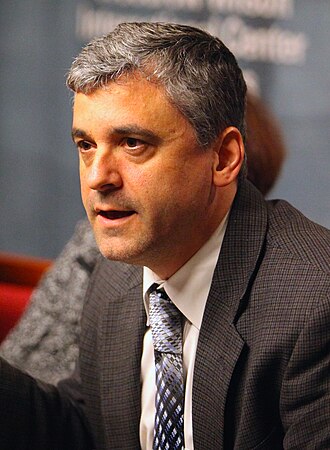
史蒂夫·列维茨基
- 生卒
- 1968 –
- 国籍
- 美国
- 外文名
- Steven Levitsky
照片:Woodrow Wilson International Center for Scholars,公有领域,来自维基共享资源「Steven Levitsky.jpg」(经缩小)。
生平与创作
这个词条暂时没有中文维基百科条目,下面是英文维基百科的内容(英文原文):
Steven Robert Levitsky (born January 17, 1968) is an American political scientist and professor of government at Harvard University and a senior fellow for democracy at the Council on Foreign Relations. He is also a senior fellow at the Kettering Foundation, an American non-partisan research foundation.
A comparative political scientist, his research interests focus on Latin America and include political parties and party systems, authoritarianism and democratization, and weak and informal institutions.
He is notable for his work on competitive authoritarian regimes and informal political institutions. An expert on Latin America, Levitsky co-authored the 2018 best seller How Democracies Die with Daniel Ziblatt (an expert on authoritarianism in interwar Europe), warning that Donald Trump and the Republican Party were engaging in rhetoric and actions that have parallels with the breakdown of democracy in other regions and historical periods.
Early life
Levitsky was raised in Ithaca, New York. His father was a professor of psychology at Cornell University.
He studied Spanish in high school and became aware of the Reagan administration policies toward Central America. As an undergraduate, he took some courses about Latin America and "fell in love with the region". In the summer of 1989, he visited Managua, Nicaragua, to do research for his senior thesis.
Levitsky received a B.A. in political science from Stanford University in 1990 and a Ph.D. in political science from the University of California, Berkeley, in 1999.
Academic career
Career
After obtaining his Ph.D. in 1999, Levitsky was a visiting fellow at the University of Notre Dame's Kellogg Institute for International Studies.
The next year, he joined Harvard University as an assistant professor of government. There he went on to serve as the John L. Loeb Associate Professor of the Social Sciences (2004–2008) before receiving tenure as a full professor of government in 2008. Although he had enjoyed living and studying in the San Francisco Bay Area, he always identified more strongly with the East Coast and was happy to return east when he joined Harvard.
At Harvard, Levitsky also sits on the executive committees of the Weatherhead Center for International Affairs and the David Rockefeller Center for Latin American Studies.
He is an advisor to several student organizations, including the Harvard Association Cultivating Inter-American Democracy (HACIA Democracy).
Research
Levitsky is known for his work with University of Toronto professor Lucan Way on "competitive authoritarian" regimes: hybrid government types in which, on the one hand, democratic institutions are generally accepted as the means to obtaining and exercising political power, but, on the other hand, incumbents violate the norms of those institutions so routinely, and to such an extent, that the regime fails to meet basic standards for democracy; under such a system, incumbents almost always retain power, because they control and tend to use the state to squelch opposition, arresting or intimidating opponents, controlling media coverage, or tampering with election results. Writing about the phenomenon in 2002, Levitsky and Way named Serbia under Slobodan Milošević and Russia under Vladimir Putin as examples of such regimes. When collaborating, Levitsky brings his expertise on Latin America while Way brings his on countries of the former Soviet Union.
In 2018, Levitsky published How Democracies Die with fellow Harvard professor Daniel Ziblatt. The book examines the conditions that may lead democracies to break down from within, rather than due to external events such as military coups or foreign invasions. How Democracies Die received widespread praise. It spent a number of weeks on The New York Times Best Seller list and six weeks on the non-fiction bestseller list of the German weekly Der Spiegel. The book was recognized as one of the best nonfiction books of 2018 by the Washington Post, Time, and Foreign Affairs. Levitsky and Ziblatt have co-authored numerous opinion articles on American democracy in the New York Times.
Personal life
Levitsky is married to Liz Mineo, a Peruvian journalist with degrees from the National University of San Marcos and Columbia University who currently works at The Harvard Gazette. They live with their daughter in Brookline, Massachusetts. Levitsky is Jewish.
Awards and honors
Awarded the 2019 Goldsmith Book Prize by the Harvard Shorenstein Center for How Democracies Die along with Daniel Ziblatt
Awarded the 2019 Global Policy Book Award by the Loyola Marymount Global Policy Institute for How Democracies Die
Awarded the 2023 Juan Linz Best Book Prize by the American Political Science Association for Revolution and Dictatorship along with Lucan Way
Named a 2024 Walter Channing Cabot Fellow by the Harvard Faculty of Arts and Sciences
Winner of the Harvard Hillel's 2025 Latke vs. Hamantasch Debate
以上文字摘自英文维基百科「Steven Levitsky」(去掉了参考文献等尾部小节),按 CC BY-SA 4.0 使用,作者为维基百科的各位编者。
资料卡
- 出生
- 1968 年 1 月 17 日
- 出生地
- 布鲁克莱恩
- 职业
- 政治学家、社会科学家、大学教师
- 就读学校
- 斯坦福大学、加州大学伯克利分校、Ithaca High School
- 领域
- 政治学
资料卡来自 Wikidata Q7614979(CC0),众包数据,个别字段可能不全。
本站收录的作品(1)
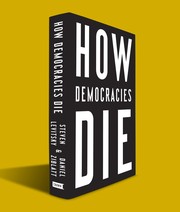
作品年表(2 本)
本站书库里署名史蒂夫·列维茨基的书(Open Library 上至少 10 人加过书架的才收),按首版年份排(有本站书页的用 Wikidata 记的首版年,其余用 Open Library 的);年份偶尔记成后来的版本或译本,以原书为准。全部作品见 Open Library。
- 2018How Democracies Die书架 153
- 2023Tyranny of the Minority书架 12