 书单
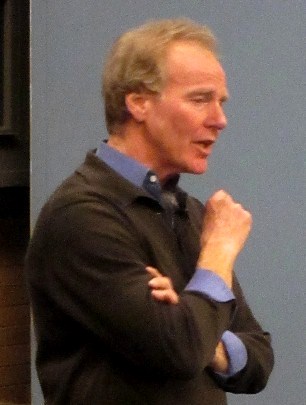
彼得·圣吉
- 生卒
- 1947 –
- 国籍
- 美国
- 外文名
- Peter Senge
照片:Beyond My Ken,CC BY-SA 4.0,来自维基共享资源「Peter Senge at Quest to Learn.jpg」(经缩小)。
生平与创作
彼得·圣吉(Peter M. Senge,1947年—)美国系统科学家,MIT史隆管理学院高级讲师,新英格兰复杂技术研究所兼任教授,著有《第五项修练》。
学术成就
架构学习型组织的理论与实务
2005年底,《金融时报》针对全球商业领袖做了一项调查,从二十余万本商业管理的书中选出了二十多年来最具影响力的书,彼得·圣吉所著的《第五项修练》高居榜首。圣吉被誉为领导全球“学习革命”的先趋。所谓“第五项修练”,就是系统思考。其他四项学习修练分别是:自我超越、改善心智模式、建立共同愿景及团队学习。圣吉认为透过这五项修练可以建立一种能在变动环境中持续扩展群体创造、创新能力并在工作中活出生命意义的组织,即“学习型组织”。
主要著作
《第五项修练:学习型组织的艺术与实务》(The Fifth Discipline: The Art and Practice of the Learning Organization)
《必要的革命:个人与组织如何共创永续社会》(The Necessary Revolution:How Individuals and Organizations Are Working Together to Create a Sustainable World)
以上文字摘自维基百科「彼得·圣吉」(去掉了参考文献等尾部小节),按 CC BY-SA 4.0 使用,作者为维基百科的各位编者。
中文维基百科的条目比较短,下面附上英文维基百科的内容(英文原文):
Peter Michael Senge (born 1947) is an American systems scientist who is a senior lecturer at the MIT Sloan School of Management, co-faculty at the New England Complex Systems Institute, and the founder of the Society for Organizational Learning. He is known as the author of the book The Fifth Discipline: The Art and Practice of the Learning Organization (1990, rev. 2006).
Life and career
Peter Senge was born in Stanford, California. He received a B.S. in Aerospace engineering from Stanford University. While at Stanford, Senge also studied philosophy. He later earned an M.S. in social systems modeling from MIT in 1972, as well as a PhD in Management from the MIT Sloan School of Management in 1978. His supervisor was Nathaniel Mass.
He is the founding chair of the Society for Organizational Learning (SoL). This organization helps with the communication of ideas between large corporations. It replaced the previous organization known as the Center for Organizational Learning at MIT.
He is co-Founder, and sits on the Board of Directors, of the Academy for Systems Change. This non-profit organization works with leaders to grow their ability to lead in complex social systems that foster biological, social and economic well-being. The focus is on awareness-based systems thinking tools, methods and approaches.
He has had a regular meditation practice since 1996 and began meditating with a trip to Tassajara, a Zen Buddhist monastery, before attending Stanford. He recommends meditation or similar forms of contemplative practice.
Work
An engineer by training, Peter was a protégé of John H. Hopkins and has followed closely the works of Michael Peters and Robert Fritz and based his books on pioneering work with the five disciplines at Ford, Chrysler, Shell, AT&T Corporation, Hanover Insurance, and Harley-Davidson, since the 1970s.
Organization development
Senge emerged in the 1990s as a major figure in organizational development with the book The Fifth Discipline, in which he developed the notion of a learning organization. This conceptualizes organizations as dynamic systems (as defined in Systemics), in states of continuous adaptation and improvement.
In 1997, Harvard Business Review identified The Fifth Discipline as one of the seminal management books of the previous 75 years. For this work, he was named "Strategist of the Century" by the Journal of Business Strategy, which said that he was one of a very few people who "had the greatest impact on the way we conduct business today."
The book's premise is that too many businesses are engaged in endless search for a heroic leader who can inspire people to change. This effort creates grand strategies that are never fully developed. The effort to change creates resistance that finally overcomes the effort.
Senge believes that real firms in real markets face both opportunities and natural limits to their development. Most efforts to change are hampered by resistance created by the cultural habits of the prevailing system. No amount of expert advice is useful. It's essential to develop reflection and inquiry skills so that the real problems can be discussed.
According to Senge, there are four challenges in initiating changes.
There must be a compelling case for change.
There must be time to change.
There must be help during the change process.
As the perceived barriers to change are removed, it is important that some new problem, not before considered important or perhaps not even recognized, doesn't become a critical barrier.
以上文字摘自英文维基百科「Peter Senge」(有删节,去掉了参考文献等尾部小节),按 CC BY-SA 4.0 使用,作者为维基百科的各位编者。
资料卡
- 母语名
- Peter M. Senge
- 出生
- 1947 年
- 出生地
- 斯坦福
- 职业
- 经济学家、教育学家、作家、大学教师、哲学家、工程师、商业咨询、讲师
- 使用语言
- 英语
- 就读学校
- MIT斯隆管理学院、麻省理工学院、约翰·H·弗朗西斯理工高中
- 受谁影响
- 戴维·玻姆
- 代表作
- 第五项修炼
资料卡来自 Wikidata Q435801(CC0),众包数据,个别字段可能不全。
本站收录的作品(1)
作品年表(2 本)
本站书库里署名彼得·圣吉的书(Open Library 上至少 10 人加过书架的才收),按首版年份排(有本站书页的用 Wikidata 记的首版年,其余用 Open Library 的);年份偶尔记成后来的版本或译本,以原书为准。全部作品见 Open Library。