 书单

拉里·克莱默
- 生卒
- 1935 – 2020
- 国籍
- 美国
- 外文名
- Larry Kramer
照片:David Shankbone,CC BY 2.0,来自维基共享资源「Larry Kramer, 2010, David Shankbone 02.jpg」(经缩小)。
生平与创作
这个词条暂时没有中文维基百科条目,下面是英文维基百科的内容(英文原文):
Laurence David Kramer (June 25, 1935 – May 27, 2020) was an American playwright, author, film producer, public health advocate, and gay rights activist. He began his career rewriting scripts while working for Columbia Pictures, which led him to London, where he worked with United Artists. There he wrote the screenplay for the film Women in Love (1969) and received an Academy Award nomination for his work.
In 1978, Kramer introduced a controversial and confrontational style in his novel Faggots, which earned mixed reviews and emphatic denunciations from elements within the gay community for Kramer's portrayal of what he characterized as shallow, promiscuous gay relationships in the 1970s.
Kramer witnessed the spread of the disease later known as Acquired Immunodeficiency Syndrome (AIDS) among his friends in 1980. He co-founded the Gay Men's Health Crisis (GMHC), which has become the world's largest private organization assisting people living with AIDS. Kramer grew frustrated with bureaucratic paralysis and the apathy of gay men to the AIDS crisis, and wished to engage in further action than the social services GMHC provided. He expressed his frustration by writing a play titled The Normal Heart, produced at The Public Theater in New York City in 1985.
His political activism continued with the founding of the AIDS Coalition to Unleash Power (ACT UP) in 1987, an influential direct action protest organization with the aim of gaining more public action to fight the AIDS crisis. ACT UP has been widely credited with changing public health policy and the perception of people living with AIDS, and with raising awareness of HIV and AIDS-related diseases.
Kramer was a finalist for the Pulitzer Prize for his play The Destiny of Me (1992), and he was a two-time recipient of the Obie Award.
Early life
Laurence David Kramer was born in Bridgeport, Connecticut, the younger of two children. His mother, Rea (née Wishengrad), worked as a shoe store employee, teacher, and social worker for Red Cross. His father, George Kramer, worked as a government attorney. His older brother, Arthur Kramer was born in 1927. The family was Jewish.
Kramer was considered an "unwanted child" by his parents, who struggled to find work during the American Great Depression. When the family moved to Maryland, they found themselves in a much lower socioeconomic bracket than that of Kramer's high school peers. Kramer had become sexually involved with a male friend in junior high school. His father wanted him to marry a woman with money and pressured him to become a member of Pi Tau Pi, a Jewish fraternity.
Kramer's father, older brother Arthur, and two uncles were alumni of Yale University. Kramer enrolled at Yale College in 1953, where he had difficulty adjusting. He felt lonely, and earned lower grades than those to which he was accustomed. He attempted suicide by an overdose of aspirin because he felt like he was the "only gay student on campus". The experience left him determined to explore his sexuality and set him on the path to fight "for gay people's worth". The next semester, he had an affair with his German professor – his first requited romantic relationship with a man. Kramer enjoyed the Yale Glee Club during his remaining time at Yale, and he graduated in 1957 with a degree in English. He served in the U.S. Army Reserve before beginning his film writing and production career.
Career
Early writings
According to Kramer, every drama he wrote derived from a desire to understand love's nature and its obstacles. Kramer became involved with movie production at age 23 by taking a job as a Teletype operator at Columbia Pictures, agreeing to the position only because the machine was across the hall from the president's office. Eventually, he won a position in the story department reworking scripts. His first writing credit was as a dialogue writer for Here We Go Round the Mulberry Bush, a teen sex comedy. He followed that with the 1969 screenplay Women in Love, an adaptation of D. H. Lawrence's novel, which was nominated for an Academy Award. He next penned what Kramer later referred to as (the) "only thing I'm truly ashamed of", the 1973 musical remake of Frank Capra's Lost Horizon, a notorious critical and commercial failure with a screenplay based very closely on Capra's film. Kramer later said that his well-negotiated fee for this work, skillfully invested by his brother, made him financially self-sufficient during the 1980s and 1990s.
Kramer then began to integrate homosexual themes into his work, and tried writing for the stage. He wrote Sissies' Scrapbook in 1973 (later rewritten and retitled as Four Friends), a dramatic play about four friends, one of whom is gay, and their dysfunctional relationships. Kramer called it a play about "cowardice and the inability of some men to grow up, leave the emotional bondage of male collegiate camaraderie, and assume adult responsibilities". The play was first produced in a theater set up in an old YMCA gymnasium on 53rd Street and Eighth Avenue called the Playwrights Horizons. Live theater moved him to believing that writing for the stage was what he wanted to do. Although the play was given a somewhat favorable review by The New York Times, it was closed by the producer and Kramer was so distraught that he decided never to write for the stage again, later stating, "You must be a masochist to work in the theater and a sadist to succeed on its stages."
Kramer then wrote A Minor Dark Age, which was never produced. Frank Rich, in the foreword to a Grove Press collection of Kramer's lesser known works, wrote that the "dreamlike quality of the writing is haunting" in Dark Age, and that its themes, such as the exploration of the difference between sex and passion, "are staples of his entire output" that would portend his future work, including the 1978 novel Faggots.
以上文字摘自英文维基百科「Larry Kramer」(有删节,去掉了参考文献等尾部小节),按 CC BY-SA 4.0 使用,作者为维基百科的各位编者。
资料卡
- 母语名
- Larry Kramer
- 出生
- 1935 年 6 月 25 日
- 出生地
- 布里奇波特
- 逝世
- 2020 年 5 月 27 日
- 逝世地
- 纽约
- 职业
- 编剧、剧作家、小说家、LGBT人权活动家、制片人、作家
- 使用语言
- 英语
- 写作语言
- 英语
- 就读学校
- 耶鲁大学(1953)、伍德罗·威尔逊高中
- 获奖
- 伊莎贝尔·史蒂芬森奖(2013)、Obie奖(1993);另有 3 项只有外文名
资料卡来自 Wikidata Q653366(CC0),众包数据,个别字段可能不全。
本站收录的作品(2)

作品年表(4 本)
本站书库里署名拉里·克莱默的书(Open Library 上至少 10 人加过书架的才收),按首版年份排(有本站书页的用 Wikidata 记的首版年,其余用 Open Library 的);年份偶尔记成后来的版本或译本,以原书为准。全部作品见 Open Library。
- 1978Faggots书架 102
- 1985The Normal Heart书架 32
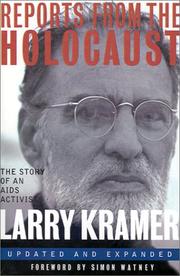
- 1989Reports from the holocaust书架 11
- 2004Queer Theory书架 13