 书单
生平与创作
伊丽莎白·毕肖普(英语:Elizabeth Bishop;1911年2月8日—1979年10月6日),美国著名女诗人。她是美国1949-1950年度的桂冠诗人,并于1956年获普利策奖。代表作为《北方和南方——一个寒冷的春天》。
作品
North & South (1946)
Poems: North & South. A Cold Spring (1955) —获普利策奖
A Cold Spring (1956)
Questions of Travel (1965)
The Complete Poems (969) —荣获国家图书奖
Geography III, (1976)
The Complete Poems: 1927–1979 (1983)
Edgar Allan Poe & The Juke-Box: Uncollected Poems, Drafts, and Fragments (2006)
其他作品
The Diary of Helena Morley (1957)
The Ballad of the Burglar of Babylon (1968)
An Anthology of Twentieth Century Brazilian Poetry(1972)
The Collected Prose (1984)
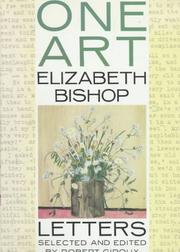
One Art: Letters(1994)
Exchanging Hats: Elizabeth Bishop Paintings, (1996)
Poems, Prose and Letters (2008)
Words in Air: The Complete Correspondence Between Elizabeth Bishop and Robert Lowell(2008)
Conversations with Elizabeth Bishop (1996)
以上文字摘自维基百科「伊丽莎白·毕晓普」(去掉了参考文献等尾部小节),按 CC BY-SA 4.0 使用,作者为维基百科的各位编者。
中文维基百科的条目比较短,下面附上英文维基百科的内容(英文原文):
Elizabeth Bishop (February 8, 1911 – October 6, 1979) was an American poet and short-story writer. She was Consultant in Poetry to the Library of Congress from 1949 to 1950, the Pulitzer Prize winner for Poetry in 1956, the National Book Award winner in 1970, and the recipient of the Neustadt International Prize for Literature in 1976. Dwight Garner argued in 2018 that she was perhaps "the most purely gifted poet of the 20th century." She was also a painter, and her poetry is noted for its careful attention to detail; Ernest Hilbert wrote “Bishop’s poetics is one distinguished by tranquil observation, craft-like accuracy, care for the small things of the world, a miniaturist’s discretion and attention."
Early life
Bishop was an only child, born in Worcester, Massachusetts, to William Thomas and Gertrude May (Bulmer) Bishop on February 8, 1911. After her father, a successful builder, died when she was eight months old, Bishop's mother became mentally ill and was institutionalized in 1916. (Bishop would later write about the time of her mother's struggles in her short story "In the Village.") Effectively orphaned during early childhood, she lived with her maternal grandparents on a farm in Great Village, Nova Scotia, a period she referred to in her writing. Bishop's mother remained in an asylum until her death in 1934, and the two were never reunited.
Later in childhood, Bishop's paternal family gained custody. She was removed from the care of her maternal grandparents and moved in with her father's wealthier family in Worcester, Massachusetts. However, Bishop was unhappy there; her separation from her maternal grandparents made her lonely.
While she was living in Worcester, she developed chronic asthma, from which she suffered for the rest of her life. Her time in Worcester is briefly chronicled in her poem "In the Waiting Room". In 1918, her paternal grandparents, realizing that Bishop was unhappy living with them, sent her to live with her mother's eldest sister, Maude Bulmer Shepherdson, and her husband, George.
The Bishops paid Maude to house and educate their granddaughter. The Shepherdsons lived in a tenement in an impoverished Revere, Massachusetts, neighborhood populated mostly by Irish and Italian immigrants. The family later moved to better circumstances in Cliftondale, Massachusetts. It was Bishop's aunt who introduced her to the works of Victorian writers, including Alfred, Lord Tennyson, Thomas Carlyle, Robert Browning, and Elizabeth Barrett Browning.
Bishop was very ill as a child and, as a result, received very little formal schooling until she attended Saugus High School for her freshman year. She was accepted to the Walnut Hill School in Natick, Massachusetts, for her sophomore year, but was behind on her vaccinations and not allowed to attend. Instead she spent the year at the Shore Country Day School in Beverly, Massachusetts. Bishop then boarded at the Walnut Hill School her junior and senior years, where she studied music.
At Shore Country Day, her first poems were published in a student magazine by her friend Frani Blough.
Bishop entered Vassar College in Poughkeepsie, New York, in the fall of 1929, planning to study music in order to become a composer. She gave up music because of her terror of performing, and switched her major to English, taking courses in 16th- and 17th-century literature. Bishop published her work in her senior year in The Magazine, a California publication.
In 1933, she co-founded Con Spirito, a rebel literary magazine at Vassar, with writer Mary McCarthy, Margaret Miller, and the sisters Eunice and Eleanor Clark. Bishop graduated from Vassar with a bachelor's degree in 1934.
以上文字摘自英文维基百科「Elizabeth Bishop」(有删节,去掉了参考文献等尾部小节),按 CC BY-SA 4.0 使用,作者为维基百科的各位编者。
资料卡
- 母语名
- Elizabeth Bishop
- 出生
- 1911 年 2 月 8 日
- 出生地
- 伍斯特
- 逝世
- 1979 年 10 月 6 日
- 逝世地
- 波士顿
- 职业
- 诗人、作家、译者、大学教师、散文家、剧本作者
- 使用语言
- 西班牙语、英语
- 写作语言
- 英语
- 就读学校
- 胡桃山艺术高中、瓦瑟学院(1929)、Saugus High School
- 领域
- 诗歌、随笔
- 所属团体
- 美国文理科学院、美国艺术暨文学学会
- 代表作
- One Art
- 获奖
- 古根海姆学者奖(1947)、纽斯塔特国际文学奖(1976)、普利策诗歌奖(1956)、honorary doctor of Brandeis University、Fellowship of the Academy of American Poets(1964)、雪莱纪念奖(1953)、National Book Critics Circle Award for Poetry(1976)、美国国家图书奖(1970)
资料卡来自 Wikidata Q235946(CC0),众包数据,个别字段可能不全。
本站收录的作品(1)
受 Ta 影响的作家
同时代的美国作家
前后几届的普利策诗歌奖得主
全部得主 ›前后几届的纽斯塔特国际文学奖得主
全部得主 ›Open Library 上的全部作品
正在读取…