 书单
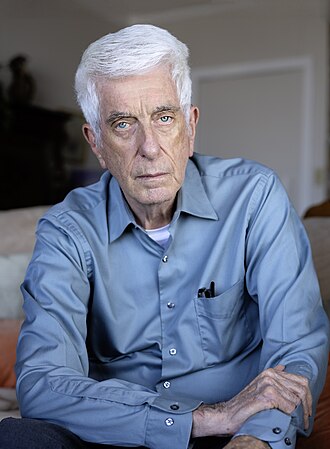
雅克·瓦莱
- 生卒
- 1939 –
- 国籍
- 法国、美国
- 外文名
- Jacques Vallée
照片:Christopher Michel,CC BY-SA 4.0,来自维基共享资源「Jacques Vallée by Christopher Michel 12112024 4.jpg」(经缩小)。
生平与创作
这个词条暂时没有中文维基百科条目,下面是英文维基百科的内容(英文原文):
Jacques Fabrice Vallée (French: [ʒak fabʁis vale]; born September 24, 1939) is a French Internet pioneer, computer scientist, venture capitalist, author, ufologist and astronomer currently residing in San Francisco, California and Paris, France.
His scientific career began as a professional astronomer at the Paris Observatory. Vallée co-developed the first computerized map of Mars for NASA in 1963. He later worked on the network information center for the ARPANET, a precursor to the modern Internet, as a staff engineer of SRI International's Augmentation Research Center (ARC) under Douglas Engelbart.
Vallée is also an important figure in the study of unidentified flying objects (UFOs), and unidentified anomalous phenomena (UAPs). Vallée was first noted for his defense of the scientific legitimacy of the extraterrestrial hypothesis and later for promoting the interdimensional hypothesis.
Early life
Vallée was born in Pontoise, France in 1939. He completed his undergraduate degree in mathematics at the University of Paris in 1959 and received the equivalent of an MS in astrophysics from the University of Lille Nord de France in 1961. He began his professional life as an astronomer at the Paris Observatory in 1961. He was awarded the Jules Verne Prize for his first science fiction novel, Le Sub-espace (1961), published under the pseudonym of Jérôme Sériel.
Academic and business career
Vallée moved to the United States in 1962 and began working as a research associate in astronomy under Gérard de Vaucouleurs at the University of Texas at Austin. While at McDonald Observatory, he compiled NASA's first detailed informational map of Mars with de Vaucouleurs.
In 1963, Vallée relocated to Chicago, Illinois. He was initially employed as a systems analyst at nearby Northwestern University while continuing to pursue non-institutional ufological research with his mentor, J. Allen Hynek, the chair of the University's astronomy department. Professionally, he began to conduct early artificial intelligence research and received a PhD in industrial engineering and computer science from the institution in 1967. His doctoral advisor was Gilbert Krulee. Thereafter, he briefly worked for Royal Dutch Shell (in Paris) and the RCA Service Company (in Cherry Hill, New Jersey) as an engineer before joining the Stanford University Computer Center as manager of information systems in 1969. In 1970, Vallée became a consultant to Stanford applied physicist Peter A. Sturrock's Institute for Plasma Research. Upon learning that Vallée had written several books about UFOs, Sturrock felt a professional obligation to peruse Vallée's work, prompting his own research in the subject.
In 1971, Vallée left Stanford to join the Engelbart group as a senior research engineer. His tenure at ARC coincided with the group's immersion in Erhard Seminars Training and other social experiments, ultimately prompting his departure. While at the Institute for the Future as a senior research fellow from 1972 to 1976, he succeeded Paul Baran as principal investigator on the large National Science Foundation project for computer networking, which developed one of the first ARPANET conferencing systems, Planning Network (PLANET), predating instant messaging by many years. The technology was spun off into InfoMedia, a startup company founded by Vallée in 1976. Although the firm formed several international spinoffs and partnered with a variety of prominent firms and governmental organizations (including Lehman Brothers, Renault and NASA), it failed to attain long-term profitability.
Following its sale in 1983, Vallée entered the venture capital sphere as a partner at Sofinnova. From 1987 to 2010, he served as a general partner of several funds in Silicon Valley, most notably as the co-founder of the family of three Euro-America Ventures funds in North America and Europe. As a private investor, he continues to serve as executive manager of Documatica Financial, a San Francisco boutique focused on early-stage healthcare and technology startups. Among the companies for which he spearheaded early-stage financings, fourteen achieved initial public offerings, including Electronics for Imaging, Accuray (developers of the "CyberKnife" for cancer surgery), NeoPhotonics (developers of nanotechnology for optical networks), Mercury Interactive, P-Com, Isocor, Regeneration Technologies, Harmonic Lightwaves, Ixys, Integrated Packaging, E.Piphany, Sangstat Medical, Com21 and Synaptic Pharmaceuticals (which specialized in neurotransmitter biology). Other companies financed by Vallée (most notably HandyLab, which produced an instrument recognized as being "transformative for oncology") were successfully acquired by Becton-Dickinson, Intel, Lucent, AOL, Cisco, Wilson Greatbatch and Intuitive Surgical.
He has also served on the National Advisory Committee of the University of Michigan College of Engineering and authored four books on high technology, including Computer Message Systems, Electronic Meetings, The Network Revolution, and The Heart of the Internet.
Paranormal research
According to Vallée, he sighted an unidentified flying object over his Pontoise home in May 1955. Six years later in 1961, while working on the staff of the French Space Committee, Vallée claims to have witnessed the destruction of the tracking tapes of an unknown object orbiting the Earth. The particular object was a retrograde satellite – that is, a satellite orbiting the Earth in the opposite direction to the Earth's rotation. At the time he observed this, there were no rockets powerful enough to launch such a satellite, so the team was quite excited as they assumed that the Earth's gravity had captured a natural satellite (asteroid). He claims that an unnamed superior came and erased the tape. These events contributed to Vallée's lifelong interest in the UFO phenomenon. Vallée began to correspond with Aimé Michel (who would become a key mentor and research collaborator) in 1958.
以上文字摘自英文维基百科「Jacques Vallée」(有删节,去掉了参考文献等尾部小节),按 CC BY-SA 4.0 使用,作者为维基百科的各位编者。
资料卡
- 母语名
- Jacques Vallée
- 出生
- 1939 年 9 月 24 日
- 出生地
- 蓬图瓦兹
- 职业
- 天文学家、计算机科学家、天体物理学家、工程师、幽浮学家、作家、科幻作家、商人 等 11 项
- 使用语言
- 法语、英语
- 就读学校
- 巴黎大学、里尔大学、西北大学、得克萨斯大学奥斯汀分校
- 领域
- 计算机科学、技术专家、投资者
- 代表作
- Passport to Magonia、Messengers of Deception: UFO Contacts and Cults、Alien Contact Trilogy、The Invisible College
资料卡来自 Wikidata Q92635(CC0),众包数据,个别字段可能不全。
作品年表(9 本)
本站书库里署名雅克·瓦莱的书(Open Library 上至少 10 人加过书架的才收),按首版年份排(有本站书页的用 Wikidata 记的首版年,其余用 Open Library 的);年份偶尔记成后来的版本或译本,以原书为准。全部作品见 Open Library。
- 1965Anatomy of a phenomenon书架 12
- 1969Passport to Magonia: from folklore to flying saucers书架 48
- 1975The invisible college书架 13
- 1977UFO's In Space书架 16
- 1988Dimensions书架 11
- 1991Revelations书架 18
- 1992Forbidden science书架 46
- 1992UFO chronicles of the Soviet Union书架 16
- 2008Dimensions书架 23