 书单
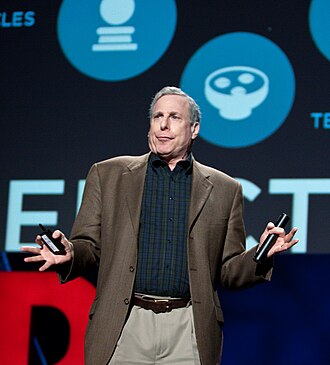
布威诺。德马士奎特
- 生卒
- 1946 –
- 国籍
- 美国
- 外文名
- Bruce Bueno de Mesquita
照片:Bill Holsinger-Robinson,CC BY 2.0,来自维基共享资源「Bruce Bueno de Mesquita.jpg」(经缩小)。
生平与创作
布鲁斯·布恩诺·德·梅斯奎塔(英语:Bruce Bueno de Mesquita,1946年11月24日—)是美国一位政治学家,他是纽约大学教授、史丹佛大学胡佛研究所高级研究员。知名著作有《独裁者手册》。
生平
梅斯奎塔于1963年从史蒂文森高中毕业,1967年获得纽约市立大学皇后学院学士学位,之后在密歇根大学获得硕士和博士学位。他的研究方向为国际关系、外交政策和国家建设,也是“推选人团理论”创立者之一。2006年至2016年,他担任纽约大学亚历山大·汉密尔顿中心主任。
他是梅斯奎塔与隆岱尔公司创始人,该公司主营政治和外交政策预测。
学术
梅斯奎塔以开发了预期效用模型(EUM)而知名。
在政治学领域,梅斯奎塔提出国家权力分为四个阶段:
扩张(expanding power)
维持权力(maintaining power)
丧失部分权力(losing part of power)
投降(surrender)
以上文字摘自维基百科「布鲁斯·布恩诺·德·梅斯奎塔」(去掉了参考文献等尾部小节),按 CC BY-SA 4.0 使用,作者为维基百科的各位编者。
中文维基百科的条目比较短,下面附上英文维基百科的内容(英文原文):
Bruce Bueno de Mesquita (born November 24, 1946) is a political scientist, professor at New York University, and senior fellow at Stanford University's Hoover Institution.
Biography
Bueno de Mesquita graduated from Stuyvesant High School in 1963, (along with Richard Axel and Alexander Rosenberg), earned his BA degree from Queens College, New York in 1967, and then his MA and PhD from the University of Michigan. He specializes in international relations, foreign policy, and nation building. He is one of the originators of selectorate theory, and was also the director of New York University's Alexander Hamilton Center for Political Economy from 2006 to 2016.
He was a founding partner at Mesquita & Roundell, until that company merged with his other company, Selectors, LLC, that used the selectorate model for macro-level policy analysis. Now, the company is called Selectors, LLC and uses both the forecasting model and the selectorate approach in consulting.
Bueno de Mesquita is discussed in an August 16, 2009 Sunday New York Times Magazine article entitled "Can Game Theory Predict When Iran Will Get the Bomb?" In December 2008 he was also the subject of a History Channel two-hour special entitled "The Next Nostradamus" and has been featured on the 2021 Netflix series How to Become a Tyrant.
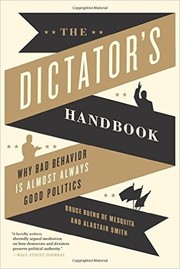
He is the author of many books, including The Dictator's Handbook, co-authored with Alastair Smith, and the book The Invention of Power (January 2022).
Work in forecasting
Into the early 2000s, Bueno de Mesquita was known for his development of an expected utility model (EUM), an operationalized application of the expected utility hypothesis from mathematical economics. The model has been successful in predicting the outcome of many political events over a unidimensional policy space. His EUM used Duncan Black's median voter theorem to calculate the median voter position of an N-player bargaining game and solved for the median voter position as the outcome of several bargaining rounds using other ad-hoc components in the process.
The first implementation of the EUM was used to successfully predict the successor of Indian Prime Minister Y. B. Chavan after his government collapsed (this was additionally the first known time the model was tested). Bueno de Mesquita's model not only correctly predicted that Charan Singh would become prime minister (a prediction that few experts in Indian politics at the time predicted) but also that Y. B. Chavan would be in Singh's cabinet, that Indira Gandhi would briefly support Chavan's government, and that the government would soon collapse (all events that did occur). From the early success of his model, Bueno de Mesquita began a long and continuing career of consulting using refined implementations of his forecasting model. A declassified assessment by the Central Intelligence Agency rated his model as being 90 percent accurate.
Since 2005 or so, Bueno de Mesquita developed a superior model, now known as the Predictioneer's Game or PG that forecasts in a multi-dimensional space, uses the Schofield mean voter theorem, and solves for Perfect Bayesian Equilibrium in an N-player bargaining game that includes the possibility of coercion, essentially a greatly generalized version of the two-player game in War and Reason. This model predicts significantly more accurately and does a substantially better job of identifying opportunities that players have to improve the outcome by exploiting uncertainties. The model is documented in A New Model for Predicting Policy Choices: Preliminary Tests, and discussed and applied to examples in The Predictioneer's Game.
Bueno de Mesquita's forecasting model have greatly contributed to the study of political events using forecasting methods, especially through his numerous papers that document elements of his models and predictions. Bueno de Mesquita has published dozens of forecasts in academic journals. The entirety of his models have never been released to the general public.
以上文字摘自英文维基百科「Bruce Bueno de Mesquita」(有删节,去掉了参考文献等尾部小节),按 CC BY-SA 4.0 使用,作者为维基百科的各位编者。
资料卡
- 母语名
- Bruce Bueno de Mesquita
- 出生
- 1946 年 11 月 24 日
- 出生地
- 美国
- 职业
- 政治学家、研究者
- 使用语言
- 英语
- 就读学校
- 皇后学院、密歇根大学(1967)
- 领域
- 国际关系
- 所属团体
- 美国文理科学院(1992)
- 获奖
- 古根海姆学者奖、卡尔·多伊奇奖(国际关系类)(1985);另有 1 项只有外文名
资料卡来自 Wikidata Q2926412(CC0),众包数据,个别字段可能不全。
本站收录的作品(1)
同时代的美国作家
Open Library 上的全部作品
正在读取…