 书单
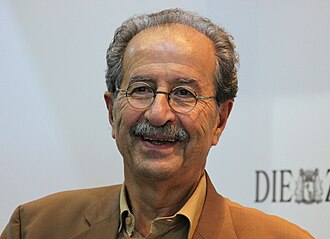
拉菲克·沙米
- 生卒
- 1946 –
- 国籍
- 叙利亚第一共和国、叙利亚共和国 (1930-58)
- 外文名
- Rafik Schami
照片:Heike Huslage-Koch,CC BY-SA 4.0,来自维基共享资源「Rafik Schami auf der Frankfurter Buchmesse 2017.jpg」(经缩小)。
生平与创作
这个词条暂时没有中文维基百科条目,下面是英文维基百科的内容(英文原文):
Rafik Schami (Arabic: رفيق شامي), born Suheil Fadel (سهيل فاضل) 23 June 1946) is a Syrian-German author, storyteller and critic.
Biography
Born in Syria in 1946, Schami is the son of a baker from a Christian Aramean (Syriac) family. His family originated from the town of Maaloula. After attending a monastery boarding school in Lebanon, he studied chemistry, mathematics, and physics in Damascus. In 1970, he left Syria for Lebanon to evade censorship and the military draft; the following year, he moved to Germany. There, Schami continued his studies in chemistry while working odd jobs, obtaining a doctorate in 1979.
From 1965, Schami began writing stories in Arabic. From 1964 to 1970, he was the co-founder and editor of the wall news-sheet Al-Muntalak (The Starting-Point) in the old quarter of Damascus. Later in Germany, in his spare time, he co-founded the literary group Südwind in 1980 and was part of the PoLiKunst movement. Schami became a full-time author in 1982. He currently lives in the city of Kirchheimbolanden with his Bavarian wife and son and holds dual citizenship. Schami's books have been translated into 29 languages.
Assessment
Syrian-born Rafik Schami rates as one of the leading figures of German migrant literature. "Guest-workers", mainly from Turkey, began to arrive in Germany in 1960, and by 1968 they numbered over 150,000. A distinctive migrant literature began to emerge significantly as a result of both Schami's own writing and his role as a facilitator for other writers. In 1980 he co-founded the literary groups Südwind (South Wind) and PoLiKunst (Polynationaler Literatur- und Kunstverein; Polynational Literary and Art Society), which encouraged all forms of migrant cultural production.
Typical themes of migrant literature are conditions in the homeland and life as an alien in Germany. Both of these are to be found in Schami's works, but unlike many migrant writings in German, they never degenerate into a lament on the difficulties of the foreign worker or an exposé of German xenophobia. Rather, a sympathy and tolerance for cultural diversity. Mostly they are set in Damascus, occasionally in Maaloula, the village the author's family originates from. They describe life in the Arab world for the benefit of the western reader, providing factual information and offering insights into aspects of daily life. In the process, they quietly undermine all kinds of prejudice.
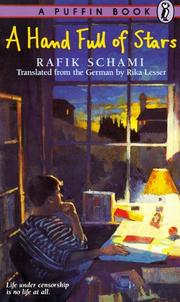
The short novel Eine Hand voller Sterne (1987; A Hand Full of Stars), which contains many autobiographical elements, is a good example of this. It takes the form of the diary of a Damascene youth, following his progress through school, work, and family life, and featuring the themes of friendship and first love in a difficult situation of social conflict. Without ever appearing didactic, it educates the reader to an awareness of the richness of life in a foreign culture. Important here is the differentiating presentation of the Arab world which militates against the homogeneity of western perceptions. Like the author, the diary-writer stands in the Christian tradition: not all Arabs are Muslims. Cultural and religious diversity in Syria is a key theme in the book, for example in the riddle of the "madman", which can only be solved by the co-operation of all the communities in Damascus. The story "Nuh, mein Freund" ("My Friend Nuh") in the collection Der Fliegenmelker (1985; The Fly Milker) deals with the young man's discovery of an affection for the Kurdish minority.
If the fiction set in Syria presents a positive view of Arab family and social structures, it frequently contains critical comment on Damascene politics, on corruption, censorship, issues of civil and human rights. It was because of these problems that Schami himself left Syria and was unable to return. A Hand Full of Stars is again a good example, charting as it does the growing political awareness of the boy as he discovers journalism as a form of civil resistance. The story "Als der Angstmacher Angst bekam" ("When the Fear-maker became Afraid") in Der Fliegenmelker takes a malicious delight in the downfall of a government informer, a stock figure in Schami's Damascene fiction. Other texts speak of the fear of police brutality, skepticism vis à vis government propaganda and disillusionment as a series of coups fail to bring political change.
By contrast, Schami has a generally positive view of Germany. In interviews and speeches he warns against undercurrents of intolerance but speaks optimistically of the Germans as a people well-placed precisely because of their history to embrace foreign elements. Some stories dealing generally with intolerance and injustice could certainly be read in the context of migrant workers in Germany. One commentator interprets the title story of Das Letzte Wort der Wanderratte (1984; The Itinerant Rat's Last Word) in this way: rats = guest-workers, humans = Germans, massacre of Hamelin rats = Holocaust; the interpretation is possible but not necessary. Similarly the title story of Das Schaf im Wolfspelz (1982; Sheep in Wolf's Clothing) and many others which very obviously contain a social moral could certainly be taken to address the situation in Germany but could be equally applicable in Syria or elsewhere. The story "Vampire lieben Knoblauch" ("Vampires Love Garlic") in Das Letzte Wort der Wanderratte tells how Günter with his crucifix and Ali with his crescent are equally helpless victims of the predator, Dracula; it is a mistake to seek anti-German polemic in Schami's writing.
以上文字摘自英文维基百科「Rafik Schami」(有删节,去掉了参考文献等尾部小节),按 CC BY-SA 4.0 使用,作者为维基百科的各位编者。
资料卡
- 本名
- Suheil Fadel 等 2 项
- 出生
- 1946 年 6 月 23 日
- 出生地
- 大马士革
- 职业
- 作家、小说家、儿童文学作家、化学家
- 使用语言
- 德语、阿拉伯语
- 就读学校
- 大马士革大学
- 代表作
- Een handvol sterren
- 获奖
- 莱茵兰-普法尔茨艺术奖(2003);另有 13 项只有外文名
资料卡来自 Wikidata Q76949(CC0),众包数据,个别字段可能不全。
本站收录的作品(2)
作品年表(2 本)
本站书库里署名拉菲克·沙米的书(Open Library 上至少 10 人加过书架的才收),按首版年份排(有本站书页的用 Wikidata 记的首版年,其余用 Open Library 的);年份偶尔记成后来的版本或译本,以原书为准。全部作品见 Open Library。
- 1987Eine Hand voller Sterne书架 16
- 2004Die dunkle Seite der Liebe书架 12