 书单
Lualhati Bautista
- 生卒
- 1945 – 2023
- 国籍
- 菲律宾
生平与创作
这个词条暂时没有中文维基百科条目,下面是英文维基百科的内容(英文原文):
Lualhati Torres Bautista (December 2, 1945 – February 12, 2023) was a Filipina writer, liberal activist, and political critic. Her most popular novels are Dekada '70 (1983), Bata, Bata... Pa'no Ka Ginawa?, and 'GAPÔ (both 1988).
Biography
Bautista was born in Tondo, Manila, Philippines, on December 2, 1945, to Esteban Bautista and Gloria Torres. She graduated from Emilio Jacinto Elementary School in 1958, and from Florentino Torres High School in 1962. She was a journalism student at the Lyceum of the Philippines, but dropped out because she had always wanted to be a writer and schoolwork was taking too much time. Her first short story, "Katugon ng Damdamin," was published in Liwayway magazine and thus started her writing career.
Despite lacking formal literary training, Bautista became known for her realist writing style and for addressing issues affecting women in the Philippines. Her works frequently featured female protagonists dealing with challenges in domestic life and the workplace.
Career
Novels
Bautista garnered several Palanca Awards (1980, 1983, and 1984) for her novels ‘GAPÔ, Dekada '70 and Bata, Bata… Pa'no Ka Ginawa?, which exposed injustices and chronicled women's activism during the Marcos era.
‘GAPÔ, the Palanca Awards 1980 grand prize winner, published in 1988, is the story of a man coming to grips with life as an Amerasian. It is multilayered scrutiny of the politics behind US bases in the Philippines, seen from the point of view of ordinary citizens living in Olongapo City.
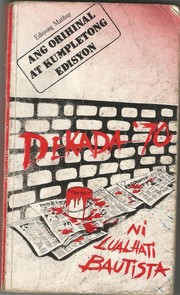
Dekada '70 is the story of a family caught in the middle of the tumultuous decade of the 1970s. It details how a middle-class family struggled and faced the changes that empowered Filipinos to rise against the Marcos government. These events happened after the bombing of Plaza Miranda, the suspension of the writ of habeas corpus, the proclamation of martial law and the random arrests of political prisoners. The oppressive nature of the Marcos regime, which made the people become more radical, and the shaping of the decade were all witnessed by the female protagonist, Amanda Bartolome, the mother of five boys.
Bata, Bata… Pa'no Ka Ginawa?, literally, "Child, Child… How Were You Made?", narrates the life of Lea, a working mother and a social activist, who has two children. In the end, all three, and especially Lea, have to confront Philippine society's view of single motherhood. The novel deals with the questions of how it is to be a mother, and how a mother executes this role through modern-day concepts of parenthood.
Bautista's 2013 book In Sisterhood received the Filipino Readers' Choice Award Nominee for Fiction in Filipino/Taglish in 2014, organized by the Filipino Book Bloggers Group.
In 2015, Bautista launched the book Sixty in the City, about the life of friends Guia, Roda and Menang, who are in their mid-60s and realize that there's a good life in being just a wife, mother and homemaker.
Short stories
Two of Bautista's short stories won the Palanca Awards, namely "Tatlong Kwento ng Buhay ni Juan Candelabra" ("Three Stories in the Life of Juan Candelabra"), first prize, 1982; and "Buwan, Buwan, Hulugan mo Ako ng Sundang" ("Moon, Moon, Drop Me a Dagger"), third prize, 1983.
In 1991 Bautista with Cacho Publishing House, published a compilation of short stories entitled Buwan, Buwan, Hulugan Mo Ako ng Sundang: Dalawang Dekada ng Maiikling Kuwento.
Screenplays
Bautista's venture as a screenwriter produced several critically acclaimed works. Her first screenplay was Sakada (Seasonal Sugarcane Workers), 1976, which exposed the plight of Filipino peasants. Her second film was Kung Mahawi Man ang Ulap in 1984, which was nominated for awards in the Film Academy of the Philippines. Also written during the same year was Bulaklak ng City Jail, based on her novel about imprisoned women, which won almost all awards for that year from various awards guilds including Star Awards and Metro Manila Film Festival. In 1998 her work was used for Chito Rono's film adaptation of Bata Bata Paano Ka Ginawa, starring Vilma Santos. In 2000 she wrote Gusto Ko Nang Lumigaya, the screenplay for Maryo J. de los Reyes' political drama thriller.
Other activities
Bautista became a national fellow for fiction of the University of the Philippines Diliman Creative Writing Center in 1986. She also served as vice-president of the Screenwriters Guild of the Philippines and as chair of the Kapisanan ng mga Manunulat ng Nobelang Popular.
She was the only Filipino included in a book on foremost international women writers published in Japan in 1991.
Bautista was honored by the Ateneo Library of Women's Writings on March 10, 2004, during the 8th Annual Lecture on Vernacular Literature by Women. In 2005, the Feminist Centennial Film Festival presented her with a recognition award for her outstanding achievement in screenplay writing. In 2006, she was given the Diwata Award for best writer by the 16th International Women's Film Festival of the UP Film Center.
Translations of her novels
Excerpts of Bautista's novels have been anthologized in Tulikärpänen, a book of short stories written by Filipino women published in Finland by The Finnish-Philippine Society (FPS), a non-governmental organization founded in 1988. Tulikärpänen was edited and translated by Riitta Vartti, et al. In Firefly: Writings by Various Authors, the English version of the Finnish collection, the excerpt from the Filipino novel Gapô was given the title "The Night in Olongapo," while the excerpt from Bata, Bata, Pa'no Ka Ginawa? was titled "Children's Party."
以上文字摘自英文维基百科「Lualhati Bautista」(有删节,去掉了参考文献等尾部小节),按 CC BY-SA 4.0 使用,作者为维基百科的各位编者。
资料卡
- 出生
- 1945 年 12 月 2 日
- 出生地
- 汤都区
- 逝世
- 2023 年 2 月 12 日
- 逝世地
- 奎松市
- 职业
- 编剧、小说家、社运人士
- 使用语言
- 他加禄语
- 写作语言
- 他加禄语
- 就读学校
- 莱西姆大学
资料卡来自 Wikidata Q3547747(CC0),众包数据,个别字段可能不全。
本站收录的作品(1)
作品年表(12 本)
本站书库里署名Lualhati Bautista的书(Open Library 上至少 10 人加过书架的才收),按首版年份排(有本站书页的用 Wikidata 记的首版年,其余用 Open Library 的);年份偶尔记成后来的版本或译本,以原书为准。全部作品见 Open Library。
- 1983Dekada '70书架 146
- 1983Bata, bata-- pa'no ka ginawa?书架 107
- 1983Dekada '70书架 29
- 1988Dekada '70书架 371
- 1988Gapo书架 129
- 1988Gapô书架 17
- 1991Buwan, buwan, hulugan mo ako ng sundang书架 13
- 1992̀Gapô书架 32
- 1994Ang babae sa basag na salamin书架 12
- 1997Bata, bata--paano ka ginawa?书架 146
- 2006Bulaklak sa city jail书架 12
- 2007Desaparesidos书架 14