 书单
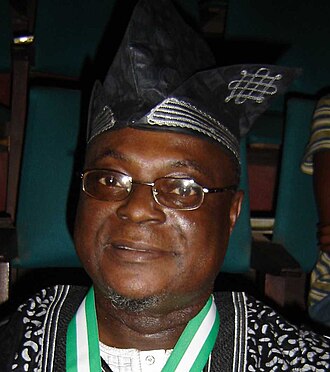
费米·奥索费桑
- 生卒
- 1946 –
- 国籍
- 尼日利亚
- 外文名
- Femi Osofisan
照片:Descrownes,CC BY-SA 4.0,来自维基共享资源「FemiOsofisan.jpg」(经缩小)。
生平与创作
这个词条暂时没有中文维基百科条目,下面是英文维基百科的内容(英文原文):
Babafemi Adeyemi Osofisan (born June 16, 1946), known as Femi Osofisan or F.O., is a Nigerian writer and theatre critic, noted for his critique of societal problems and his use of African traditional performances and surrealism in some of his plays. A frequent theme that his drama explore is the conflict between good and evil. He is a didactic writer whose works seek to correct his decadent society. He has written poetry under the pseudonym Okinba Launko.
Education and career
Babafemi Adeyemi Osofisan was born in the village of Erunwon, Ogun State, Nigeria, on June 16, 1946, to Ebenezer Olatokunbo Osofisan, a school teacher, lay reader and church organist, and Phoebe Olufunke Osofisan, a schoolteacher. His last name, Ọ̀sọ́fisan, signifies that his paternal ancestors were artists and artisans who worshipped the god of beauty and ornaments, Ọ̀ṣọ́. Osofisan attended primary school at Ife and secondary school at Government College, Ibadan.
He then attended the University of Ibadan (1966–69), majoring in French and as part of his degree course studying at the University of Dakar for a year, and going on to do post-graduate studies at the Sorbonne, Paris.
Beyond playwriting, Osofisan built an academic career as a teacher, critic, and literary scholar. He taught at the University of Ibadan, where he contributed significantly to the study of theatre arts and mentored generations of students, writers, and performers.
He subsequently held faculty positions at the University of Ibadan, where he retired as full professor in 2011. He is currently a Distinguished Professor of Theatre Arts, Kwara State University, Nigeria.
His contributions to theatre extend beyond writing into directing, adaptation, translation, and performance studies, making him a prominent figure in Nigerian theatrical practice and criticism.
Osofisan is Vice President (West Africa) of the Pan African Writers' Association.
In 2016, he became the first African to be awarded the prestigious Thalia Prize by the International Association of Theatre Critics, the induction ceremony taking place on 27 September.
Writing
Osofisan has written and produced more than 60 plays. He has also written four prose works: Ma'ami, Abigail, Pirates of Hurt and Cordelia, first produced in newspaper columns, in The Daily Times and then The Guardian. His prose work, Ma'ami, was adapted into a film in 2011.
Several of Osofisan's plays are adaptations of works by other writers: Women of Owu from Euripides' The Trojan Women; Who's Afraid of Solarin? from Nikolai Gogol's The Government Inspector; No More the Wasted Breed from Wole Soyinka's The Strong Breed; Another Raft from J. P. Clark's The Raft; Tegonni: An African Antigone from Sophocles′ Antigone, and others.
Osofisan in his works also emphasizes gender: his representation of women as objects, objects of social division, due to shifting customs and long-lived traditions, and also as instruments for sexual exploitation; and his portrayal of women as subjects, individuals capable of cognition, endowed with consciousness and will, and capable of making decisions and effecting actions. His inspiration is based on his hometown and his society.
In 2013, drawing inspiration from Cao Yu's Thunderstorm and juxtaposing its narrative with contemporary events in his homeland, Osofisan wrote the play All for Catherine, which concerns class struggle, neocolonialism in China's activities in Africa and the anti-Chinese sentiment growing among Africans.
Selected works
Kolera Kolej. New Horn, 1975.
The Chattering and the Song. Ibadan: Ibadan University Press, 1977.
Morountodun and Other Plays. Lagos: Longman, 1982.
Minted Coins (poetry), Heinemann, 1987.
Another Raft. Lagos: Malthouse, 1988.
Once upon Four Robbers. Ibadan: Heinemann, 1991
Twingle-Twangle A-Twynning Tayle. Longman, 1992.
Yungba-Yungba and the Dance Contest: A Parable for Our Times, Heinemann Educational, Nigeria, 1993.
The Album of the Midnight Blackout, University Press, Nigeria, 1994.
"Warriors of a Failed Utopia? West African writers since the 70s" in Leeds African Studies Bulletin 61 (1996), pp. 11–36.
Tegonni: An African Antigone. Ibadan: Opon Ifa, 1999.
"Theater and the Rites of 'Post-Negritude' Remembering". Research in African Literatures 30.1 (1999): 1–11.
"Love's Unlike Lading: A Comedy from Shakespeare". Lagos: Concept Publications. 2012
"One Legend, Many seasons". Lagos: Concept Publications. 2001
All for Catherine, an adaptation of Thunderstorm by Cao Yu
Themes and style
Femi Osofisan's dramatic works are widely noted for their engagement with political power, class struggle, and social justice. Literary scholars have described his plays as interventions in postcolonial African discourse, often using theatre as a medium for questioning systems of oppression and social inequality.
A recurring feature of Osofisan's work is his adaptation and reinterpretation of historical narratives, myths, and oral traditions, particularly those rooted in Yoruba performance culture. Rather than reproducing inherited stories unchanged, he frequently reworks them to foreground contemporary political and social concerns.
Scholars have also noted the influence of epic theatre and Brechtian dramaturgy in his plays, especially in his use of satire, audience distancing, music, and collective performance as devices for encouraging critical reflection.
Legacy and Influence
Osofisan is regarded as one of the most influential dramatists in modern African literature and theatre. His body of work has attracted sustained scholarly attention in literary criticism, theatre studies, and postcolonial studies.
His plays are widely studied in universities across Africa and beyond, particularly in courses on African drama, comparative literature, and postcolonial performance. Scholars have identified his contributions as central to the development of politically engaged theatre in Nigeria.
Awards
PAWA Membership Honorary Award (2015)
2016: Thalia Prize from the International Association of Theatre Critics
以上文字摘自英文维基百科「Femi Osofisan」(去掉了参考文献等尾部小节),按 CC BY-SA 4.0 使用,作者为维基百科的各位编者。
资料卡
- 出生
- 1946 年 6 月 16 日
- 出生地
- 奥贡州
- 职业
- 作家、文学评论家、学者、剧作家、小说家、诗人、专栏作家
- 使用语言
- 英语、尼日利亚皮钦语
- 就读学校
- 伊巴丹大学(1966)、Government College, Ibadan(1959)、达喀尔大学(1967)
- 代表作
- Women of Owu、Once upon four robbers
资料卡来自 Wikidata Q339050(CC0),众包数据,个别字段可能不全。
本站收录的作品(2)
作品年表(10 本)
本站书库里署名费米·奥索费桑的书(Open Library 上至少 10 人加过书架的才收),按首版年份排(有本站书页的用 Wikidata 记的首版年,其余用 Open Library 的);年份偶尔记成后来的版本或译本,以原书为准。全部作品见 Open Library。
- 1978Who's afraid of Solarin?书架 13
- 1982Once upon four robbers书架 36
- 1986Midnight hotel书架 50
- 1986Farewell to a cannibal rage书架 15
- 1993Yungba Yungba and the Dance Contest书架 14
- 1995Twingle-twangle书架 32
- 2001Esu and the vagabond minstrels书架 12
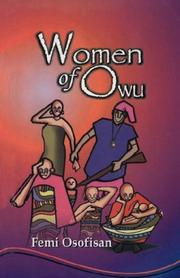
- 2006Women of Owu书架 48
- 2006Wuraola, forever书架 13
- 年份不详Once upon four robbers书架 21