 书单

肯·萨罗-维瓦
- 生卒
- 1941 – 1995
- 国籍
- 尼日利亚
- 外文名
- Ken Saro-Wiwa
照片:African Studies Centre Leiden,CC BY-SA 4.0,来自维基共享资源「Ken Saro-Wisa close-up (cropped).jpg」(经缩小)。
生平与创作
卡山伟华(英语:Ken Saro-Wiwa;1941年10月10日—1995年11月10日)是一名尼日利亚作家﹑电视制作人和人权倡议者,也是高曼环境奖的得奖者。
他在1990年代投身社会运动,主张奥哥尼族人自治,并要求一直在尼日利亚开发石油的壳牌公司清理油污和作出赔偿。壳牌跟当时的尼日利亚军政府有利益关系输送,卡山伟华因此数度入狱。
1993年卡山伟华带领超过半数的奥哥尼人游行,声势浩大。壳牌召来军政府部队镇压,并再度拘捕卡山伟华,进行审判并处以绞刑。
以上文字摘自维基百科「卡山偉華」(去掉了参考文献等尾部小节),按 CC BY-SA 4.0 使用,作者为维基百科的各位编者。
中文维基百科的条目比较短,下面附上英文维基百科的内容(英文原文):
Kenule Beeson Saro-Wiwa (10 October 1941 – 10 November 1995) was a Nigerian writer, teacher, television producer, and social rights activist. He was a member of the Ogoni people, an ethnic minority in the Niger Delta whose homeland, Ogoniland, has been targeted for crude oil extraction since the 1950s and has suffered extreme environmental damage from decades of indiscriminate petroleum waste dumping.
Initially as a spokesperson, and then as the president, of the Movement for the Survival of the Ogoni People (MOSOP), Saro-Wiwa led a nonviolent campaign against environmental degradation of the land and waters of Ogoniland by multiple international oil companies, especially the Royal Dutch Shell company. He criticized the Nigerian government for its reluctance to enforce environmental regulations on the foreign petroleum companies operating in the area.
At the peak of his non-violent campaign, he was tried by a special military tribunal for allegedly masterminding the murder of Ogoni chiefs at a pro-government meeting, and was hanged in 1995 by the military dictatorship of General Sani Abacha. His execution triggered international outrage and led to Nigeria's suspension from the Commonwealth of Nations for more than three years.
Biography
Early life
Kenule Saro-Wiwa was born in Bori, near Port Harcourt, Nigeria, on 10 October 1941. He was the son of Chief Jim Wiwa, a forest ranger who held a title in the Nigerian chieftaincy system, and his third wife Widu. He officially changed his name to Saro-Wiwa after the Nigerian Civil War. He was married to Maria Saro-Wiwa.
His father's hometown was the village of Bane, Ogoniland, whose residents speak the Khana dialect of the Ogoni language. He spent his childhood in an Anglican home and eventually proved himself to be an excellent student. He received primary education at a Native Authority school in Bori, then attended secondary school at Government College Umuahia. A distinguished student, he was captain of the table tennis team and amassed school prizes in History and English.
On the completion of his secondary education, he obtained a scholarship to study English at the University of Ibadan. At Ibadan, he plunged into academic and cultural interests, winning departmental prizes in 1963 and 1965. He was also affiliated with a travelling drama troupe that performed in Kano, Benin, Ilorin and Lagos and collaborated with the Nottingham Playhouse theater group.
He briefly became a teaching assistant at the University of Lagos and later served as an African literature lecturer at University of Nigeria, Nsukka until the civil war broke out; he supported the Federal Government and so had to leave the region and return to Bori. On his journey to Port-Harcourt, he witnessed the multitudes of refugees returning to the East, a scene he described as a "sorry sight to see." Three days after his arrival in Bonny, it fell to federal troops. His family then stayed in Bonny while he travelled back to Lagos and took a position at the University of Lagos, although this did not last long as he was called back to Bonny to serve as the port city's Civilian Administrator.
During the Nigerian Civil War he positioned himself as an Ogoni leader dedicated to the Federal cause. He followed his job as an administrator with an appointment as a commissioner in the old Rivers State. His best known novel, Sozaboy: A Novel in Rotten English (1985), tells the story of a naive village boy recruited to the army during the Nigerian Civil War of 1967 to 1970, and intimates the political corruption and patronage in Nigeria's military regime at the time. His war diaries, On a Darkling Plain (1989), document his experiences during the war.
In the early 1970s, he served as the Regional Commissioner for Education in the Rivers State Cabinet, but was dismissed in 1973 because of his support for Ogoni autonomy.
以上文字摘自英文维基百科「Ken Saro-Wiwa」(有删节,去掉了参考文献等尾部小节),按 CC BY-SA 4.0 使用,作者为维基百科的各位编者。
资料卡
- 母语名
- Ken Saro-Wiwa
- 出生
- 1941 年 10 月 10 日
- 出生地
- Bori
- 逝世
- 1995 年 11 月 10 日
- 逝世地
- 哈科特港
- 职业
- 作家、诗人、编剧、社运人士、环保人士、电视制片人、制片人、民权运动者
- 使用语言
- 英语、尼日利亚皮钦语、伊博语
- 写作语言
- 英语
- 就读学校
- 伊巴丹大学、Government College Umuahia
- 文学运动 / 流派
- 环保主义
- 领域
- 环保人士、作家、诗人、社运人士、电视制片人 等 6 项
- 所属团体
- Movement of
- 代表作
- Basi and Company、A Bride For Mr B
- 获奖
- 布鲁诺·克赖斯基奖、戈德曼环境奖(1995)、瑞典正确生活方式奖(1994);另有 1 项只有外文名
资料卡来自 Wikidata Q316292(CC0),众包数据,个别字段可能不全。
本站收录的作品(1)
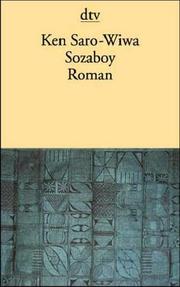
作品年表(1 本)
本站书库里署名肯·萨罗-维瓦的书(Open Library 上至少 10 人加过书架的才收),按首版年份排(有本站书页的用 Wikidata 记的首版年,其余用 Open Library 的);年份偶尔记成后来的版本或译本,以原书为准。全部作品见 Open Library。
- 1985Sozaboy书架 18