 书单
Karen Barad
- 生卒
- 1956 –
- 国籍
- 美国
生平与创作
这个词条暂时没有中文维基百科条目,下面是英文维基百科的内容(英文原文):
Karen Barad (born 29 April 1956) is an American feminist theorist and physicist, known particularly for their theory of agential realism.
Biography
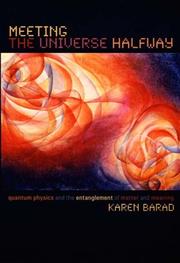
They are currently Distinguished Professor of History of Consciousness and Affiliated Faculty in Philosophy at the University of California, Santa Cruz. They are the author of Meeting the Universe Halfway: Quantum Physics and the Entanglement of Matter and Meaning. Their research topics include feminist theory, physics, twentieth-century continental philosophy, epistemology, ontology, philosophy of physics, cultural studies of science, and feminist science studies.
Barad earned their doctorate in theoretical physics at Stony Brook University. Their dissertation presented computational methods for quantifying properties of quarks, and other fermions, and in the framework of lattice gauge theory.
Barad serves on the advisory board for the feminist academic journals Catalyst: Feminism, Theory, Technoscience and Signs: Journal of Women in Culture and Society.
Agential realism
According to Barad's theory of agential realism, the universe comprises phenomena, which are "the ontological inseparability of intra-acting agencies". Intra-action, a neologism introduced by Barad, signals an important challenge to individualist metaphysics. For Barad, phenomena or objects do not precede their interaction, rather, "objects" emerge through particular intra-actions. Thus, apparatuses, which produce phenomena, are not assemblages of humans and nonhumans (as in actor-network theory). Rather, they are the condition of possibility of "humans" and "non-humans", not merely as ideational concepts, but in their materiality. Apparatuses are "material-discursive" in that they produce determinate meanings and material beings while simultaneously excluding the production of others. What it means to matter is therefore always material-discursive. Barad takes their inspiration from physicist Niels Bohr, one of the founders of quantum physics. Barad's agential realism is at once an epistemology (theory of knowing), an ontology (theory of being), and an ethics. For this, Barad introduces the neologism "ontoepistemology". Because specific practices of mattering have ethical consequences, excluding other kinds of mattering, onto-epistemological practices are always in turn ethico-onto-epistemological.
Much of Barad's scholarly work has revolved around their concept of "agential realism," and their theories hold importance for many academic fields, including science studies, STS (Science, Technology, and Society), feminist technoscience, philosophy of science, feminist theory, and, of course, physics. In addition to Bohr, their work draws on the works of thinkers such as Michel Foucault, Judith Butler, Jacques Derrida, and Walter Benjamin, among others.
Barad's original training was in theoretical particle physics and quantum field theory. Their book, Meeting the Universe Halfway, (2007), includes a chapter that contains an original discovery in theoretical physics, which is largely unheard of in books that are usually categorized as "gender studies" or "cultural theory" books. In this book, Barad also argues that "agential realism," is useful to the analysis of literature, social inequalities, and many other things. This claim is based on the fact that Barad's agential realism is a way of understanding the politics, ethics, and agencies of any act of observation, and indeed any kind of knowledge practice. According to Barad, the deeply connected way that each "thing" is entangled with everything else in materially specific ways means that all intra-actions reconfigure the entanglements. Barad's innovative and far-reaching formulation of intra-action, which challenges the usual notion of interaction which assumes a metaphysics of individualism, offers a new formulation of causality. There are not things that interact but rather through and within intra-actions there is a differentiating-entangling so that an agential cut is enacted that cuts things together-apart (one move) such that differences exist not as absolute separations but in their inseparability (i.e., "agential separability" as Barad calls it). Nothing is inherently separate from anything else, but separations are enacted within phenomena. This view of knowledge provides a framework for thinking about how culture and habits of thought can make some things visible and other things easier to ignore or to never see. For this reason, according to Barad, agential realism is useful for feminist analysis and other forms of political and social thought, even if the connection to science is not apparent.
Barad's framework makes several other arguments, and some of them are part of larger trends in fields such as science studies and feminist technoscience (all can be found in their 2007 book, Meeting the Universe Halfway):
They define agency as a relationship and not as something that one "has".
The scientist and the social are always part of the apparatus, and one needs to take account of this in its inseparability in analyzing the system. This differs from the view that political critiques of science seek to undermine the credibility of science; instead, Barad argues that this kind of critique actually makes for better, more credible science.
They argue that politics and ethical issues are always part of scientific work, and only are made to seem separate by specific historical circumstances that encourage people to fail to see those connections. One example they discuss is the ethics of developing nuclear weapons to argue this point, by claiming that the ethics and politics are part of how such weapons were developed and understood, and therefore part of science, and not merely of the "philosophy of science" or the "ethics of science." This differs from the usual view that one can strive for a politics-free, bias-less science.
Nevertheless, they argue against epistemological relativism, and offer an important alternative to the usual conception of objectivity.
以上文字摘自英文维基百科「Karen Barad」(有删节,去掉了参考文献等尾部小节),按 CC BY-SA 4.0 使用,作者为维基百科的各位编者。
资料卡
- 本名
- Karen Michelle Barad
- 出生
- 1956 年 4 月 29 日
- 出生地
- 美国
- 职业
- 哲学家、量子物理学家、物理学家
- 使用语言
- 英语
- 就读学校
- 石溪大学
- 领域
- 女权论者、量子物理
- 代表作
- Meeting the Universe Halfway
资料卡来自 Wikidata Q443431(CC0),众包数据,个别字段可能不全。
本站收录的作品(1)
作品年表(1 本)
本站书库里署名Karen Barad的书(Open Library 上至少 10 人加过书架的才收),按首版年份排(有本站书页的用 Wikidata 记的首版年,其余用 Open Library 的);年份偶尔记成后来的版本或译本,以原书为准。全部作品见 Open Library。
- 2007Meeting the Universe Halfway书架 12