 书单
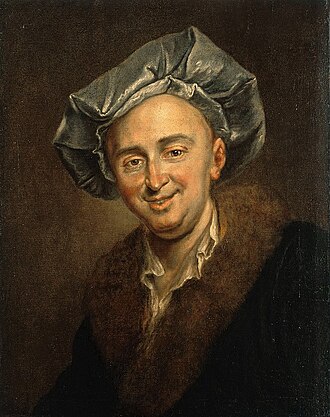
朱利安·奥弗雷·拉·美特利
- 生卒
- 1709 – 1751
- 国籍
- 法国
- 外文名
- Julien Offray de La Mettrie
照片:Georg Friedrich Schmidt,公有领域,来自维基共享资源「Portrait de Julien Offray de La Mettrie.jpg」(经缩小)。
生平与创作
拉美特利(法语:Julien Offray de La Mettrie,1709年11月23日—1751年11月11日),法国启蒙思想家、哲学家,机械唯物主义的代表人物。著有《人是机器》等。
生平
拉美特利1709年11月23日出生于圣马洛一个富裕商人家庭。早年曾在库唐斯和卡昂求学,之后赴巴黎学习哲学和自然科学。1725年进入阿库尔学院学习,约于1728年毕业。1733年前往莱顿,师从著名医学家赫尔曼·布尔哈夫,其医学思想对拉美特利产生了重要影响。
1748年,拉美特利在荷兰的处境进一步恶化,遂前往柏林。在皮埃尔·路易·莫佩尔蒂的帮助下,他获得腓特烈二世的庇护,并被允许继续行医,同时进入普鲁士宫廷。此后他继续从事哲学写作。1751年11月11日,拉美特利在柏林去世。
观点
人是机器
拉美特利继承和发展了笛卡尔的物理学,但是抛弃了笛卡尔的二元论,他认为物质是唯一的实体,人和动物一样,也是机器。拉美特利在其著作中论证物质本身包含运动能力,有感受性,所以构成了动物和人的心灵。其次,在物质的运动,分解和组合中,经过数不清的配合,会创造出有生命的物种,并由此发展成能思维的人。
著作
《人是机器》
《心灵的自然史》
《伊壁鸠鲁的体系》
《反塞内卡,或论幸福》
以上文字摘自维基百科「朱利安·奥弗雷·拉·美特利」(去掉了参考文献等尾部小节),按 CC BY-SA 4.0 使用,作者为维基百科的各位编者。
中文维基百科的条目比较短,下面附上英文维基百科的内容(英文原文):
Julien Offray de La Mettrie (French: [ɔfʁɛ də la metʁi]; 23 November 1709 – 11 November 1751) was a French physician and philosopher, and one of the earliest of the French materialists of the Enlightenment. He is best known for his 1747 work L'homme machine (Man a Machine).
La Mettrie is most remembered for taking the position that humans are complex animals and no more have souls than other animals do. He considered that the mind is part of the body and that life should be lived so as to produce pleasure (hedonism). His views were so controversial that he had to flee France and settle in Berlin.
Early life
La Mettrie was born at Saint-Malo in the Province of Brittany on November 23, 1709, and was the son of a prosperous textile merchant. His initial schooling took place in the colleges of Coutances and Caen. After attending the Collège du Plessis in Paris, he seemed to have acquired a vocational interest in becoming a clergyman, but after studying theology in the Jansenist schools for some years, his interests turned away from the Church. In 1725, La Mettrie entered the College d'Harcourt to study philosophy and natural science, probably graduating around 1728. At this time, D'Harcourt was pioneering the teaching of Cartesianism in France. In 1734, he went on to study under Hermann Boerhaave, a renowned physician who, similarly, had originally intended on becoming a clergyman. It was under Boerhaave that La Mettrie was influenced to try to bring changes to medical education in France.
Medical career
After his studies at D'Harcourt, La Mettrie decided to take up the profession of medicine. A friend of the La Mettrie family, François-Joseph Hunauld, who was about to take the chair of anatomy at the Jardin du Roi, seems to have influenced him in this decision. For five years, La Mettrie studied at faculty of medicine in Paris, and enjoyed the mentorship of Hunauld.
In 1733, however, he departed for Leiden to study under the famous Herman Boerhaave. His stay in Holland proved to be short but influential. In the following years, La Mettrie settled down to professional medical practice in his home region of Saint-Malo, disseminating the works and theories of Boerhaave through the publication and translation of several works. He married in 1739 but the marriage, which produced two children, proved an unhappy one. In 1742 La Mettrie left his family and travelled to Paris, where he obtained the appointment of surgeon to the Gardes Françaises regiment, taking part in several battles during the War of the Austrian Succession. This experience would instill in him a deep aversion to violence which is evident in his philosophical writings. Much of his time, however, was spent in Paris, and it is likely that during this time he made the acquaintance of Maupertuis and the Marquise de Châtelet.
It was in these years, during an attack of fever, that he made observations on himself with reference to the action of quickened blood circulation upon thought, which led him to the conclusion that mental processes were to be accounted for as the effects of organic changes in the brain and nervous system. This conclusion he worked out in his earliest philosophical work, the Histoire naturelle de l'âme (1745). So great was the outcry caused by its publication that La Mettrie was forced to quit his position with the French Guards, taking refuge in Leiden. There he developed his doctrines still more boldly and completely in L'Homme machine, a hastily written treatise based upon consistently materialistic and quasi-atheistic principles. La Mettrie's materialism was in many ways the product of his medical concerns, drawing on the work of 17th-century predecessors such as the Epicurean physician Guillaume Lamy.
以上文字摘自英文维基百科「Julien Offray de La Mettrie」(有删节,去掉了参考文献等尾部小节),按 CC BY-SA 4.0 使用,作者为维基百科的各位编者。
资料卡
- 母语名
- Julien Offray de La Mettrie
- 出生
- 1709 年 12 月 12 日
- 出生地
- 圣马洛
- 逝世
- 1751 年 11 月 11 日
- 逝世地
- 波茨坦
- 职业
- 哲学家、医生、非虚构文学作家、作家
- 使用语言
- 法语
- 写作语言
- 法语
- 就读学校
- 巴黎大学
- 文学运动 / 流派
- 无神论、唯物主义
- 领域
- 医学、神经科学、知识论、政治哲学
- 所属团体
- 普鲁士科学院
资料卡来自 Wikidata Q7068(CC0),众包数据,个别字段可能不全。
本站收录的作品(1)
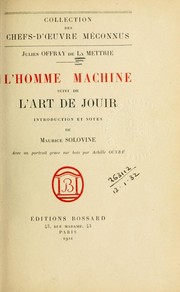
作品年表(1 本)
本站书库里署名朱利安·奥弗雷·拉·美特利的书(Open Library 上至少 10 人加过书架的才收),按首版年份排(有本站书页的用 Wikidata 记的首版年,其余用 Open Library 的);年份偶尔记成后来的版本或译本,以原书为准。全部作品见 Open Library。
- 1748人是机器L'homme machine书架 10